

















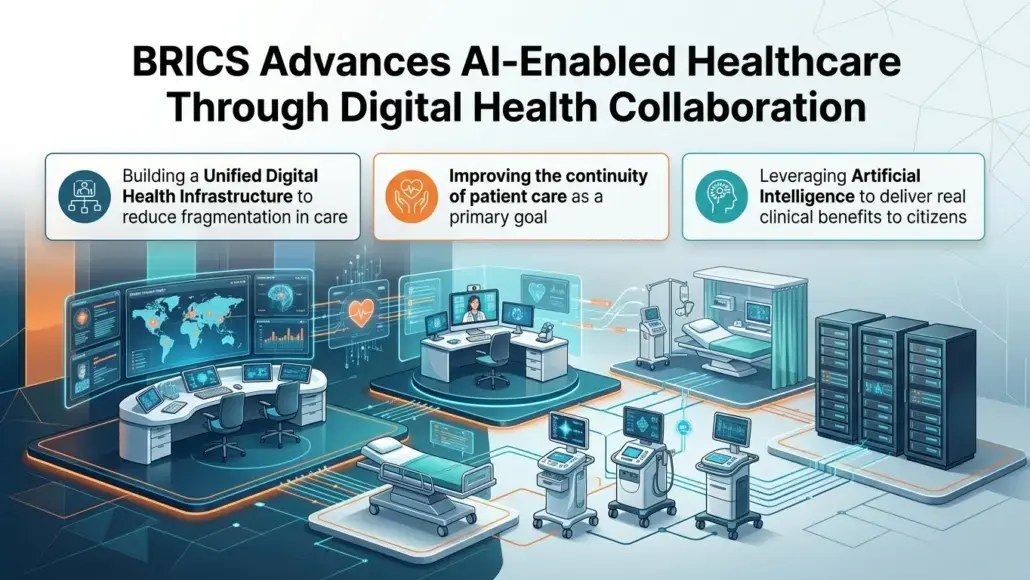

BRICS nations have prioritised the development of a unified digital health infrastructure to address the fragmentation of patient care across global health systems. During a technical briefing on the sidelines of the 16th BRICS Health Ministers’ meeting, officials emphasized that continuity of care is the fundamental measure of whether digital health and artificial intelligence (AI) are delivering meaningful clinical benefits. The objective is to ensure that a citizen’s healthcare journey remains consistently connected rather than being scattered across various providers, institutions, and geographic boundaries. This collaborative effort focuses on building resilient, equitable, and future-ready health systems through the integration of interoperable data frameworks.
The current dialogue is anchored in the findings of the BRICS Health Track Technical Working Group 4 (TWG-4), which identifies the lack of interoperable data systems as a primary constraint to seamless health service delivery. By establishing common standards for information exchange, member nations aim to overcome challenges such as large and diverse populations, rural-urban disparities, and stretched health workforces. The transition toward integrated and people-centric healthcare delivery makes the adoption of a robust digital health infrastructure an essential tool for ensuring that clinical information follows the patient throughout their medical history, rather than remaining trapped in institutional silos.
Scalable Infrastructure and Responsible AI Governance
India has provided a scalable blueprint for this digital transformation, having already created more than 940 million Ayushman Bharat Health Account (ABHA) IDs. This foundation for digital identity has enabled the registration of more than one million healthcare professionals and over 500,000 health facilities into a unified network. Furthermore, the system currently facilitates secure access to more than one billion digital health records. These metrics demonstrate the practical feasibility of managing high-volume data to support continuity of care across complex national health landscapes.
The integration of advanced analytics is being guided by India’s Strategic Framework for AI in Healthcare, which establishes the parameters for responsible AI adoption. This framework focuses on strengthening healthcare delivery while ensuring ethics, transparency, safety, and citizen trust. By aligning these AI governance protocols with interoperable data standards, BRICS countries are working to ensure that new technologies can effectively address the rising burden of chronic and non-communicable diseases. The collective focus remains on fostering mutual learning and shared innovation to achieve universal health coverage through a connected and data-driven medical ecosystem.