







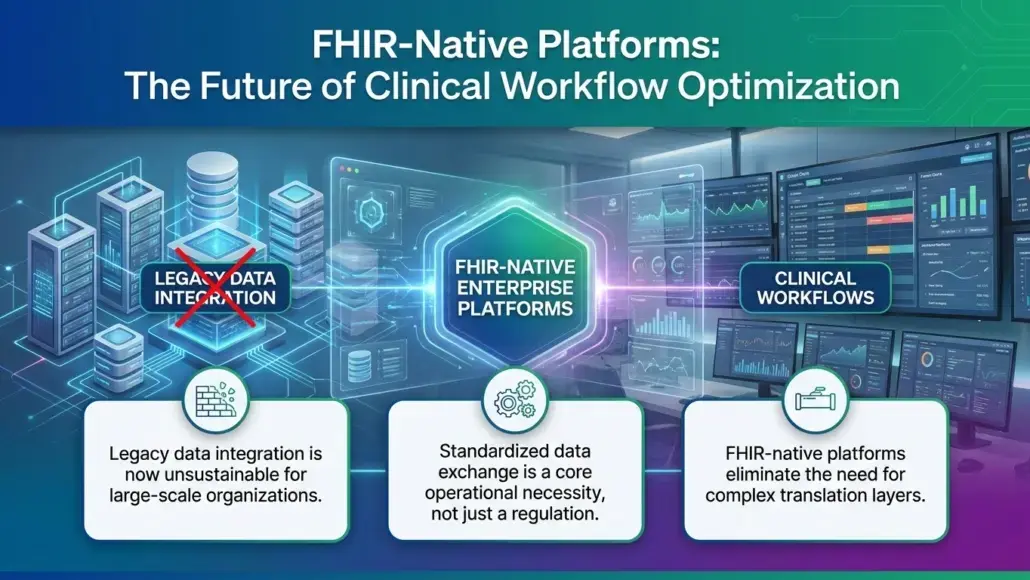
The evolution of digital health ecosystems has reached a critical juncture where the limitations of legacy data integration are becoming unsustainable for large scale healthcare organizations. Standardized data exchange has moved from being a regulatory requirement to a core operational necessity. Central to this transition is the adoption of FHIR-native enterprise platforms, which represent a departure from traditional middleware approaches that rely on complex translation layers. By adopting a data model built fundamentally on the Fast Healthcare Interoperability Resources (FHIR) standard, healthcare systems can achieve a level of agility that was previously impossible with proprietary or siloed architectures. These platforms provide a consistent framework for managing clinical, administrative, and financial data, ensuring that every piece of information is readily available for both human clinicians and automated systems. The integration of clinical data through a unified standard allows for a more comprehensive understanding of patient populations, facilitating proactive health management and reducing the administrative burden associated with data reconciliation.
The move toward native architectures is driven by the need for real-time data liquidity. Traditional electronic health record systems often store data in proprietary formats, requiring significant effort to map and translate that information for external use. In contrast, FHIR-native enterprise platforms store and manage data in the FHIR format from the moment of ingestion. This elimination of the translation layer reduces latency, minimizes the risk of data loss during mapping, and lowers the total cost of ownership for interoperability initiatives. As healthcare providers face increasing pressure to participate in value based care models and value based insurance designs, the ability to exchange high quality data without friction becomes a primary competitive advantage. The reduction in architectural complexity means that organizations can reallocate resources from maintenance to innovation, fostering a culture of continuous improvement in clinical care delivery.
Standardizing Data Structures for Enterprise Scalability
Scaling healthcare operations requires a data infrastructure that can support diverse clinical specialties while maintaining a single source of truth. FHIR-native enterprise platforms provide this foundation by utilizing modular resources that can be extended without breaking existing integrations. This modularity is essential for large enterprises that must integrate data from dozens of different software applications, ranging from laboratory information systems to specialized imaging tools. When every application speaks the same language at the data layer, the complexity of the enterprise architecture is significantly reduced. IT departments can focus on building new clinical tools rather than spending the majority of their budget on maintaining fragile point to point integrations. This approach also facilitates the standardization of terminology, ensuring that clinical concepts are represented consistently across the entire organization, regardless of the source system.
additionally, the scalability of these platforms is enhanced by their cloud native design. Most modern FHIR implementations are built to take advantage of elastic computing resources, allowing healthcare organizations to handle massive surges in data traffic during public health events or seasonal clinical peaks. The use of standardized APIs also simplifies the onboarding of new digital health solutions. Instead of custom developing an interface for every new vendor, the organization can provide a set of standard FHIR endpoints, drastically reducing the time to market for new clinical innovations. This standardization also improves data governance, as security policies and access controls can be applied consistently across the entire data estate. By centralizing data management in a native FHIR environment, organizations can more easily comply with evolving regulatory standards while maintaining a high level of performance and reliability for mission critical clinical applications.
Enhancing Clinical Decision Support Through Real Time Access
The primary beneficiary of improved data interoperability is the clinician at the point of care. When clinical data is locked in silos, doctors and nurses often lack the complete context needed to make the most informed decisions. FHIR-native enterprise platforms solve this problem by providing a unified view of the patient record that draws from multiple sources in real time. Because the data is stored in a standardized format, clinical decision support tools can be applied more effectively. For example, a medication reconciliation tool can automatically compare data from a hospital pharmacy, a retail pharmacy, and an external EHR to identify potential drug interactions without manual data entry. This real time integration reduces the risk of adverse drug events and ensures that clinicians are working with the most current information available, which is especially critical in emergency settings.
These platforms also enable the development of advanced visualization tools that present data in a more intuitive way. Rather than scrolling through hundreds of lines of laboratory results in a traditional EHR, a clinician can use a FHIR-based application to see a longitudinal trend of specific biomarkers, even if those results were generated at different facilities. This level of insight is particularly valuable in the management of chronic conditions, where long term data trends are more important than single data points. By reducing the cognitive load on clinicians, these platforms help reduce burnout and improve the overall quality of care delivered to patients. The ability to visualize data trends over time allows for more precise adjustments to treatment plans, leading to better clinical outcomes and increased patient satisfaction. additionally, the standardized nature of FHIR data allows for the seamless integration of third party analytics tools that can provide additional layers of clinical intelligence, such as risk stratification for readmissions or predictive modeling for disease progression.
Modernizing Health Information Exchange Frameworks
Health information exchange has historically been plagued by the “lowest common denominator” problem, where only a subset of data could be shared due to technical limitations. these specialized systems are changing this dynamic by supporting the full breadth of the FHIR specification, including complex clinical observations and genomic data. This rich data exchange is essential for the advancement of precision medicine, which requires the integration of diverse datasets to tailor treatments to individual patients. Organizations that utilize these platforms are better positioned to participate in national data networks, such as the Trusted Exchange Framework and Common Agreement (TEFCA), which aim to create a single on-ramp for nationwide interoperability. The capability to share detailed clinical data across disparate systems ensures that patients receive continuous and coordinated care as they move through the healthcare system.
The shift toward these specialized systems also empowers patients to take a more active role in their own care. Regulatory mandates now require providers to give patients access to their own health data via standardized APIs. By using a native FHIR architecture, organizations can easily fulfill these requirements while also providing a better user experience for patient facing apps. Patients can securely download their records, share them with family members, or contribute their own patient generated health data to their clinical record. This transparency fosters trust between patients and providers and encourages patients to engage more deeply with their treatment plans. in addition, the ability for patients to access their data in a standardized format allows them to use a variety of personal health management tools, further integrating their daily activities with their formal clinical care. This holistic approach to health data management not only improves individual outcomes but also contributes to a more comprehensive understanding of population health trends.
Navigating the Technical Transition to Native Architectures
While the benefits of native FHIR platforms are clear, the transition from legacy systems requires a strategic approach to data migration and organizational change. Healthcare leaders must evaluate their current data debt and identify the high impact areas where a native FHIR approach will provide the most immediate value. This often involves a hybrid strategy, where these specialized systems sit alongside legacy systems, acting as a modern data layer that consumes and standardizes data from older repositories. Over time, as legacy systems are retired, the FHIR platform becomes the primary system of record for the entire enterprise. This staged approach allows organizations to realize immediate benefits in interoperability and data access while managing the risks and costs associated with a large scale system replacement.
Success in this transition also depends on the development of internal expertise. IT teams must become proficient in FHIR profiles, implementation guides, and the nuances of the standard. Collaboration with clinical leaders is equally important to ensure that the technical architecture aligns with actual clinical workflows. By focusing on use cases that solve real world problems, such as improving transition of care documentation or reducing duplicate testing, organizations can build momentum for their interoperability initiatives. The long term goal is to create a healthcare environment where data is no longer a barrier to care but a catalyst for improvement across the entire enterprise. As the industry moves toward more collaborative and data driven care models, the adoption of these specialized systems will be a defining factor in an organization’s ability to remain competitive and deliver high quality care. The investment in these platforms represents a commitment to a future where health information is accessible, accurate, and actionable at every level of the healthcare system.
Engineering Data Resiliency and Security within FHIR Frameworks
In the context of enterprise healthcare, data security and resiliency are not merely technical requirements but fundamental pillars of patient trust and regulatory compliance. these specialized systems offer a sophisticated approach to data protection by integrating security protocols directly into the data model. By utilizing standardized authentication and authorization frameworks, such as SMART on FHIR, organizations can ensure that only authorized users and applications have access to sensitive patient information. This granular control is vital for maintaining HIPAA compliance and protecting against the increasing threat of cyberattacks. The native architecture allows for more efficient auditing and monitoring of data access, providing a clear trail of who accessed what information and when.
Additionally, the resiliency of these platforms is bolstered by their ability to support distributed data environments. In large healthcare systems, data may be stored across multiple locations or cloud regions to ensure high availability and disaster recovery. these specialized systems can manage these distributed datasets while presenting a unified view to the end user. This ensures that clinical services remain uninterrupted even in the event of a localized system failure. The standardized data format also simplifies the process of data backup and restoration, as the organization is not reliant on proprietary tools that may not be compatible with other systems. By prioritizing security and resiliency at the architectural level, healthcare organizations can build a powerful foundation for their digital future, ensuring that patient data is both protected and available whenever and wherever it is needed. This proactive stance on data management is essential for navigating the complexities of the modern healthcare environment and delivering on the promise of truly interoperable and patient centered care.