













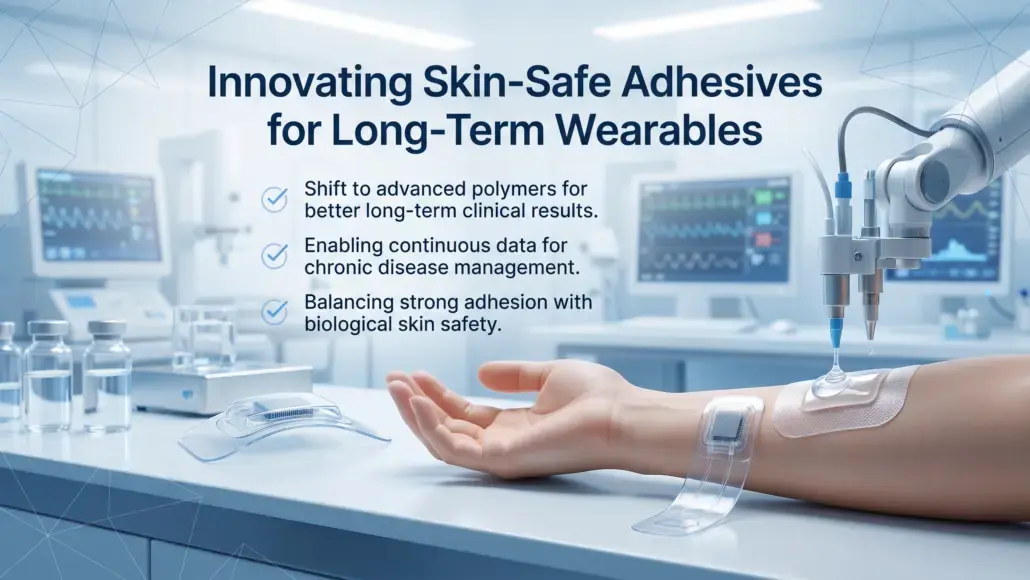
Medical device manufacturers are increasingly prioritizing advanced polymer formulations as skin-safe medical adhesives become the primary determinant of clinical success for long-term wearable monitoring systems. The necessity for continuous data collection in chronic disease management has pushed the limits of traditional adhesive materials, requiring a shift toward solutions that balance high-tack performance with biological safety. These specialized materials are engineered to maintain a secure bond for multiple days, or even weeks, without causing the epidermal trauma or allergic reactions that historically plagued wearable technology. By ensuring a stable interface between sensors and the human body, these adhesives are enabling a new generation of diagnostic tools that provide higher fidelity data while maintaining patient compliance through improved comfort.
Material Science Innovations in Epidermal Interfaces
The evolution of adhesive chemistry has moved beyond simple acrylics toward sophisticated silicone and hydrocolloid systems designed specifically for prolonged dermal contact. Silicone-based skin-safe medical adhesives offer a gentle removal process that significantly reduces the risk of skin stripping, a common issue in neonatal and geriatric populations. These materials utilize a cross-linked network that conforms to the irregular topography of the skin at a microscopic level, distributing mechanical stress across a larger surface area. This distribution is critical for preventing pressure-induced ischemia and localized inflammation. In addition, modern formulations are being developed with moisture vapor transmission rates that mimic natural skin respiration, preventing the accumulation of sweat and exudate that can lead to maceration and bacterial growth under the device. This breathability is a significant factor in preventing device failure, as moisture trapped against the skin can degrade the adhesive bond and cause the sensor to detach prematurely. Manufacturers are testing these materials in diverse climates to ensure performance in both dry and tropical environments, providing a comprehensive solution for global patient populations.
Beyond basic adhesion, the development of hybrid materials is creating new possibilities for functionalized interfaces. Some researchers are integrating conductive elements directly into the adhesive matrix, allowing the material itself to act as part of the sensing circuit. This integration minimizes the distance between the signal source and the processor, reducing noise and improving the signal-to-noise ratio in electrocardiogram and electromyography applications. The shift toward these multifunctional materials represents a departure from viewing adhesives as secondary components, instead positioning them as fundamental structural elements of the medical device architecture. As hospital-to-home transitions become more frequent, the reliability of these interfaces becomes a cornerstone of remote patient monitoring strategies. The ability of these materials to maintain electrical conductivity while undergoing mechanical deformation is a key area of research, ensuring that patient movement does not interrupt the clinical data stream. By reducing the complexity of the sensor assembly, these conductive adhesives also lower the manufacturing costs, making high-fidelity monitoring more accessible to a wider range of healthcare systems. Data suggests that these integrated solutions can reduce the footprint of wearable devices by up to thirty percent, significantly improving the aesthetic and functional appeal for long-term wearers who may be sensitive to the stigma associated with medical hardware.
Addressing the Challenges of Long-Term Wearability
Sustaining a secure bond for extended periods remains one of the most significant hurdles in the design of outpatient monitoring equipment. Environmental factors such as humidity, physical activity, and variations in skin pH can compromise the integrity of the adhesive layer over time. To combat these variables, manufacturers are employing sophisticated testing protocols that simulate various environmental stressors to ensure that skin-safe medical adhesives maintain their properties throughout the intended wear cycle. These tests include accelerated aging studies and mechanical shear testing under moist conditions, providing a data-driven foundation for device safety claims. The goal is to create a bond that is durable enough to withstand daily life yet gentle enough to be removed without specialized solvents. This balance is achieved through the use of pressure-sensitive technologies that activate only when firm contact is made, allowing for repositioning during the initial application phase without losing adhesive strength. This feature is particularly helpful for clinicians who must place sensors with high precision in emergency situations.
The physiological diversity of the patient population also requires a more nuanced approach to adhesive selection. Factors such as skin hydration, oil production, and the presence of hair all influence how an adhesive interacts with the stratum corneum. For patients with compromised skin integrity, such as those with diabetes or chronic wounds, the choice of adhesive can be as important as the sensor itself. Clinical data suggests that localized skin irritation can lead to non-compliance, where patients remove their monitoring devices prematurely to seek relief from discomfort. By utilizing advanced skin-safe medical adhesives, providers can reduce these interruptions in data collection, ensuring that clinicians have a complete and accurate picture of the patient’s status without the gaps caused by mechanical irritation.
The Role of Adhesives in Data Fidelity and Accuracy
The precision of a wearable healthcare device is directly linked to the stability of its physical connection to the patient. Any movement or “motion artifact” between the sensor and the skin can result in erroneous readings, leading to false alarms or, more dangerously, missed clinical events. Advanced skin-safe medical adhesives provide the necessary mechanical stabilization to keep electrodes and optical sensors in a fixed position relative to the underlying tissue. This stability is particularly vital in photoplethysmography and bioimpedance measurements, where even sub-millimeter shifts can distort the results. By maintaining a constant pressure and contact area, these adhesives ensure that the sensor operates within its calibrated parameters throughout the entire monitoring period.
In the context of cardiac monitoring, the stability provided by high-performance adhesives allows for the detection of subtle arrhythmias that might be obscured by noise in a less secure system. The transition from traditional bulky Holter monitors to sleek, adhesive-based patches has been enabled entirely by the ability to keep sensors flush against the chest without the need for cumbersome straps or wires. This shift not only improves the quality of the signal but also encourages patients to engage in their normal activities, providing a more representative view of their cardiac health. The ability of skin-safe medical adhesives to resist the ingress of water during bathing further enhances this continuity of care, allowing for uninterrupted monitoring that was previously impossible in a home setting.
Clinical Economics and the Impact of Adhesive Selection
The economic implications of skin health in the context of medical devices are often underestimated by procurement departments. Skin injuries resulting from improper adhesive use can lead to secondary complications, such as infections or chronic dermatitis, which require additional clinical intervention and increase the total cost of care. By investing in higher-quality skin-safe medical adhesives at the outset, healthcare organizations can mitigate these risks and the associated liabilities. The reduction in device replacements due to premature detachment also contributes to operational efficiency, as staff can spend less time re-applying sensors and more time on direct patient care. In a value-based care environment, the prevention of preventable skin complications is a key metric for institutional performance. Hospitals are now tracking the incidence of Medical Adhesive-Related Skin Injury (MARSI) as a quality indicator, which directly influences their reimbursement rates and public health ratings. The adoption of advanced adhesives is therefore a strategic financial decision as much as a clinical one.
Additionally, the regulatory scrutiny regarding the biocompatibility of materials in contact with the skin is intensifying. Manufacturers must provide extensive documentation on the cytotoxicity, sensitization, and irritation potential of their adhesive components according to international standards such as ISO 10993. This rigorous vetting process ensures that only the safest materials reach the market, protecting both the patient and the provider. As the market for wearable healthcare devices continues to expand, the differentiation between products will increasingly depend on the quality of the user interface. Companies that prioritize the integration of superior skin-safe medical adhesives will likely see higher rates of adoption and better clinical outcomes, reinforcing the vital role of these materials in the modern healthcare ecosystem.
Future Directions in Adhesive Technology and Patient Care
Looking forward, the integration of smart features into adhesive materials is expected to further refine the capabilities of wearable systems. Researchers are exploring the use of pH-sensitive polymers that can change color or properties if the skin environment shifts toward a state that promotes infection or irritation. This proactive approach to skin health could allow clinicians to address potential issues before they become visible to the naked eye. Additionally, the development of on-demand release mechanisms, where an adhesive loses its tack in response to a specific trigger like light or a mild chemical wash, could eliminate the mechanical trauma associated with removal entirely. These advancements will be particularly beneficial for the most vulnerable patients, such as premature infants with highly underdeveloped skin.
The continued refinement of skin-safe medical adhesives will also support the growth of bio-integrated electronics, where sensors are so thin and flexible that they are virtually imperceptible to the wearer. Achieving this level of integration requires adhesives that can bond to the skin while maintaining the flexibility of the electronics, preventing delamination during movement. As these technologies mature, the distinction between the device and the adhesive will continue to blur, leading to truly integrated systems that provide continuous, high-quality physiological data. The focus remains steadfast on the patient, ensuring that the technology serves as a bridge to better health without becoming a source of physical burden or discomfort. Through ongoing collaboration between material scientists and clinical practitioners, the potential for these adhesives to enhance healthcare delivery remains significant.