














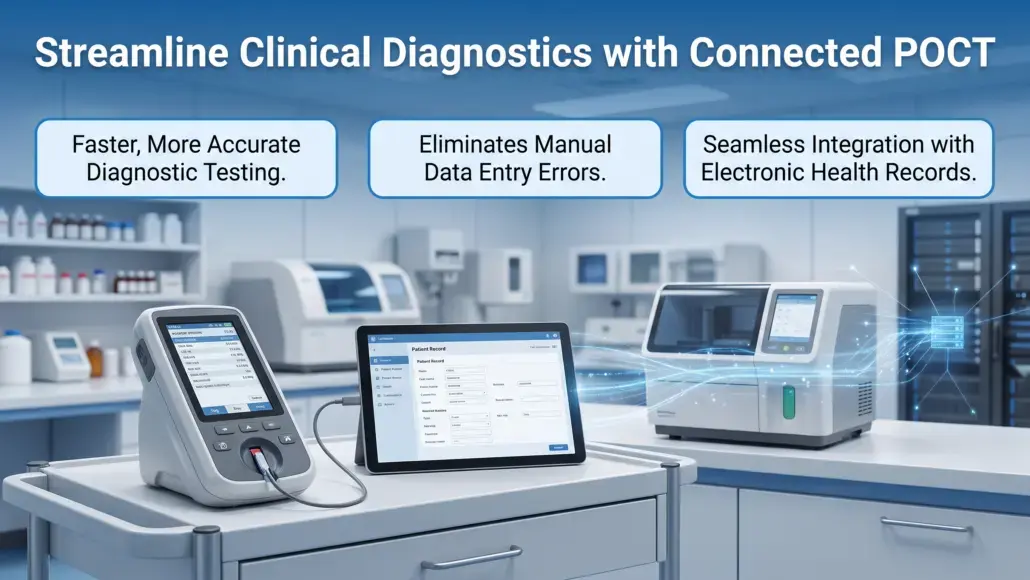

The clinical environment is increasingly defined by the need for speed and accuracy in both diagnostic testing and the subsequent recording of results. Point-of-care testing (POCT) has become a vital component of modern hospital practice, allowing for rapid analysis at the patient’s bedside. However, the manual entry of these results into a patient’s electronic health record can be a significant source of error and inefficiency. The adoption of connected POCT systems streamlining clinical documentation addresses this challenge by providing a direct, automated link between the testing device and the hospital’s central database. This connectivity ensures that every result is recorded immediately and accurately, removing the need for clinicians to spend valuable time on repetitive administrative tasks.
For nursing staff and laboratory managers, the benefits of integrated connectivity are profound. Manual documentation is not only time-consuming but also prone to transcription errors, which can have serious implications for patient safety. By automating the data capture process, healthcare organizations can ensure a higher degree of data integrity and a more complete clinical record. Additionally, the real-time availability of results across the entire care team facilitates faster decision-making and better multidisciplinary coordination. As the healthcare sector continues to prioritize workflow optimization and the reduction of clinician burnout, the role of automated documentation tools will only become more critical. The focus remains on utilizing technology to support the frontline staff, allowing them to devote more of their attention to direct patient care.
Automating Data Capture to Reduce Nursing Administrative Burdens
Nursing staff are often at the center of the diagnostic process, performing point-of-care tests and ensuring that the results are communicated to the appropriate providers. In a busy hospital setting, the requirement to manually record every test result can lead to a significant administrative burden. Connected POCT systems streamlining clinical documentation alleviate this by automatically transmitting results to the electronic health record the moment the test is completed. This automation eliminates the risk of forgotten or delayed entries, ensuring that the patient’s record is always up to date. For a nurse managing multiple high-acuity patients, this time-saving feature is invaluable, allowing for a more focused and efficient approach to care delivery.
The reduction in manual data entry also has a positive impact on staff morale and job satisfaction. Administrative tasks are frequently cited as a major contributor to burnout among healthcare professionals. By providing tools that handle the repetitive aspects of clinical practice, hospitals can create a more sustainable and rewarding work environment. Additionally, the automation of data capture reduces the likelihood of “hidden” errors, where a result is incorrectly transcribed or attributed to the wrong patient. These errors, while often minor in isolation, can cumulative impact the quality of care and the safety of the patient. The transition toward a more automated and reliable documentation process is a key priority for hospital leaders looking to improve both clinical and operational performance.
Ensuring Data Integrity and Compliance Through Wireless Connectivity
In the current regulatory environment, the accuracy and completeness of medical records are subject to intense scrutiny. Healthcare organizations must demonstrate that their diagnostic processes are both reliable and compliant with a wide range of standards. Connected POCT systems streamlining clinical documentation provide a clear and objective audit trail for every test performed. Because the data is transmitted directly from the device, there is no opportunity for unauthorized modification or accidental omission. This level of data integrity is essential for maintaining hospital accreditation and for ensuring that the facility meets all necessary billing and legal requirements.
Wireless connectivity also allows for the central monitoring of device performance and operator competency. Laboratory managers can track which staff members are performing tests, the accuracy of their results, and whether the devices are being properly maintained and calibrated. This oversight is critical for ensuring that point-of-care testing meets the same high standards as centralized laboratory analysis. If a potential issue is identified, such as a device that is consistently producing outlier results, it can be addressed immediately, reducing the risk to patient safety. The focus on quality assurance and compliance ensures that the hospital remains a safe and reliable environment for both patients and staff. The intelligent use of connectivity is a fundamental component of a modern, data-driven diagnostic framework.
Enhancing Clinical Decision Speed with Real-Time EMR Integration
The value of point-of-care testing lies in its ability to provide rapid results that can guide immediate clinical action. However, this benefit is diminished if the results are not immediately visible to the entire care team. By utilizing connected POCT systems streamlining clinical documentation, hospitals can ensure that results are available in the electronic medical record (EMR) within seconds of completion. This real-time visibility allows for faster consultations between departments and more timely adjustments to treatment plans. For instance, in an emergency department setting, the rapid availability of a troponin or lactate result can be the difference between a successful intervention and a serious complication.
Integrated data also allows for the use of advanced clinical decision support tools. The hospital’s central software can be configured to flag specific POCT results that require immediate attention or to suggest next steps based on validated protocols. This proactive approach ensures that the clinical team is alerted to potential issues as soon as they arise, allowing for a more responsive and effective style of practice. By breaking down the barriers between diagnostic testing and clinical action, these systems create a more streamlined and safe patient care pathway. The commitment to rapid, data-driven decision-making is a hallmark of the most successful healthcare organizations today. The focus remains on maximizing the impact of every diagnostic encounter to achieve the best possible patient outcomes.
Supporting Quality Assurance and Audit Readiness in Diagnostic Testing
Maintaining high standards of quality across a large and complex hospital system is a significant challenge. Point-of-care testing, by its nature, is distributed across many different departments and performed by a wide range of staff. Connected POCT systems streamlining clinical documentation provide the centralized visibility needed to manage this complexity effectively. Automated reporting tools can generate detailed summaries of testing activity, quality control results, and device maintenance schedules. This information is invaluable during internal audits and external inspections, providing clear evidence of the facility’s commitment to diagnostic excellence.
These systems also facilitate more effective inventory management. By tracking the use of testing supplies in real time, hospitals can ensure that they always have the necessary reagents on hand without overstocking. This optimization of resources reduces waste and helps to control operational costs. Additionally, the ability to identify trends in testing volume allows for more strategic planning and resource allocation. If data shows a significant increase in POCT demand in a specific department, the facility can investigate the causes and provide additional support if needed. The focus on data-driven management ensures that the hospital remains agile and responsive to the needs of its patient population, providing high-quality care in a fiscally responsible manner.
Optimizing Multidisciplinary Workflows via Unified Information Streams
Modern patient care is a highly collaborative process, involving a wide range of specialists who must work together to achieve the best outcomes. This collaboration is only possible when there is a clear and unified stream of information that everyone can access. Connected POCT systems streamlining clinical documentation play a critical role in creating this information environment. By ensuring that every test result is immediately available to all members of the team, these systems reduce the need for repetitive communication and ensure that everyone is working with the same current data. This shared visibility is essential for multidisciplinary rounds, surgical planning, and long-term chronic disease management.
Additionally, the integration of POCT data with other clinical information, such as pharmacy records and vital signs, provides a more comprehensive view of the patient’s status. This holistic overview allows for a more nuanced understanding of the patient’s condition and for the development of more personalized and effective care plans. The focus remains on utilizing technology to enhance the human element of healthcare, providing the clinical team with the tools they need to work more effectively as a team. As the healthcare sector continues to evolve, the ability to integrate information across different departments and settings will be a major differentiator for providers. By embracing connected technology, healthcare organizations are demonstrating their commitment to a more integrated, efficient, and patient-centered future. The path forward is one of continuous innovation, where data serves as the foundation for both clinical excellence and compassionate care, ensuring that every patient receives the best possible treatment at every stage of their journey.