










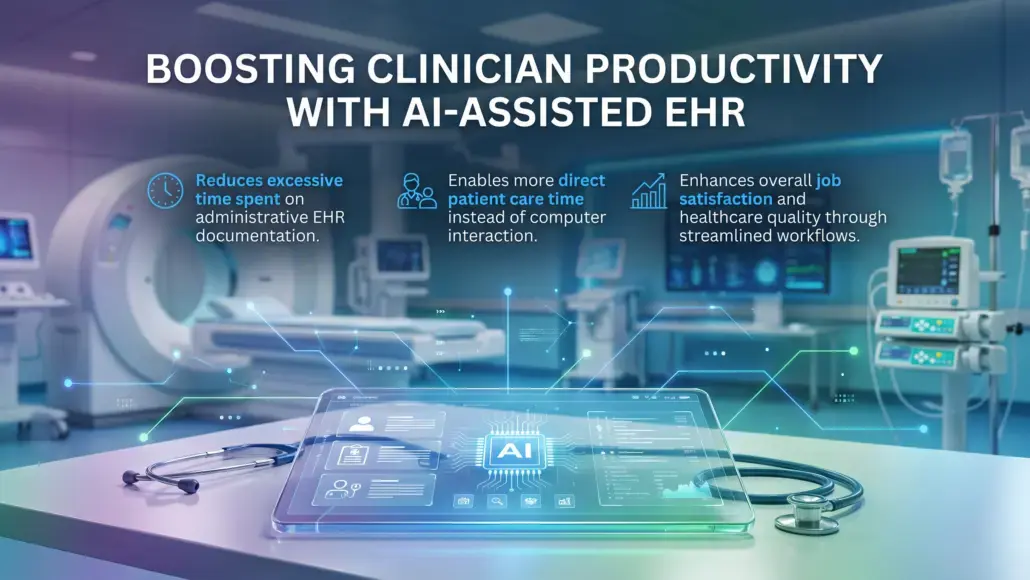

The primary driver of clinician burnout in modern healthcare is the excessive time spent on administrative tasks, particularly the documentation of patient encounters within electronic health records. Physicians often find themselves spending more time interacting with a computer screen than with their patients, leading to a significant decrease in job satisfaction and a potential decline in the quality of care. The implementation of ai-assisted ehr workflows improving clinician productivity offers a revolutionary solution to this problem through the use of ambient intelligence. Ambient systems use highly sensitive microphones and sophisticated natural language processing to listen to the conversation between the doctor and the patient, automatically generating a detailed and accurate clinical note in real time. This allows the physician to focus entirely on the patient, fostering a stronger connection and ensuring that all clinical details are captured without the need for manual data entry.
Ambient documentation is far more than simple transcription; it involves the intelligent extraction of clinical concepts and the organization of those concepts into a structured format that aligns with standard medical templates. The AI models are trained to distinguish between casual conversation and clinically relevant information, ensuring that the resulting note is concise and professional. They can also identify specific actions, such as the ordering of tests or the prescribing of medications, and automatically populate the corresponding fields within the EHR. This level of automation significantly reduces the time required for post encounter documentation, allowing clinicians to see more patients or spend more time on complex cases. By removing the burden of manual typing, healthcare organizations can create a more efficient and humane clinical environment.
Additionally, the use of ambient intelligence can improve the accuracy and completeness of the medical record. Because the AI captures the conversation as it happens, it is less susceptible to the memory errors and biases that can occur when documentation is completed hours or even days after the encounter. The resulting notes are often more detailed and provide a more faithful representation of the patient’s concerns and the physician’s reasoning. This transparency is essential for ensuring continuity of care and for supporting the billing and coding process. As the technology continues to mature, it will become an indispensable tool for any healthcare organization looking to improve clinician productivity and enhance the overall quality of patient care. The shift from manual to ambient documentation represents one of the most significant advancements in clinical workflow in decades.
Intelligent Task Prioritization and Contextual Information Delivery
Clinicians are constantly bombarded with information, from laboratory results and imaging reports to alerts from monitoring devices and messages from other members of the care team. Managing this overwhelming volume of data is a major challenge that can lead to information overload and a high risk of errors. The deployment of ai-assisted ehr workflows improving clinician productivity can address this challenge by providing intelligent task prioritization and contextual information delivery. AI models can analyze the entire stream of incoming information and identify the most critical tasks that require immediate attention. For example, a system could flag a life threatening laboratory result and move it to the top of the physician’s to do list, while deprioritizing routine administrative tasks.
This intelligent prioritization is based on a deep understanding of the clinical context and the specific needs of each patient. The AI can analyze the patient’s current condition, their medical history, and their ongoing treatment plan to determine the clinical significance of every new piece of information. It can also provide the clinician with the specific data they need to address a particular task, such as a summary of the patient’s previous laboratory results or a link to the relevant clinical guidelines. This contextual delivery of information reduces the time spent searching for data within the EHR, allowing clinicians to make faster and more informed decisions. By streamlining the way information is presented, organizations can significantly improve the efficiency of their clinical workflows and reduce the cognitive burden on their staff.
In addition, these systems can help to reduce alert fatigue, a common problem in healthcare where clinicians become desensitized to the constant stream of warnings from electronic systems. By using AI to filter out low priority alerts and ensure that only the most critical information is presented, organizations can ensure that important warnings are not missed. This improves patient safety and reduces the stress associated with managing a constant barrage of alerts. The ability to manage the flow of information intelligently is a fundamental requirement for the modern clinical environment, where the volume and complexity of data continue to grow. By providing clinicians with the right information at the right time, AI driven workflows enable them to practice at the top of their license and deliver the highest quality of care.
Reducing Cognitive Load with Automated Chart Summarization
Reviewing a patient’s medical record, especially for those with complex chronic conditions, can be a time consuming and mentally exhausting task. Clinicians must often sift through hundreds of pages of notes, lab results, and reports to get a clear picture of the patient’s current status and their medical history. The implementation of ai-assisted ehr workflows improving clinician productivity addresses this issue by providing automated chart summarization. AI models can analyze the entire medical record and generate a concise, structured summary that highlights the most important information, such as the patient’s active diagnoses, their current medications, and their most recent laboratory results. This allows the clinician to quickly understand the patient’s clinical situation and identify any areas that require attention.
Automated summaries can be tailored to the specific needs of different clinicians and different clinical scenarios. For example, a surgeon might require a summary that focuses on the patient’s recent imaging results and their surgical history, while a primary care physician might need a summary that highlights the patient’s ongoing management of chronic conditions. The AI can also identify trends and patterns in the data, such as a gradual decline in kidney function or a change in the patient’s response to a particular medication. By presenting this information in a clear and organized format, AI models can significantly reduce the cognitive load on clinicians, allowing them to focus their mental energy on clinical decision making and patient interaction.
In addition, chart summarization can improve the efficiency of handoffs between different members of the care team. When a patient is transferred from the emergency department to the intensive care unit, or from the hospital to a post acute care facility, the receiving clinician must quickly get up to speed on the patient’s condition. An AI generated summary provides a clear and accurate overview of the patient’s status, ensuring that there are no gaps in the transition of care. This reduces the risk of errors and improves the overall safety and quality of the care provided. By providing a clear and organized view of the patient’s story, AI driven summarization allows clinicians to work more efficiently and effectively across the entire continuum of care. The ability to turn a mountain of data into a clear and actionable summary is a powerful tool for modern medicine.
Streamlining Clinical Communication and Care Coordination
Effective communication and coordination between different members of the care team are essential for the delivery of high quality healthcare. However, the current methods for communication, such as paging systems, phone calls, and insecure messaging apps, are often inefficient and can lead to delays and errors. The deployment of ai-assisted ehr workflows improving clinician productivity can streamline clinical communication by integrating intelligent messaging tools directly into the electronic health record. These tools can automatically identify the appropriate members of the care team for a particular patient and facilitate secure, real time communication between them. For example, an AI system could automatically notify the attending physician, the primary nurse, and the respiratory therapist when a patient’s oxygen saturation levels fall below a certain threshold.
These intelligent communication tools can also provide clinicians with the context they need to respond to messages effectively. When a clinician receives a message about a patient, the system can automatically display the patient’s most recent vitals, their active medications, and their most recent lab results. This reduces the time spent searching for information and allows the clinician to provide a faster and more accurate response. Additionally, AI models can analyze the content of messages and identify specific tasks that need to be completed, such as ordering a follow up test or updating a treatment plan. By automatically tracking these tasks and ensuring that they are completed, the system can significantly improve the coordination of care and reduce the risk of important tasks falling through the cracks.
Additionally, intelligent communication systems can help to improve the coordination of care between different healthcare organizations. By facilitating the secure exchange of information between hospitals, clinics, and post acute care facilities, these systems ensure that everyone involved in a patient’s care has access to the same information. This is particularly important for patients with complex chronic conditions who require care from multiple specialists in different locations. By breaking down the silos that prevent effective communication, AI driven workflows enable a more integrated and patient centered approach to care. The ability to coordinate care effectively across the entire healthcare system is essential for improving outcomes and reducing the overall cost of care.
Measuring the Economic and Human Impact of AI Integration
The ultimate goal of integrating AI into clinical workflows is to improve the overall health of the population while reducing the cost of care. To achieve this goal, it is essential to measure the economic and human impact of these technologies. The implementation of ai-assisted ehr workflows improving clinician productivity provides healthcare organizations with the data they need to conduct these evaluations. By tracking metrics such as the time spent on documentation, the number of patients seen per day, and the rate of clinician burnout, organizations can assess the effectiveness of their AI investments and identify areas for improvement. This data driven approach to evaluation is essential for ensuring that AI is used in a way that provides the greatest benefit to both patients and providers.
From an economic perspective, the primary benefit of AI integration is the reduction in operational costs associated with administrative tasks. By automating documentation and streamlining communication, healthcare organizations can significantly reduce the number of staff required for these tasks, allowing them to reallocate their resources to more critical areas of patient care. Additionally, by improving the efficiency of clinical workflows, organizations can increase their patient volume and improve their revenue cycle management. These financial benefits are essential for maintaining the long term sustainability of the healthcare system in an environment of rising costs and decreasing reimbursements.
However, the human impact of AI integration is equally important. By reducing the documentation burden and alleviating clinician burnout, these technologies can lead to higher levels of job satisfaction and a more engaged and effective workforce. This not only improves the well being of individual clinicians but also leads to better patient outcomes, as engaged clinicians are more likely to provide high quality, compassionate care. The investment in AI is an investment in the people who deliver healthcare every day, ensuring that they have the tools and support they need to succeed in their roles. By focusing on both the economic and human impact of AI, healthcare organizations can create a more efficient, effective, and sustainable healthcare system that meets the needs of the entire population. The journey toward a more intelligence driven healthcare system is a complex and ongoing process, but the potential benefits for patients, providers, and society as a whole are truly profound.