












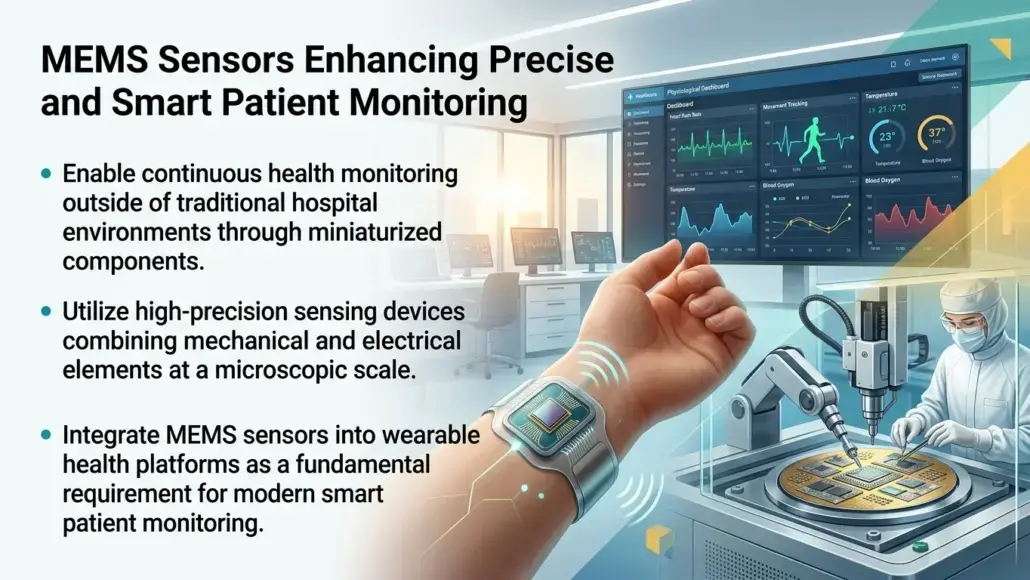
The miniaturization of electronic components has opened new possibilities for the continuous monitoring of human health outside of the traditional hospital environment. At the center of this technological shift are micro-electromechanical systems, which combine mechanical and electrical elements at a microscopic scale to create high-precision sensing devices. The integration of MEMS sensors into wearable health platforms is a fundamental requirement for the modern approach to smart patient monitoring, providing the data necessary for proactive and personalized care. By capturing subtle physiological changes in real-time, these sensors allow clinicians to identify potential health issues before they become acute crises, significantly improving the quality of life for patients with chronic conditions.
Smart patient monitoring relies on the ability to collect accurate data without interfering with the patient’s daily life. Traditional monitoring equipment is often bulky and intrusive, limiting its use to clinical settings. In contrast, MEMS sensors are small, lightweight, and low-power, making them ideal for integration into clothing, patches, or watches. This move toward a more discreet and continuous form of observation is a hallmark of the modern healthcare sector, where the focus is on shifting care from the hospital to the home. The data generated by these devices provides a comprehensive view of the patient’s health that a single office visit cannot replicate.
Wearable Health and Remote Monitoring Standards
The widespread adoption of remote monitoring is driven by the need to manage a growing population of patients with chronic diseases more efficiently. By utilizing wearable health devices equipped with MEMS sensors, healthcare providers can monitor vital signs such as heart rate, respiratory rate, and physical activity levels around the clock. This constant flow of healthcare data allows for a more granular understanding of how a patient’s condition responds to different treatments and environmental factors. For the physician, this means being able to make more informed decisions based on empirical evidence rather than subjective reports.
The technical performance of these sensors is a critical factor in the success of any remote monitoring program. MEMS sensors must be highly accurate, reliable, and resistant to the environmental stresses of daily life, such as sweat, motion, and temperature changes. The ongoing innovation in sensor technology is focused on improving the sensitivity and the durability of these devices while reducing their power consumption. This ensures that the patient can wear the device for extended periods without needing to recharge it, which is essential for maintaining a high level of compliance. The focus is on creating a seamless and reliable experience for both the patient and the clinician.
Managing Healthcare Data and Clinical Decisions
The volume of data generated by a network of smart patient monitoring devices is immense, presenting both an opportunity and a challenge for the healthcare system. To turn this raw information into actionable insights, organizations must invest in sophisticated data analytics and cloud-based platforms. When MEMS sensors provide a continuous stream of data, the system can use machine learning to identify trends and anomalies that might indicate a change in the patient’s status. For instance, a subtle change in gait or a slight increase in resting heart rate can be early indicators of a fall risk or a cardiac event.
Automated alerts based on these data-driven insights allow for a more responsive and proactive form of care. Instead of waiting for a patient to report a problem, the healthcare team can reach out to them the moment an anomaly is detected. This reduction in the time to intervention is a key factor in improving clinical outcomes and reducing the number of emergency room visits and hospital readmissions. The move toward a more data-driven and automated approach to patient care is a defining characteristic of the modern healthcare industry, and the role of high-precision sensors in supporting this transition is indisputable.
Sensor Technology and Technical Reliability
The reliability of MEMS sensors is the foundation upon which all smart patient monitoring is built. If a sensor provides inaccurate data, it can lead to false alarms or, more dangerously, a missed diagnosis. Manufacturers are therefore focused on ensuring the absolute consistency of their devices through rigorous testing and quality control. This involves a comprehensive program of calibration and validation to verify the performance of the sensor across a wide range of physiological conditions. The use of advanced manufacturing techniques, such as wafer-level packaging and automated testing, ensures that every sensor meets the required specifications for precision and durability.
Furthermore, the integration of multiple sensors into a single device—known as sensor fusion—provides an even more robust and comprehensive view of the patient’s health. By combining data from accelerometers, gyroscopes, and pressure sensors, the system can filter out noise and provide a more accurate interpretation of the patient’s activity and physiological state. This level of technical sophistication is essential for creating a reliable monitoring platform that can be used in the complex and unpredictable environment of daily life. The ongoing innovation in sensor technology is what will continue to define the boundaries of what is possible in remote patient care.
Future Directions in Patient Centered Monitoring
The continued evolution of the smart patient monitoring market will likely lead to an even greater emphasis on the integration of sensing technology into every aspect of the human environment. We are seeing the development of “smart home” systems that use embedded MEMS sensors to monitor the health and safety of elderly residents without the need for wearable devices. This move toward more passive and ubiquitous sensing represents the next frontier in patient-centered care. The role of micro-electromechanical systems in supporting this evolution is essential, as they provide the small and low-cost sensing elements needed for large-scale deployment.
In the coming years, the integration of biological and chemical sensors into the MEMS platform will allow for the continuous monitoring of biomarkers in blood or interstitial fluid. This would provide a real-time view of a patient’s glucose levels, electrolyte balance, or medication concentrations, significantly improving the management of conditions such as diabetes and kidney disease. The ability to monitor these complex internal states with the same ease as heart rate or activity is a major goal of the medical device industry. The ongoing commitment to technical innovation and data-driven care is what will define the leaders of the industry in the decades to come.
The transition toward a more connected and data-driven approach to patient monitoring is a defining characteristic of the modern healthcare industry. By prioritizing the use of MEMS sensors, healthcare providers can achieve levels of insight and efficiency that were once considered unattainable. The benefits of this approach extend beyond the walls of the clinic, contributing to a more responsive and resilient health system that is better equipped to handle the challenges of a global population. The commitment to technical excellence and patient-centered care is what will define the success of these programs in the decades to come.
As the industry moves forward, the focus will remain on the refinement of sensor properties and the continued improvement of clinical outcomes. The ability to handle the increasing complexity of new monitoring modalities will remain a key challenge for engineers and clinicians alike. The ongoing evolution of MEMS sensors is a testament to the power of technical innovation in the service of human health, ensuring that the next generation of smart patient monitoring is both accurate and accessible to every patient who needs it.