






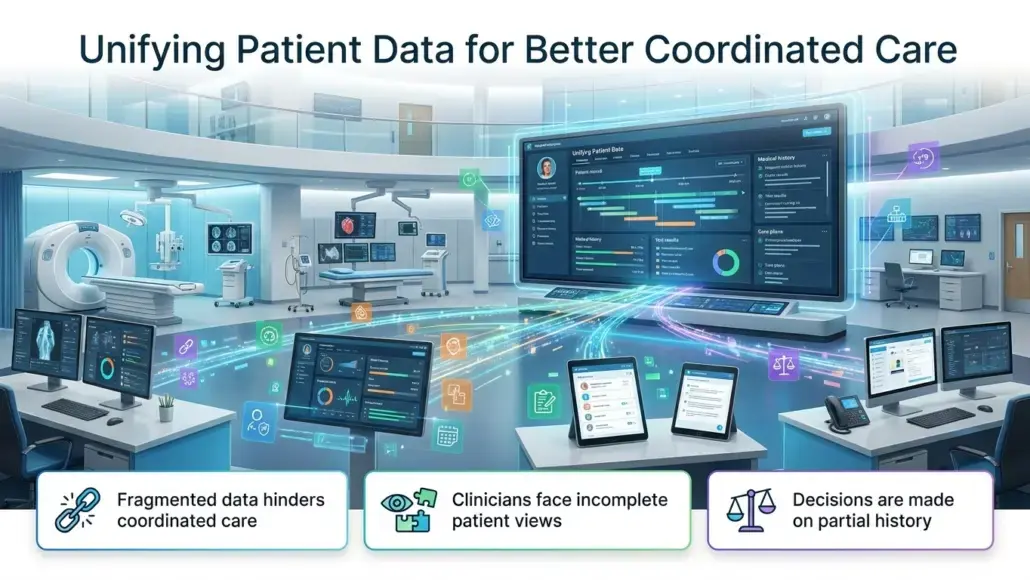
The fragmentation of health data across different providers, facilities, and care settings remains a significant obstacle to delivering high quality, coordinated care. In large healthcare enterprises, patients often receive treatment from multiple specialists and in various departments, each of which may maintain its own independent record of the patient encounter. Without a unified view of the patient’s entire medical history, clinicians are forced to make decisions based on incomplete or disconnected information. Longitudinal patient records are designed to solve this problem by consolidating data from all available sources into a single, chronological timeline of the patient’s journey through the healthcare system. By providing a comprehensive and continuous view of clinical events, these records enable better communication between providers, more informed clinical decision making, and more effective management of complex patient populations.
The development of longitudinal patient records is a critical component of the shift toward value based care, which emphasizes the quality and outcomes of care rather than the volume of services provided. To succeed in this model, healthcare organizations must be able to track a patient’s progress over time and identify opportunities for intervention that can prevent costly complications or hospital readmissions. Longitudinal records provide the necessary visibility into the patient’s health status, allowing care teams to identify patterns and trends that might be missed in a single, isolated encounter. For example, a clinician can easily see how a patient’s laboratory results have changed over several years or how their medication adherence has impacted their overall health. This level of insight is essential for developing effective care plans and ensuring that patients receive the most appropriate treatments at every stage of their journey.
Unifying Disparate Data Sources for a Holistic Patient View
Creating a truly comprehensive longitudinal record requires the integration of data from a wide variety of sources, including electronic health records, claims data, pharmacy records, and even patient generated health data from wearable devices. Longitudinal patient records achieve this by utilizing advanced data ingestion and normalization techniques to harmonize information from these diverse platforms. This process involves not only moving the data but also ensuring that clinical concepts are represented consistently, regardless of the source system. By providing a unified data model, these records allow clinicians to see the full context of a patient’s health, including their medical history, allergies, immunizations, and social determinants of health.
This holistic view is particularly important for patients with multiple chronic conditions, who often require care from a large team of specialists. When every member of the care team has access to the same longitudinal record, they can coordinate their efforts more effectively and avoid duplicating tests or prescribing conflicting medications. The record acts as a single source of truth that travels with the patient, ensuring that every clinician they see is aware of their previous treatments and current health status. This reduces the risk of errors and improves the overall safety and quality of care. additionally, the ability to integrate data from non clinical sources, such as social services and community health organizations, provides a more complete understanding of the factors that influence a patient’s health, enabling more targeted and effective interventions.
Improving Transitions of Care and Reducing Clinical Fragmentation
Transitions of care, such as moving from a hospital to a rehabilitation facility or from a specialist back to a primary care provider, are high risk periods for patients. Information gaps during these transitions can lead to medication errors, missed follow up appointments, and avoidable readmissions. Longitudinal patient records mitigate these risks by providing a continuous flow of information between different care settings. When a patient is discharged from the hospital, their longitudinal record is automatically updated with their discharge summary, medication changes, and follow up instructions. This information is then immediately available to their primary care provider and any other members of their care team, ensuring a seamless transition and continuity of care.
The reduction of clinical fragmentation also has significant benefits for the patient experience. Patients no longer have to repeatedly explain their medical history to every new provider they see or undergo redundant tests because their previous results were not available. This not only improves patient satisfaction but also fosters a stronger relationship of trust between patients and their healthcare providers. The longitudinal record empowers patients by giving them a clearer understanding of their own health journey and encouraging them to take a more active role in their care. By facilitating better communication and information sharing, these specialized systems help create a more connected and patient centered healthcare system that is better equipped to meet the needs of a diverse and complex population.
Empowering Care Teams with Actionable Clinical Insights
Beyond providing a simple chronological view of clinical events, modern these specialized systems also incorporate advanced analytics and decision support tools that generate actionable insights for care teams. By analyzing the data within the record, these tools can identify patients who are at high risk for specific conditions or who are falling behind on their preventative care. For example, the system could alert a care manager to a patient whose blood pressure has been steadily increasing over several months, indicating a need for a medication adjustment or lifestyle intervention. These proactive alerts allow care teams to address health issues before they become serious, improving outcomes and reducing the overall cost of care.
Longitudinal records also support the development of more effective population health management strategies. By analyzing the health trends of large groups of patients, organizations can identify common gaps in care and develop targeted programs to address them. For example, an organization might discover that a specific patient population has low rates of diabetic eye screenings and implement a community outreach program to improve access to this important service. The data from these specialized systems provides a powerful foundation for evaluating the effectiveness of these programs and identifying opportunities for further improvement. By using data to drive clinical and operational decisions, healthcare organizations can improve the health of entire communities while ensuring that every individual patient receives the personalized care they need.
Enhancing Research and Clinical Trials through Longitudinal Data
The rich historical data contained within these specialized systems is also a valuable resource for clinical research and the development of new treatments. Researchers can use these records to identify suitable candidates for clinical trials, track the long term effectiveness of medications, and gain new insights into the natural progression of various diseases. The ability to access large datasets of real world clinical information allows for more powerful and generalizable research findings than would be possible with smaller, isolated datasets. This accelerates the pace of medical discovery and helps bring new and more effective treatments to patients more quickly.
in addition, the use of longitudinal data in clinical trials allows for more accurate monitoring of patient safety and outcomes over time. Researchers can identify potential side effects or complications that may not be apparent in short term studies. This long term perspective is essential for ensuring the safety and efficacy of new therapies, especially for chronic conditions that require long term management. The integration of these specialized systems with research databases also simplifies the data collection process, reducing the administrative burden on clinical researchers and improving the quality of the data collected. By bridging the gap between clinical care and medical research, these specialized systems are helping to create a more integrated and evidence based healthcare system that continuously learns and improves.
Navigating the Technical and Governance Challenges of Longitudinal Record Implementation
Implementing a successful longitudinal patient record system requires a sophisticated technical infrastructure and a strong commitment to data governance and privacy. Healthcare organizations must develop powerful master patient indexing strategies to ensure that data from different sources is correctly matched to the right individual. They must also implement standardized data models and terminology to ensure that the information is accurately interpreted across the organization. This technical complexity is matched by the need for clear policies on data access and use, ensuring that patient privacy is protected and that the organization remains in compliance with all relevant regulations.
Success in this area also depends on fostering a culture of collaboration and data sharing across the entire enterprise. Clinicians and administrators must understand the value of these specialized systems and be willing to contribute their data to the shared record. This requires ongoing communication and engagement to address any concerns about data ownership or clinical autonomy. By focusing on the shared goal of improving patient outcomes and care coordination, organizations can build the necessary momentum to overcome these challenges and realize the full benefits of a unified patient record. The investment in these specialized systems represents a commitment to a more integrated and patient centered future, where every individual’s health journey is fully understood and supported at every stage of their care.