












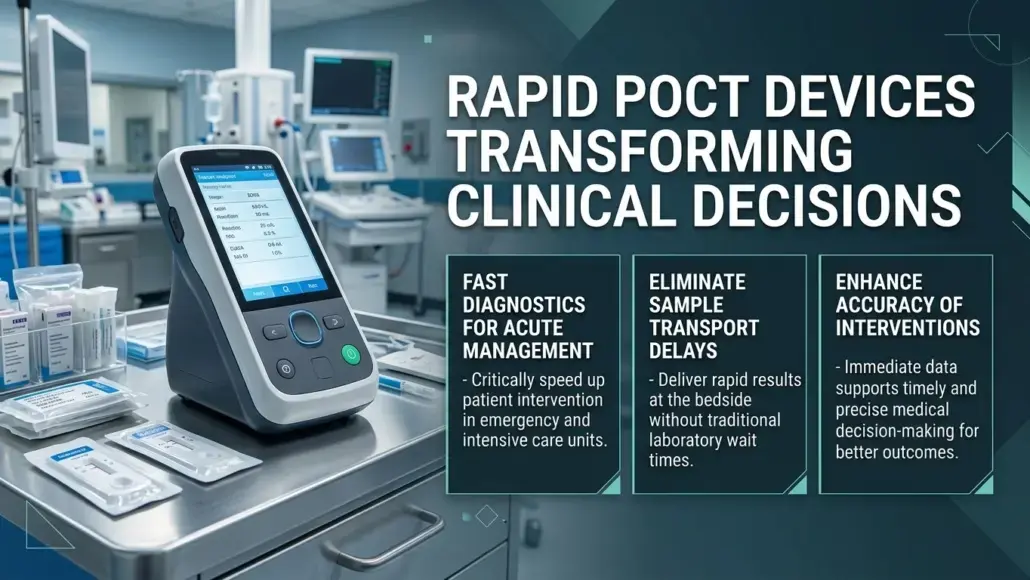
The speed of a diagnostic test is often the most critical factor in the management of acute medical conditions. In a traditional clinical workflow, the time required to transport a sample to a central laboratory and receive a result can range from several hours to several days. For a patient in the emergency department or the intensive care unit, this delay can significantly impact the speed and the accuracy of the intervention. The emergence of rapid Point-of-Care Testing (POCT) devices is fundamentally changing this dynamic, moving the laboratory to the patient’s bedside and providing immediate results that allow for faster and more effective clinical decisions. This transition toward decentralized testing is a hallmark of the modern healthcare sector, where the focus is on improving the efficiency and the responsiveness of patient care.
Point-of-care testing is not a new concept, but the technical sophistication of modern devices has reached a point where they can match the performance of large-scale laboratory equipment. The integration of microfluidics, advanced sensors, and digital connectivity allows for the rapid analysis of blood, urine, or saliva for a wide range of biomarkers. When rapid POCT devices are utilized, the time to result is reduced from hours to minutes, allowing clinicians to initiate treatment, adjust medications, or discharge patients with greater confidence. This focus on diagnostic speed is a key driver for improving the overall healthcare efficiency of the institution.
Diagnostic Speed and Bedside Monitoring Standards
The primary benefit of utilizing rapid testing at the bedside is the significant reduction in the total time to treatment. In emergency medicine, where every second counts, the ability to confirm a diagnosis of a heart attack, a stroke, or a severe infection in minutes is life-saving. Rapid POCT devices allow for the immediate triage of patients, ensuring that those in the greatest need receive priority care. This proactive approach to patient management is essential for reducing the overcrowding that often plagues modern emergency departments. For the hospital administrator, this means being able to manage the flow of patients with greater precision and for improving the overall throughput of the facility.
Furthermore, the continuous monitoring of patients in the intensive care unit is enhanced by the presence of rapid diagnostic tools. By providing real-time data on blood gases, electrolytes, and metabolic markers, these devices allow for the immediate adjustment of life-support systems and medications. The move toward a more responsive and data-driven approach to critical care is a defining characteristic of the modern healthcare industry, and the role of rapid POCT devices in supporting this transition is indisputable. The focus remains on achieving the best possible clinical outcomes for the most vulnerable patients.
Enhancing Clinical Decisions and Healthcare Efficiency
The data generated by rapid testing platforms provides a wealth of information for making informed clinical decisions at the point of care. Instead of relying on clinical judgment alone, physicians can use empirical evidence to guide their interventions. This reduction in diagnostic uncertainty leads to a more targeted and effective use of healthcare resources, avoiding the costs and the risks associated with unnecessary treatments or prolonged hospital stays. Rapid POCT devices allow for the implementation of evidence-based protocols that improve the consistency and the quality of care across the entire organization.
The integration of these devices with the patient’s electronic health record also ensures that the results are available to the entire healthcare team in real-time. This connectivity supports better communication and coordination between different departments, which is essential for managing complex cases. The move toward a more integrated and digitalized diagnostic workflow is a hallmark of the modern healthcare sector, and the role of rapid testing in supporting this evolution is essential. The focus remains on creating a more responsive and patient-centered health system that is better equipped to handle the challenges of a global population.
Quality Assurance and Technical Reliability in POCT
The transition toward a more decentralized testing model requires a rigorous adherence to international standards for quality and performance. Regulatory compliance is a fundamental requirement for both manufacturers and healthcare providers, as the integrity of the diagnostic results depends on the consistency of the device. Hospitals must ensure that their POCT systems are subject to a comprehensive program of calibration, maintenance, and quality control. This involves the training of clinical staff on the proper use of the devices and the interpretation of the results to ensure that the data is handled in a professional and accurate manner.
Furthermore, the technical reliability of rapid POCT devices is a critical factor in their success. These devices must be highly accurate, durable, and easy to use in the fast-paced and often stressful environment of the bedside. The ongoing innovation in diagnostic technology is focused on improving the sensitivity and the specificity of these devices while reducing the manual steps required for testing. This ensures that the results are consistent and reliable, regardless of the person performing the test. The focus is on creating a robust and dependable diagnostic platform that can be used with confidence in every clinical setting.
Future Horizons in Point of Care Innovation
The continued evolution of the diagnostic market will likely lead to an even greater emphasis on the integration of multiple tests into a single, portable device. We are seeing the development of “lab-on-a-chip” systems that can analyze a single sample for dozens of different markers simultaneously. The role of rapid POCT devices in supporting this evolution is essential, as they provide the platform for large-scale, decentralized testing. This move toward more comprehensive and integrated diagnostics represents the next frontier in point-of-care care.
In the coming years, the integration of artificial intelligence and cloud-based analytics will further enhance the value of rapid testing. AI algorithms can analyze the diagnostic results in the context of the patient’s history and current status, providing decision support and predictive insights for the clinician. This would provide a real-time view of the patient’s trajectory and help identify potential complications before they occur. The ability to manage complex medical cases with the same speed and precision as a simple diagnostic test is a major goal for both researchers and healthcare providers. The ongoing commitment to technical innovation and data-driven care is what will define the leaders of the industry in the decades to come.
The transition toward a more connected and data-driven approach to clinical diagnostics is a defining characteristic of the modern healthcare industry. By prioritizing the use of rapid POCT devices, healthcare providers can achieve levels of speed and efficiency that were once considered unattainable. The benefits of this approach extend beyond the emergency department, contributing to a more responsive and resilient health system that is better equipped to handle the challenges of a global population. The commitment to technical excellence and patient-centered care is what will define the success of these programs in the decades to come.
As the industry moves forward, the focus will remain on the refinement of diagnostic properties and the continued improvement of clinical outcomes. The ability to handle the increasing complexity of new testing modalities will remain a key challenge for engineers and clinicians alike. The ongoing evolution of rapid POCT devices is a testament to the power of technical innovation in the service of human health, ensuring that the next generation of clinical diagnostics is both accurate and accessible to every patient who needs it.