



















Workflow problems in ABA clinics rarely announce themselves all at once. They accumulate gradually a billing error here, a missed authorization there, a supervisor spending an extra hour tracking down session data that should have been available in seconds. Over time, these friction points add up to something significant: therapists buried in documentation, administrators chasing claims, and clinical leaders without the real-time visibility they need to make good decisions.
The right practice management platform does not just digitize existing processes. It restructures them. It removes the manual steps between care delivery and billing, gives every role in the clinic the information it needs without requiring someone else to compile and send it, and makes routine administrative tasks scheduling, reminders, authorization tracking, progress reporting happen automatically in the background while the clinical team focuses on clients.
This guide covers the five best ABA practice management platforms for improving clinic workflow in 2026. Each review examines what the platform does best, where it has limits, how it affects day-to-day operations for different roles in the clinic, and which type of practice it fits.
Platform Reviews
1. Theralytics — Best Overall for Clinic Workflow Improvement
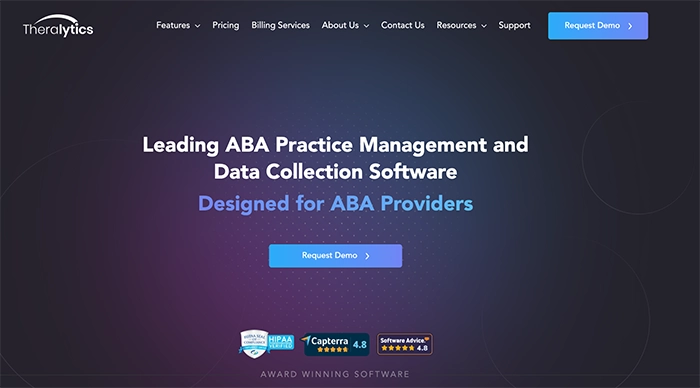
Theralytics is the platform most directly built around the goal of workflow efficiency. Every major function a clinic needs data collection, scheduling, billing, authorization management, progress reporting, parent communication sits inside a single connected system. That connection is not just a convenience. It is the mechanism through which workflow improves. When clinical data does not have to be manually transferred into billing, when schedules update in real time across every device, when progress graphs generate automatically after each session, the hours that administrative and clinical staff spend on manual tasks shrink significantly.
The design philosophy behind Theralytics is visible in how each role in the clinic interacts with the platform. RBTs get a fast, intuitive data entry experience with offline capability no dropped sessions because of unreliable internet, no end-of-day scramble to recreate data that was not saved. BCBAs get automated graphing and real-time progress data that supports timely treatment decisions without manual charting. Administrators get billing that integrates directly with session records, reducing the re-entry and reconciliation work that is one of the most common sources of claim errors. Supervisors get a real-time view of the schedule and session activity across the entire team.
For clinics dealing with the specific workflow problem of staff onboarding every new hire representing a temporary dip in operational efficiency Theralytics is notable for how quickly new users reach proficiency. Most staff are fully comfortable within two to three days of implementation. That speed matters not just for individual hires but for the cumulative impact on a clinic that is growing and onboarding regularly.
Theralytics also addresses workflow at the administrative level through authorization tracking, reports, and caregiver portal that gives families scheduling visibility and progress access without requiring staff to manually communicate that information. These automations remove a category of routine tasks from the administrative workload entirely.
On the compliance side, the platform meets 2026 HHS Technical Safeguard requirements including biometric MFA and real-time audit trails. SOC 2 Type II certification provides independently audited proof of ongoing data security a meaningful distinction from platforms that rely on self-reported compliance claims.
Theralytics is also the only platform on this list with publicly listed pricing. The per-client model scales predictably, and a free startup tier gives new clinics a runway to get established before costs begin. For practices evaluating software against a budget, the ability to model costs without entering a sales process is a practical workflow improvement before the platform is even implemented.
Pricing: Free startup package (6 months or until first client) | $20/client/month for Practice Management or Data Collection | $30/client/month for both combined.
Ideal for: Clinics of any size that want comprehensive workflow improvement across clinical and administrative functions in one connected, scalable platform with fast staff onboarding and transparent pricing.
2. Raven Health — Best for Improving Workflow in Field-Based and Mobile Teams
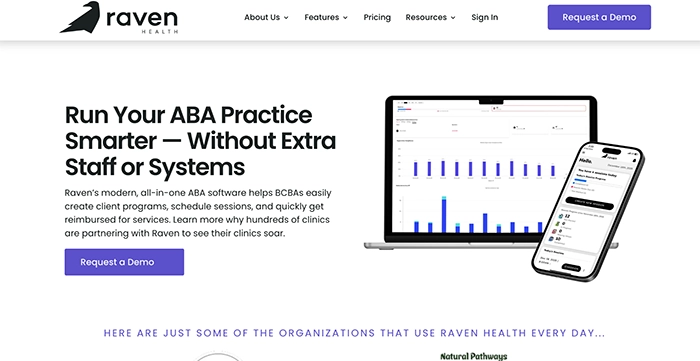
Raven Health addresses a specific and common workflow problem: the friction that builds up when therapists are delivering services across multiple locations homes, schools, community settings and the tools they are using were designed for a desk. Data gets entered late, session notes accumulate at the end of the day, coordination between field therapists and supervisors requires separate communication channels, and the result is a documentation lag that affects both clinical accuracy and billing timeliness.
Raven Health was built by a BCBA who worked in exactly those conditions, and the platform reflects that origin directly. The mobile app is the core product built for phones and tablets first, with an interface designed for the pace and physical constraints of in-home and school-based therapy. Data entry happens at the point of care. Offline mode keeps the workflow running in settings where internet access is unreliable, with automatic syncing when connectivity returns. There is no version of Raven Health where field therapists are entering session data hours after the fact because the mobile experience was too cumbersome to use in the moment.
AI-generated session notes are one of the platform’s most direct workflow improvements. Session documentation is one of the largest non-clinical time commitments for field-based therapists, and reducing that burden meaningfully while maintaining clinical quality translates into time that can be redirected toward clients or toward ending the workday at a reasonable hour. The built-in caregiver communication tools streamline family coordination that would otherwise happen through phone calls, texts, or separate messaging apps.
For clinics that want to simplify the billing workflow alongside the clinical one, Raven Health’s managed billing service is available as an add-on. Rather than building an internal billing operation, clinics can keep their clinical and financial data in one system while the revenue cycle work is handled by the vendor.
The platform is best suited for small to midsize clinics rather than large enterprises, and some features continue to mature as the product develops. Pricing requires a direct conversation with the vendor.
Pricing: Custom contact Raven Health directly.
Ideal for: Clinics whose workflow problems are rooted in field-based delivery documentation lag, mobile data entry friction, coordination gaps between therapists and supervisors and who need a platform designed for the reality of in-home and school-based ABA.
3. ABA Matrix — Best for Improving Clinical Workflow Through Customization
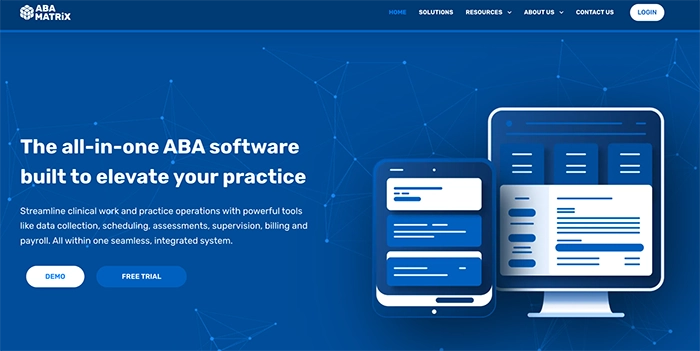
Most workflow problems in ABA clinics fall into one of two categories: administrative friction or clinical friction. ABA Matrix is built to address the second kind. When BCBAs are spending time building workarounds because the software does not support their clinical approach, when data collection formats do not match the way the clinic actually measures behavior, when reporting has to be manually reformatted before it is useful those are clinical workflow problems, and they are the ones ABA Matrix is designed to solve.
The platform allows BCBAs to configure programs, data collection formats, target structures, and reporting outputs to match the clinic’s clinical model precisely. Multiple ABA methodologies can run within the same system without conflict. The assessment and curriculum libraries provide a strong clinical foundation that reduces the time BCBAs spend building programs from scratch for each new client. Reporting is flexible enough to reflect the clinical priorities the team has actually defined, rather than defaulting to generic templates that have to be interpreted before they are actionable.
The workflow improvement ABA Matrix delivers is the reduction of clinical workarounds the manual adjustments, the parallel spreadsheets, the offline documentation that happens because the software cannot accommodate the way the clinic operates. For teams that currently spend time working around their platform’s clinical limitations, moving to a system that matches their approach can reclaim significant hours each week.
The tradeoffs are real and worth naming. ABA Matrix carries a steep learning curve. Initial configuration is involved and requires dedicated time from experienced clinical staff. The interface is less modern than newer platforms. Support responsiveness has been noted as inconsistent. These are genuine friction points during implementation that a clinic needs to plan for. Once the system is configured, however, the clinical workflow it enables is difficult to match with off-the-shelf alternatives.
Pricing: Custom contact ABA Matrix directly.
Ideal for: Established clinics with experienced clinical teams where workflow problems are rooted in clinical limitations mismatched data collection formats, inflexible programming structures, reporting that does not reflect the clinic’s actual clinical model.
4. Rethink Behavioral Health — Best for Improving Workflow Through Staff Consistency
There is a category of workflow problem that does not appear on any feature comparison chart: the inefficiency created by inconsistency across a clinical team. When different therapists document sessions differently, when new hires require weeks of one-on-one supervision before they can work independently, when clinical quality varies depending on who is assigned to a case those inconsistencies create workflow friction for supervisors, for administrators, and for the families receiving care.
Rethink Behavioral Health addresses workflow at that level. Rather than optimizing individual tasks, it builds consistency across the entire team through integrated training, standardized clinical resources, and a staff development infrastructure that reduces the supervisory overhead that inconsistency creates. The built-in RBT certification program allows clinics to train and certify new hires without external costs or scheduling dependencies. The video training library covers ABA principles through specific intervention strategies, and the evidence-based curricula give BCBAs structured program content that reduces the time spent building from scratch.
The workflow benefit is most visible in how quickly new staff reach the point where they can operate independently. When onboarding includes both clinical training and software proficiency simultaneously when a new therapist is learning ABA procedures and the documentation platform at the same time, using the same system the supervisor’s involvement tapers off faster and the workflow impact of bringing on new staff is smaller.
The parent portal and family education resources extend this consistency beyond the clinic. Families who understand treatment goals and know how to support skill development at home generate fewer clarification calls, fewer re-explanations, and fewer coordination tasks for the clinical team. That reduction in external communication friction is a real workflow improvement even if it does not appear in a list of platform features.
The clinical and administrative tools treatment planning, data collection, scheduling, billing are solid and cover day-to-day operational needs. Some users note the interface is less modern than newer platforms, and occasional syncing delays have been reported.
Pricing: Custom contact Rethink Behavioral Health directly.
Ideal for: Clinics where workflow inefficiency is driven by team inconsistency variable documentation quality, high onboarding overhead, supervision bottlenecks and where building standardized clinical practices across a growing team is the primary goal.
How to Choose
Workflow improvement starts with identifying where your workflow is actually breaking down. A clinic losing hours to billing corrections needs a different solution than one losing hours to documentation lag in the field. A clinic whose BCBAs are building clinical workarounds needs a different platform than one whose supervisors are spending too much time onboarding new therapists. The clearer you are about the specific problem, the easier the platform choice becomes.
When evaluating any platform, require SOC 2 Type II certification, mandatory biometric MFA, and AES-256 encryption these are the baseline security standards for 2026, not optional extras. Use trial periods to test platforms against the actual workflows your team uses every day, not scenarios the vendor has set up to look good. Speak with current users at clinics similar to yours in size and service model. Their experience will reflect the platform’s real performance under the conditions you will face.
Factor in the total cost of implementation, not just the monthly fee. Training time, configuration effort, data migration, and onboarding overhead are real costs that vary significantly across platforms. A platform that costs more per month but gets your team operational in three days may cost less in practice than one that is cheaper per month but takes six weeks to implement.
Conclusion
Workflow improvement in an ABA clinic is not about adding more software it is about removing the friction between the work your team is already doing. The five platforms reviewed here each address that friction from a different angle.
Theralytics delivers the most comprehensive workflow improvement across clinical and administrative functions, with transparent pricing and fast staff onboarding that makes it the strongest overall choice for most clinics. Raven Health solves the documentation and coordination friction that builds up in field-based teams. ABA Matrix removes clinical workflow limitations for established teams that need precise control over how programs and data are structured. Rethink Behavioral Health builds the team consistency that reduces supervision overhead and onboarding friction as a practice grows.
The right platform is the one that removes the specific friction slowing your clinic down and gets out of the way so your team can focus on delivering care.