














In almost every treatment group, there’s a person who goes quiet when it’s their turn. Someone asks them to talk about the hard thing, and they freeze, or shrug, or say “I don’t know” for the tenth time. It’s not that they’re hiding. It’s that the words aren’t there. Some things sit too deep or too raw to hand over in a sentence.
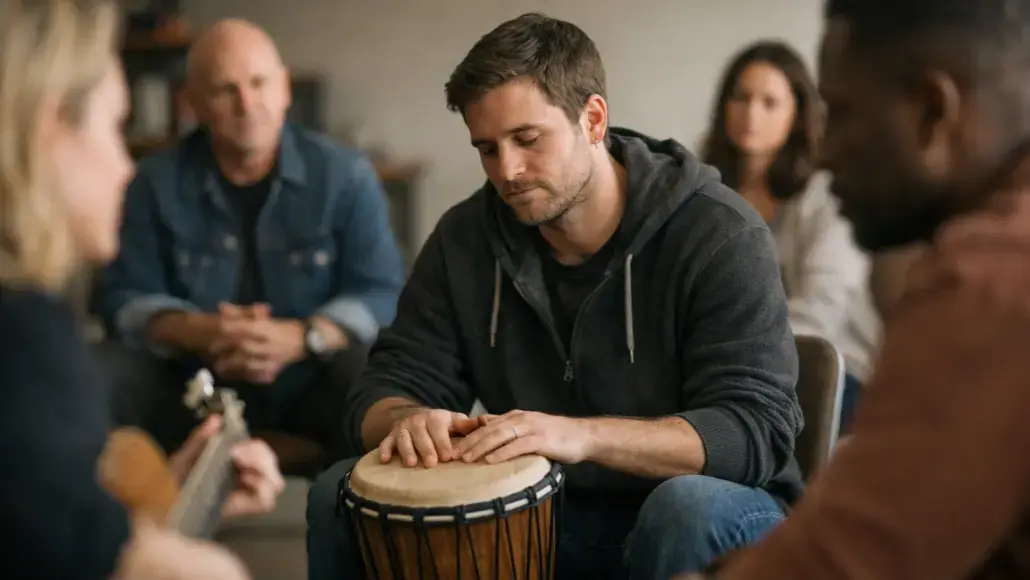
Then a song comes on. Or someone puts a drum in their hands. And something in their face moves that an hour of questions couldn’t reach.
That gap, between what people feel and what they can say, is where music does some of its best work.
Why talk sometimes hits a wall
Talking is the backbone of most recovery work and it should be. But it has limits, and pretending it doesn’t helps no one.
Trauma, shame, and grief don’t always live in the part of the brain that makes sentences. They sit lower down, in the body, in reactions that fire before words show up. You can ask someone to explain what happened to them and watch them go blank, not because they’re being difficult, but because the memory isn’t stored as a story. It’s stored as a feeling.
Early recovery makes this harder. The brain is foggy. Shame is loud. A lot of people spent years using it specifically so they wouldn’t have to feel these things, let alone describe them. Handing them a worksheet and asking them to open up can feel like being told to speak a language they never learned.
What music does that words can’t
Music skips the front door and comes in through a side one.
It works on the body first. A slow rhythm can settle a racing heart. A song from a hard year can pull up a memory a person had locked away and let them feel it without having to narrate it. This isn’t mystical. It’s physical.
Researchers have watched it happen on brain scans. In a 2011 study in Nature Neuroscience, Salimpoor and colleagues found that listening to deeply pleasurable music triggers the release of dopamine in the brain’s reward system, the same circuitry tied to appetite, motivation and craving. Music reaches the exact machinery that addiction hijacks, and it does it without a single word being spoken.
That’s the part talk can miss. You don’t have to explain a feeling to a song for the song to move it.
What music therapy actually is
This isn’t the same as putting on headphones, though that has its place too.
Music therapy is a clinical practice run by a board-certified therapist with real training. It’s goal-directed. It might look like writing lyrics about something you can’t say out loud, or pulling apart the words of a song that’s followed you around for years, or drumming in a group until the tension in the room finally breaks. The music is the tool. The target is emotional regulation, connection, and honesty.
A good music therapist isn’t there to entertain. They’re using sound to help someone reach a feeling, sit with it, and slowly start to work with it.
A moment that plays out often
Picture a man who lost someone during his using years and has never once cried about it. In group, he’s a wall. Ask him about the loss and he changes the subject.
One afternoon, the therapist has the group write short songs. He fumbles out a few lines about a person he “used to know.” Halfway through singing it, his voice cracks, and for the first time in months the grief comes out sideways, through a melody, because the front door was locked and this window happened to be open.
What the research shows in recovery
This isn’t a nice extra. The evidence is building.
A 2022 Cochrane review pulled together 21 trials with almost 2,000 people and found that adding music therapy to standard treatment reduced substance cravings and improved people’s motivation to stay in treatment and work toward change. Craving and motivation are two of the biggest hinges in early recovery, and music moved both.
Music also helps with what often rides alongside addiction. A separate Cochrane review (Aalbers and colleagues, 2017) found that adding music therapy to usual care improved symptoms of depression and anxiety. For someone drinking or using partly to quiet those exact feelings, that matters.
None of this means music therapy replaces counseling, medication, or medical care. It works best sitting beside them, reaching the parts those tools sometimes can’t.
When and how to get help
If you or someone you love is trying to get sober and keeps hitting a wall in talk-based therapy, it’s worth looking for care that offers more than one way in.
Ask a treatment center what they actually provide beyond standard counseling. Some build in music, art, and other hands-on approaches for exactly the people who struggle to put things into words. A program offering addiction treatment that includes music therapy can pair those experiences with the medical and clinical care that recovery needs.
If things feel dangerous, if you or your loved one is thinking about not being here anymore, call or text 988 to reach the Suicide and Crisis Lifeline. To find treatment near you, SAMHSA’s national helpline at 1-800-662-HELP (4357) is free, confidential, and open every day.
What stays after the song ends
People remember the day something finally moved. Sometimes it’s a hard conversation that cracks them open. Sometimes it’s four minutes of a song that says what they couldn’t. Recovery needs both. When the words run out, and at some point they will, it helps to know there’s another way through.
Sources
- Salimpoor VN, Benovoy M, Larcher K, Dagher A, Zatorre RJ. Anatomically distinct dopamine release during anticipation and experience of peak emotion to music. Nature Neuroscience (2011) — https://www.nature.com/articles/nn.2726
- Ghetti C, et al. Music therapy for people with substance use disorders. Cochrane Database of Systematic Reviews (2022) — https://www.cochranelibrary.com/cdsr/doi/10.1002/14651858.CD012576.pub3/full
- Aalbers S, et al. Music therapy for depression. Cochrane Database of Systematic Reviews (2017) — https://www.cochranelibrary.com/cdsr/doi/10.1002/14651858.CD004517.pub3/full