














The Dawn of Intelligent Medicine: How Algorithms are Saving Lives
In the high-stakes environment of clinical medicine, the margin for error is razor-thin, and the pressure on practitioners is immense. For decades, clinicians have relied on their training, experience, and the tools at their disposal to make life-altering decisions. However, the volume of medical knowledge and patient data has grown to such an extent that it has exceeded the capacity of the human mind to process it in real-time. This is where AI healthcare solutions transforming clinical care have stepped in, not as a replacement for human judgment, but as a powerful ally that enhances every aspect of the patient journey.
The shift toward clinical AI represents a move from reactive to proactive care. Traditionally, medical intervention occurred after a patient presented with symptoms. Today, sophisticated algorithms can analyze historical and real-time data to identify subtle indicators of impending health crises long before clinical symptoms manifest. This transition is redefining the standard of care, ensuring that “precision medicine” is more than just a buzzword it is a tangible outcome of high-level computational power applied to biological complexity.
Predictive Analytics: Anticipating the Unseen
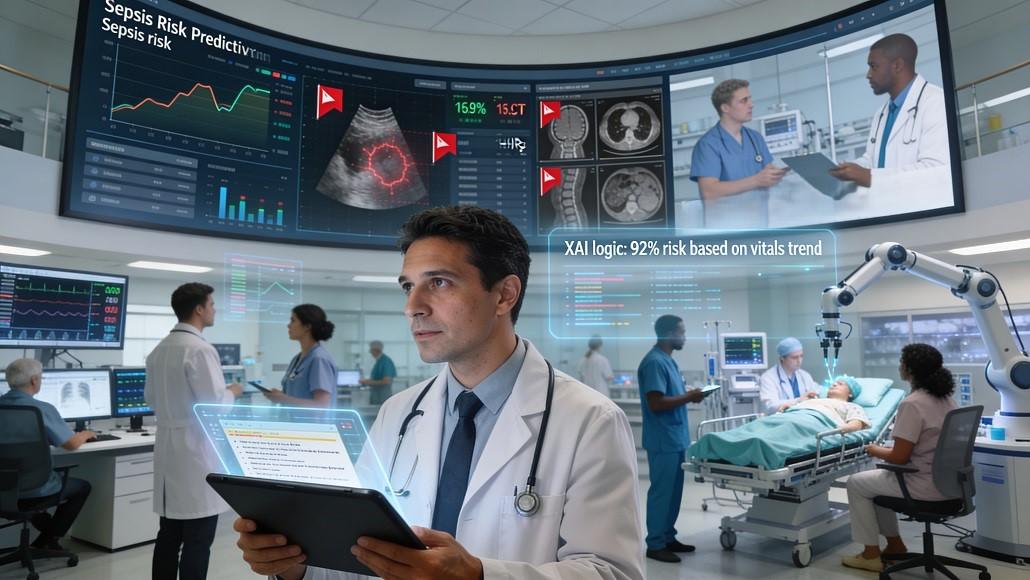
One of the most profound applications of AI healthcare solutions transforming clinical care is found in the realm of predictive analytics healthcare. Hospitals are vast repositories of data, much of it previously underutilized. By applying machine learning models to Electronic Health Records (EHRs), lab results, and real-time vitals, AI can predict patient outcomes with startling accuracy. For instance, predictive models are now widely used to identify patients at high risk of sepsis, a leading cause of hospital mortality. These systems can alert a nursing team up to twelve hours before the onset of visible symptoms, providing a critical window for intervention.
Beyond acute crises, predictive analytics are also instrumental in managing chronic diseases and reducing readmission rates. By analyzing social determinants of health alongside clinical markers, AI can identify which patients are likely to struggle with their post-discharge care plans. This allows hospitals to allocate resources more effectively, providing targeted support such as home health visits or remote monitoring to those who need it most. The result is a more efficient healthcare system that treats the patient as an individual rather than a set of symptoms.
Intelligent Diagnostics and the Future of Medical Imaging
In the field of diagnostics, the impact of AI is perhaps most visible. Intelligent diagnostics are revolutionizing radiology, pathology, and dermatology. Modern AI models, trained on millions of high-resolution images, can now detect anomalies such as early-stage tumors, micro-fractures, or retinal diseases with a level of consistency that rivals or exceeds that of human experts. This is not to say that the radiologist is becoming obsolete; rather, the AI acts as a first-pass filter, flagging suspicious areas for the specialist to review and ensuring that no detail is overlooked due to fatigue or cognitive bias.
Furthermore, AI healthcare solutions transforming clinical care are shortening the time between imaging and diagnosis. In emergency departments where every second counts, AI can automatically prioritize scans that show signs of urgent conditions like intracranial hemorrhages or pulmonary embolisms. By moving these critical cases to the top of the radiologist’s queue, AI-driven hospital systems are directly contributing to faster treatments and significantly improved survival rates. This speed and accuracy are the hallmarks of a truly modernized clinical environment.
Automating Workflow to Reclaim the Human Connection
A common criticism of modern medicine is that doctors spend more time looking at screens than at their patients. Administrative burdens, particularly documentation, have become a primary driver of clinician burnout. Healthcare automation is addressing this crisis by taking over the repetitive, time-consuming tasks that bog down the clinical day. Natural Language Processing (NLP) tools can now listen to patient-doctor consultations and automatically generate accurate, structured clinical notes. This allows the physician to maintain eye contact and build rapport with the patient, restoring the human touch to the medical encounter.
Hospital workflow optimization also extends to logistics and resource management. AI can predict patient arrival patterns in the emergency room, allowing administrators to staff accordingly. It can optimize operating room schedules, ensuring that expensive surgical suites are used to their maximum capacity while minimizing patient wait times. By smoothing out these operational friction points, AI healthcare solutions transforming clinical care allow the entire institution to function more harmoniously, ultimately benefiting the patient experience.
Data-Driven Hospital Systems: The Foundation of Strategy
The true power of AI lies in its ability to synthesize information from disparate sources. Data-driven hospital systems provide administrators and clinical leads with a “birds-eye view” of their operations. This systemic intelligence allows for better long-term planning and more agile responses to emerging health trends. Whether it is tracking the efficacy of a new treatment protocol across thousands of patients or identifying a sudden cluster of infections within a specific ward, AI provides the clarity needed to make informed strategic decisions.
This macro-level analysis is also vital for public health. During the COVID-19 pandemic, AI healthcare solutions were instrumental in modeling disease spread and predicting which regions would experience a surge in hospitalizations. This capability is now being institutionalized, allowing hospitals to prepare for seasonal flu outbreaks or other public health emergencies with unprecedented precision. The hospital of the future is an institution that learns from every interaction, constantly refining its processes to provide better care at a lower cost.
Navigating the Ethical Landscape of Clinical AI
As we integrate AI more deeply into clinical care, we must remain vigilant regarding the ethical implications. Issues such as algorithmic bias, data privacy, and the “black box” nature of some deep learning models are the subject of intense debate. It is essential that AI healthcare solutions transforming clinical care are developed and deployed with transparency and inclusivity. If the data used to train an AI model is not representative of a diverse population, the resulting insights may be skewed, leading to disparities in care.
To address these challenges, the medical community is calling for “Explainable AI” (XAI), where the logic behind a machine’s recommendation can be understood and verified by a human clinician. This ensures that the final decision always rests with the doctor, and that the AI serves as a transparent tool for enhancement rather than a hidden arbiter of care. Rigorous regulatory oversight and ongoing clinical validation are the safeguards that will allow AI to reach its full potential while maintaining the highest ethical standards.
A Future Defined by Collaborative Intelligence
The transformation of clinical care through AI is not an end-state, but an ongoing journey. As algorithms become more sophisticated and data sets more comprehensive, we will see even more innovative applications. From genomic-based drug recommendations to robotic assistants that can perform complex microsurgery with superhuman steadiness, the possibilities are vast. However, the core of medicine will always be the relationship between the provider and the patient.
The ultimate goal of AI healthcare solutions transforming clinical care is to augment the human provider. By stripping away the mundane, flagging the dangerous, and uncovering the hidden, AI allows clinicians to work at the very top of their license. It provides the space and the insights necessary to practice medicine as it was intended: with skill, compassion, and a relentless focus on healing. In this new era of collaborative intelligence, the synergy between man and machine is creating a healthcare system that is more resilient, more equitable, and more effective than ever before.