













The Integrated Ecosystem: Building the Foundations of a Smart Hospital
In the traditional healthcare model, departments often operated as distinct islands of activity. Radiology, the laboratory, the intensive care unit, and the outpatient clinics each had their own systems, their own data formats, and their own workflows. This fragmentation was not only inefficient but also a major barrier to providing truly coordinated care. Today, however, we are witnessing the emergence of connected healthcare powering smart hospitals, a transformative approach that unites these disparate elements into a single, cohesive, and intelligent whole. This is the culmination of decades of technological progress, brought together by the power of high-speed connectivity and ubiquitous data.
The “smart hospital” is more than just an institution filled with computers. it is a facility that is aware of its own status and the status of everyone within its walls. By leveraging an interconnected digital infrastructure, these hospitals can anticipate needs, streamline logistics, and ensure that clinical information is always available exactly where and when it is needed. This connectivity is the “secret sauce” that allows modern hospitals to operate with unprecedented levels of safety, efficiency, and patient satisfaction.
IoT Integration: The Eyes and Ears of the Facility
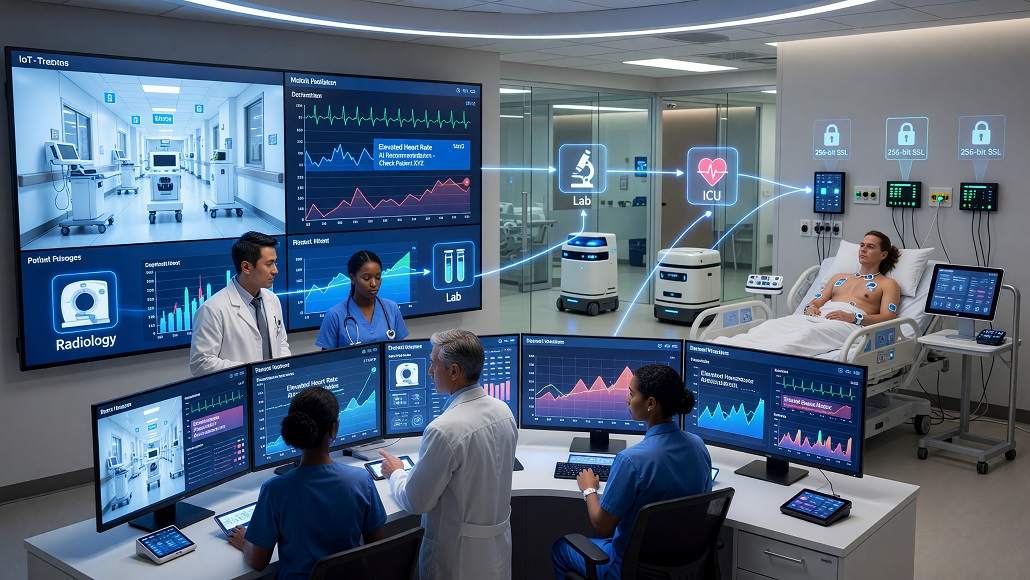
The foundation of any smart hospital is a robust IoT healthcare network. Every piece of equipment, from the humble IV pole to the most advanced surgical robot, is becoming a connected device. This integration allows for a level of visibility that was previously unimaginable. For example, a smart hospital can track the location and status of every mobile ventilator in real-time. If a sudden influx of patients occurs in the emergency department, the system can automatically identify the nearest available equipment and alert the transport team to move it.
Beyond asset tracking, IoT integration is revolutionizing patient monitoring. Wearable sensors that transmit data over a secure wireless network allow patients to be mobile while still being under constant clinical surveillance. If a patient’s heart rate or oxygen levels deviate from their personalized baseline, an alert is automatically sent to the nurse’s mobile device. This level of continuous, connected monitoring ensures that no patient “falls through the cracks,” even in a busy and crowded hospital environment. By turning the entire hospital into a sensing network, connected healthcare powering smart hospitals is creating a safer and more responsive care environment.
Cloud Healthcare Systems: The Scalable Brain
The massive amounts of data generated by a connected hospital require a powerful and flexible platform for storage and analysis. Cloud healthcare systems have become the preferred solution for this challenge, providing the scalability and processing power needed to manage petabytes of medical information. By moving data to the cloud, hospitals can break down traditional silos and enable seamless clinical data exchange across different locations and even different healthcare providers.
The cloud also serves as the host for advanced analytics and AI monitoring solutions. Instead of having to invest in massive on-site server rooms, hospitals can leverage the nearly infinite computing power of the cloud to run complex diagnostic algorithms and predictive models. This allows even smaller community hospitals to access the same high-level intelligence as major academic centers. Furthermore, the cloud facilitates disaster recovery and data redundancy, ensuring that critical patient information is always protected and available, even in the event of a localized hardware failure.
Seamless Clinical Data Exchange and Interoperability
For connectivity to be meaningful, data must be able to move freely and securely between different platforms. This is the goal of seamless clinical data exchange. In a smart hospital, when a patient undergoes a lab test, the results are automatically populated into their electronic health record (EHR) and flagged for the physician’s attention. If the results are critical, the system can automatically trigger a consultation request for the relevant specialist.
This level of automation reduces the administrative burden on clinical staff and minimizes the delays that often plague traditional medical workflows. Furthermore, by adhering to global standards for interoperability, smart hospitals can share data with outside partners, such as rehabilitation centers or home health agencies. This ensures that the patient’s care remains coordinated and consistent as they move through different stages of their recovery. The patient journey is no longer a series of handoffs, but a single, continuous, and well-documented process.
AI Monitoring Solutions: Transforming Data into Action
While connectivity provides the data, artificial intelligence provides the insight. AI monitoring solutions are the interpretative layer of the smart hospital. These systems can analyze real-time streams of physiological data from thousands of patients simultaneously, identifying patterns that are invisible to the human eye. For instance, an AI system might notice a specific combination of heart rate variability and blood pressure changes that, across a large population, has been shown to be a precursor to a specific type of cardiac event.
By providing these early warnings, AI-enabled monitoring allows clinicians to move from a “reactive” to a “proactive” posture. Instead of responding to a crisis, they can prevent the crisis from occurring in the first place. This shift has a profound impact on patient outcomes, particularly in high-acuity environments like the ICU and the neonatal ward. The combination of connected healthcare powering smart hospitals and AI is creating a new standard of “intelligent surveillance” that is saving lives every day.
Enhancing the Patient and Provider Experience
The benefits of a connected hospital extend beyond clinical outcomes to the overall experience of care. For the patient, a smart hospital offers a more streamlined and personalized journey. Digital wayfinding apps can guide them to their appointment, while bedside tablets allow them to control their room environment, order meals, and view their daily care plan. This level of control reduces the anxiety often associated with hospital stays and increases patient engagement.
For the provider, hospital digital transformation is a powerful tool for reducing burnout. By automating documentation, optimizing schedules, and providing clear, actionable insights, connected systems allow clinicians to focus on what they do best: treating patients. A nurse who doesn’t have to spend an hour every shift searching for equipment or manually charting vitals is a nurse who can spend more time at the bedside, providing the emotional and physical support that is the heart of healing.
Security, Ethics, and the Future of Connected Care
As we build these hyper-connected environments, we must also build robust defenses to protect them. Cybersecurity is a critical component of connected healthcare powering smart hospitals. Every node in the network must be secured, and every data transmission must be encrypted. Hospitals are now adopting “zero-trust” architectures, where every access request is verified, regardless of where it originates. This focus on security is essential for maintaining the trust of the patients who entrust their most sensitive data to the system.
Looking ahead, the evolution of the smart hospital will be driven by even faster networks, such as 5G, and the continued advancement of edge computing. This will allow for even more real-time analysis and the use of high-bandwidth technologies like remote-assisted surgery over long distances. The hospital is no longer a physical place; it is a digital presence that extends into the community. Through the continued power of connectivity, we are creating a healthcare system that is more resilient, more efficient, and more focused on the human element than ever before.