
















The Digital Bridge: Revolutionizing Care Beyond the Clinic Walls
For over a century, the medical model was centered on the “episode of care” a discrete encounter between a patient and a provider. This model was inherently reactive, often leaving a void in patient support once they left the examination room. However, the rise of digital health systems enhancing patient outcomes has fundamentally changed this dynamic. We are transitioning toward a model of continuous engagement, where technology serves as a bridge that keeps patients connected to their care teams regardless of their physical location. This evolution is driven by the recognition that health happens in the intervals between doctor visits, and that digital tools are the only way to manage those intervals effectively.
The implementation of these systems is not merely about digitizing paper records; it is about creating an environment where information is fluid, actionable, and patient-centered. By integrating various health IT solutions into a cohesive framework, healthcare providers can now offer a level of personalized attention that was previously impossible. This is the heart of digital transformation in medicine: the use of technology to empower both the provider and the patient, leading to safer, more efficient, and more successful clinical results.
Telehealth Expansion: Democratizing Access to Specialized Care
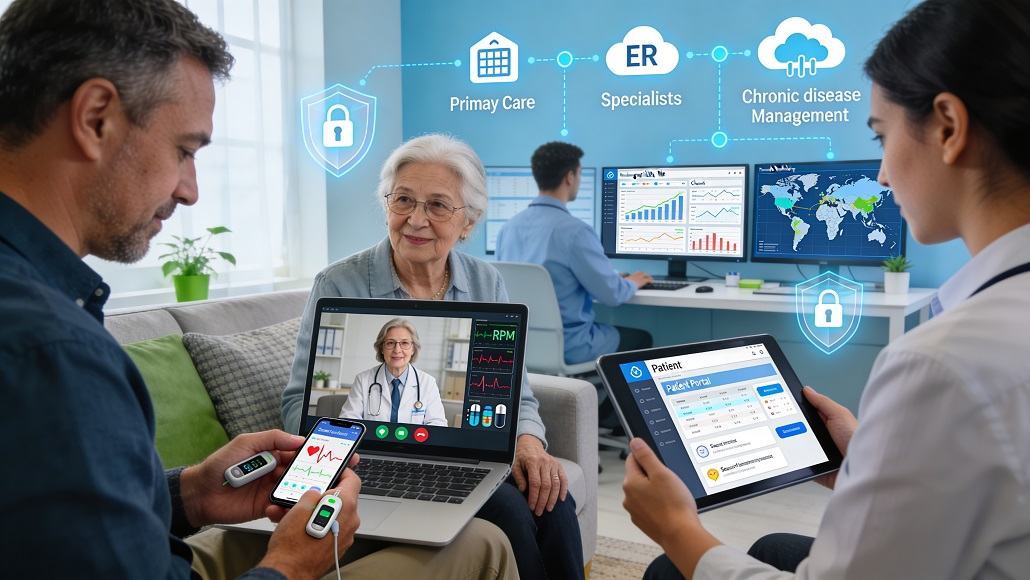
One of the most visible pillars of this transformation is the growth of telehealth platforms. What began as a convenience for rural populations has evolved into a cornerstone of the modern medical experience. Telehealth expansion has removed the geographical and logistical hurdles that once prevented patients from seeking timely care. For an elderly patient with mobility issues or a busy professional managing a chronic condition, the ability to consult with a specialist via a secure video link is a game-changer.
The impact on patient outcomes is profound. Early data suggests that telehealth significantly reduces missed appointments and improves adherence to follow-up care. Furthermore, by providing easier access to mental health services and chronic disease management, digital health systems enhancing patient outcomes are helping to prevent the escalation of minor health issues into major crises. This proactive approach not only improves the quality of life for the patient but also reduces the burden on overstretched emergency departments and inpatient facilities.
Remote Patient Monitoring: The Virtual Ward
While telehealth facilitates communication, remote patient monitoring (RPM) provides the data to make that communication meaningful. Through the use of wearable sensors, smart scales, and digital blood pressure cuffs, patients can now transmit vital health data to their providers in real-time. This “virtual ward” allows clinicians to monitor a patient’s recovery or disease progression with surgical precision. For a patient with congestive heart failure, a sudden weight gain monitored by a connected scale can trigger an immediate medication adjustment, preventing a hospital admission for fluid overload.
This level of surveillance is particularly transformative for the management of chronic diseases like diabetes and hypertension. Instead of relying on a patient’s memory or infrequent office readings, doctors have access to continuous trends. This allows for “nudge-based” medicine, where digital health systems enhancing patient outcomes send automated alerts to patients to take their medication, exercise, or check their glucose levels. By keeping patients within their target physiological ranges more consistently, RPM is drastically reducing the long-term complications associated with these chronic conditions.
Interoperability and the Seamless Flow of Medical Data
The true potential of digital health can only be realized when systems talk to each other. Healthcare interoperability is the technical foundation that allows for the secure data exchange across different platforms and institutions. In a fragmented healthcare landscape where a patient might see several different specialists across different health systems, a lack of data flow is a major safety risk. Digital health systems enhancing patient outcomes solve this by ensuring that the right information is available at the point of care, no matter where that care occurs.
When an emergency room doctor can instantly access a patient’s medication history from their primary care physician and their recent scan from a different hospital, the risk of adverse drug reactions or redundant testing is significantly mitigated. This fluidity of information supports better clinical decision-making and ensures a more coherent experience for the patient. We are moving toward a future where the “patient story” is no longer scattered across various digital silos but is a single, comprehensive, and portable record.
Empowering the Patient as an Active Partner
At the core of digital health systems enhancing patient outcomes is a shift in the patient-provider power dynamic. Traditionally, the patient was a passive recipient of care. Today, patient portals and mobile health apps are turning individuals into active managers of their own wellness. By providing easy access to lab results, educational resources, and secure messaging with their care teams, these tools improve health literacy and engagement.
When patients are engaged and informed, they are more likely to comply with treatment plans and make healthier lifestyle choices. This empowerment is a critical component of improving long-term health outcomes. Furthermore, digital platforms allow for the collection of patient-reported outcomes (PROs), giving clinicians insight into how a treatment is affecting a patient’s daily life and well-being. This feedback loop ensures that care is not just clinically sound, but also aligned with the patient’s personal goals and values.
Privacy and Trust in the Digital Era
As we move more health data into the cloud and onto mobile devices, the importance of cybersecurity cannot be overstated. Patients must feel confident that their most sensitive information is protected by the highest levels of security. Digital health systems enhancing patient outcomes must be built on a foundation of trust, utilizing advanced encryption and rigorous access controls. Transparency about how data is used and who has access to it is essential for maintaining the integrity of the patient-provider relationship in a digital-first world.
Health IT solutions are increasingly incorporating privacy-by-design principles, ensuring that security is a functional requirement rather than an add-on. As data sharing becomes more prevalent, the industry is also developing new standards for consent management, allowing patients to have granular control over their information. This ethical approach to data management is the only way to ensure the long-term viability and acceptance of digital health technologies.
A Scalable Future for Global Health Equity
The most exciting aspect of digital health systems enhancing patient outcomes is their potential for global impact. Digital technologies can leapfrog traditional infrastructure challenges, bringing high-quality care to underserved populations across the globe. Mobile health initiatives in developing nations are already showing success in maternal health tracking and infectious disease monitoring. By lowering the cost of care delivery and expanding the reach of specialized expertise, digital health is a powerful tool for reducing health disparities.
As we look forward, the integration of artificial intelligence and advanced genomics into these digital platforms will further personalize the patient experience. We are entering an era where medicine is not just digital, but truly intelligent. By focusing on the user experience for both the patient and the provider we can ensure that these technologies remain a force for good. The goal of digital health systems enhancing patient outcomes is clear: to create a healthcare system that is as dynamic and connected as the world we live in, ensuring that no patient is left behind in the journey toward wellness.