













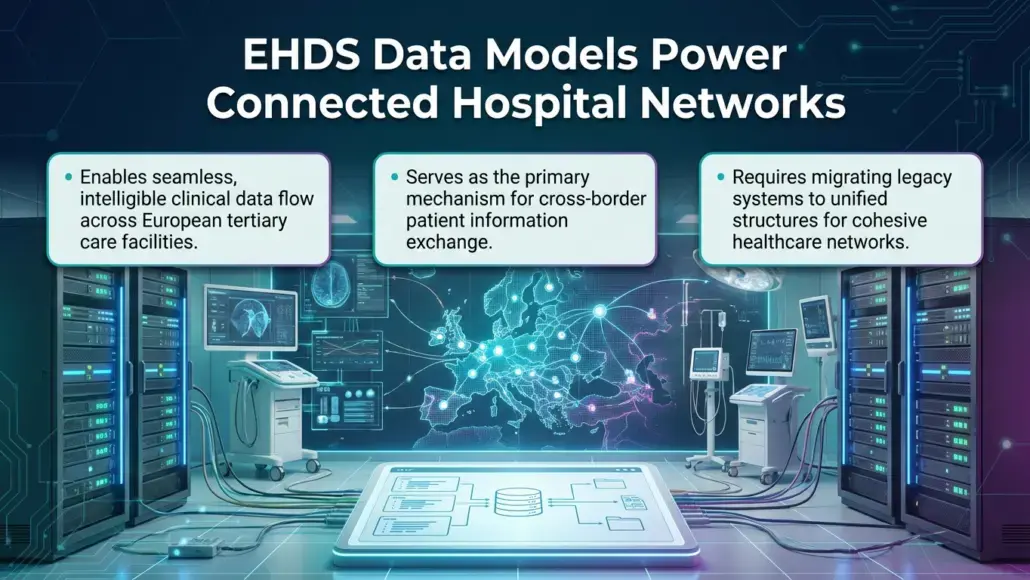

The implementation of the European Health Data Space represents a fundamental shift in how clinical information moves between tertiary care facilities. At the center of this initiative are EHDS data models, which serve as the primary mechanism for ensuring that patient information remains intelligible as it crosses borders and administrative boundaries. Hospital administrators are currently facing the challenge of migrating legacy systems into these unified structures to facilitate a more cohesive care environment. By adopting a common semantic framework, hospitals can eliminate the fragmentation that historically hindered collaborative care efforts. These models are not merely technical specifications; they are the foundation for a continent-wide network that prioritizes patient safety and administrative efficiency.
The transition toward these standardized models requires a deep understanding of how raw clinical data is categorized and stored. Traditional electronic health record systems often utilize proprietary formats that do not communicate effectively with external platforms. This isolation creates significant bottlenecks during patient transfers or multi-center research projects. The introduction of EHDS data models addresses this by providing a universal language for medical terminology, laboratory results, and imaging reports. As hospitals integrate these standards, they gain the ability to participate in a broader digital ecosystem where data flows securely and purposefully. This connectivity is essential for the modern healthcare facility, which must operate as part of a larger, integrated system rather than a standalone silo.
Enhancing Clinical Decision Support Through Interoperability
The primary objective of creating connected hospital networks is to improve the quality of care provided at the bedside. When clinicians have access to a comprehensive and standardized view of a patient’s medical history, the likelihood of diagnostic errors decreases significantly. EHDS data models allow for the real-time aggregation of diverse data points, including medication lists, allergy records, and prior surgical outcomes. This holistic view is critical in emergency departments where every second counts and historical data might be otherwise inaccessible. By ensuring that information is presented in a consistent format, these models reduce the cognitive load on physicians and nurses, allowing them to focus on patient interaction rather than data interpretation.
Furthermore, the adoption of these models enables more sophisticated clinical decision support tools. These tools rely on high-quality, structured data to provide accurate alerts and recommendations. If the underlying data is inconsistent or poorly categorized, the effectiveness of the support system is compromised. Within the EHDS framework, data is mapped to specific terminologies like SNOMED CT or LOINC, which ensures that an alert for a drug interaction or a specific diagnostic trend is based on precise clinical definitions. This level of precision is what allows modern hospitals to move beyond basic record-keeping and toward proactive, data-driven patient management. The result is a safer environment for patients and a more efficient workflow for the clinical staff.
Administrative Efficiency and Regulatory Compliance
Beyond the clinical benefits, the shift to a unified data environment offers substantial administrative advantages. Managing disparate data sources is a costly and time-consuming process for hospital IT departments. By standardizing on EHDS data models, organizations can streamline their data governance processes and reduce the overhead associated with maintaining complex integration engines. This standardization also simplifies compliance with emerging regulations regarding data privacy and portability. As the European Union tightens its requirements for health data management, having a pre-vetted, standardized model in place ensures that hospitals remain ahead of the regulatory curve without having to reinvent their internal architectures.
The economic impact of this transition is also noteworthy. When data flows smoothly between institutions, redundant testing is minimized, and administrative redundancies are eliminated. For instance, if a patient’s recent laboratory results are immediately available and verified through the EHDS network, there is no need to repeat those tests upon admission to a different facility. This saves direct costs and also frees up laboratory capacity for other patients. The efficiency gains extend to the billing and reporting functions as well, as standardized data makes it easier to track resource utilization and patient outcomes across the entire hospital network. In a time of tightening healthcare budgets, these operational efficiencies are vital for the long-term sustainability of the healthcare system.
Facilitating Large-Scale Medical Research and Population Health
One of the most promising aspects of the EHDS initiative is the potential for secondary data use. By aggregating anonymized information within EHDS data models, researchers can access vast datasets that were previously locked within individual hospital databases. This access is crucial for developing new treatments, identifying public health trends, and conducting longitudinal studies on chronic diseases. The standardized nature of the data means that researchers spend less time cleaning and normalizing information and more time performing actual analysis. This acceleration of the research cycle directly contributes to the development of better clinical protocols and more effective pharmaceuticals.
For hospital management, this means that their institution can become a more active participant in global medical innovation. Being part of a connected network that utilizes EHDS data models increases the value of the hospital’s data assets and enhances its reputation as a center for advanced research. It also allows for better population health management at the regional level. By analyzing data across multiple hospitals, health authorities can identify disease clusters, track the effectiveness of vaccination programs, and allocate resources more effectively. The connectivity provided by these models ensures that the hospital is not just treating individual patients but is also contributing to the broader health of the community.
Future-Proofing Hospital Digital Infrastructure
As healthcare technology continues to advance, the importance of a flexible and standardized data foundation cannot be overstated. The integration of artificial intelligence and machine learning into hospital operations depends entirely on the availability of high-quality, structured data. EHDS data models provide this foundation, ensuring that as new technologies emerge, they can be easily integrated into the existing clinical workflow. Hospitals that adopt these models now are effectively future-proofing their digital infrastructure against the next wave of technological disruption. They are positioning themselves to take advantage of new diagnostic tools and management software that will be built upon these universal standards.
The journey toward full EHDS integration is complex and requires significant investment in both technology and staff training. However, the cost of remaining isolated is far higher. The competitive advantage in healthcare is increasingly defined by how well an organization manages and utilizes its data. By committing to EHDS data models, hospital leaders are choosing a path of openness, collaboration, and excellence. They are building the infrastructure that will support the next generation of healthcare delivery, characterized by seamless transitions, evidence-based care, and a relentless focus on patient outcomes. This connectivity is the hallmark of the modern, smart hospital network, and it starts with the adoption of a unified data language.