







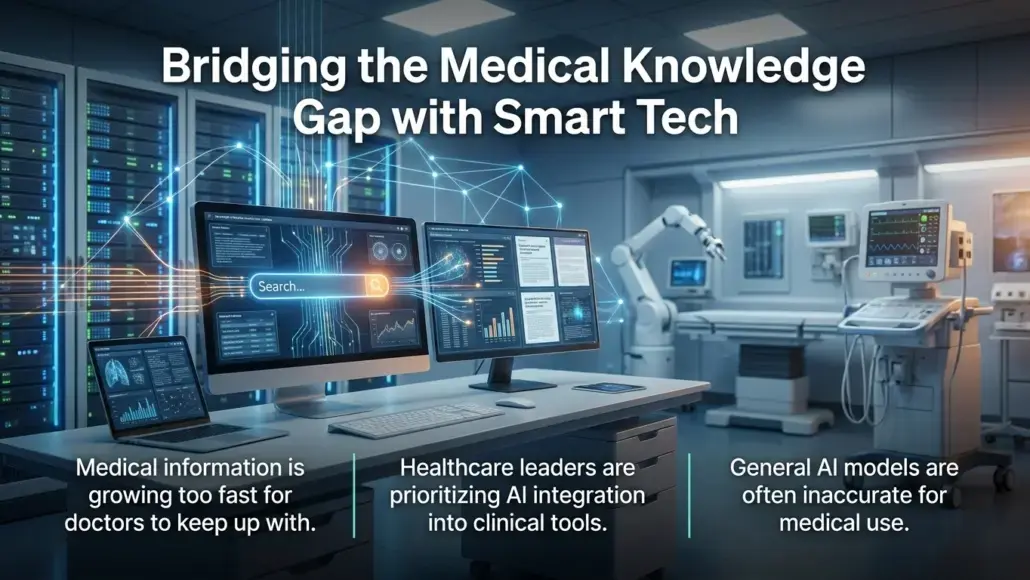
The explosion of medical literature and the increasing complexity of clinical data have made it difficult for healthcare providers to keep pace with the latest evidence based practices. To address this challenge, the integration of large language models into clinical workflows has become a primary focus for healthcare technology leaders. However, the use of general purpose models in a medical context is often limited by concerns over accuracy and the potential for generating incorrect information. Retrieval-augmented generation is emerging as a critical solution to these problems by grounding the outputs of AI models in a trusted repository of medical knowledge. By combining the natural language processing capabilities of large language models with a targeted retrieval mechanism, this technology provides clinicians with a powerful tool for accessing the most relevant and up to date information at the point of care.
The core advantage of retrieval-augmented generation is its ability to provide specific, evidence-backed answers to complex clinical questions. Unlike traditional search engines, which return a list of potentially relevant documents, this technology can synthesize information from multiple sources to provide a concise and actionable response. For example, a clinician could ask about the most effective treatment protocol for a patient with a rare combination of comorbidities and receive an answer that is directly linked to the latest clinical guidelines and peer reviewed studies. This capability not only saves time but also improves the quality of clinical decision making by ensuring that providers have access to the best available evidence. As healthcare organizations continue to adopt digital tools, the role of retrieval-augmented generation in facilitating clinical knowledge access will be a key driver of improved patient outcomes and clinical efficiency.
Grounding Artificial Intelligence in Verified Medical Evidence
The primary technical challenge in applying large language models to healthcare is the phenomenon known as hallucination, where a model generates a response that sounds plausible but is factually incorrect. In a clinical setting, such errors can have serious consequences for patient safety. Retrieval-augmented generation mitigates this risk by requiring the model to base its responses on specific, retrieved documents. When a clinician enters a query, the system first searches a curated database of verified medical literature, clinical guidelines, and internal hospital protocols. The most relevant information is then provided to the language model as context, which it uses to generate a response. This process ensures that the model’s output is rooted in established facts rather than the patterns it learned during its initial training on general datasets.
This grounding mechanism also allows healthcare organizations to maintain control over the knowledge base used by the AI system. As new clinical research is published or hospital protocols are updated, the organization can simply update its internal document repository. The system will then automatically incorporate the latest information into its responses, without the need for expensive and time consuming retraining of the underlying model. This agility is essential in the rapidly evolving field of medicine, where new discoveries and treatment methods are constantly being introduced. By providing a transparent and updateable source of truth, these specialized systems builds trust among clinicians and ensures that the AI assistant remains a reliable and valuable asset in the clinical environment.
Improving Clinical Decision Support Through Contextual Information
The utility of these specialized systems extends beyond general medical knowledge to the specific context of an individual patient’s clinical record. By integrating with an organization’s electronic health record system, the technology can retrieve and analyze a patient’s medical history, lab results, and previous encounter notes to provide more personalized clinical insights. For example, when a clinician asks for treatment recommendations, the system can tailor its response based on the patient’s specific allergies, current medications, and past responses to therapy. This level of personalization is the foundation of precision medicine and allows for more effective and targeted care delivery.
Additionally, these specialized systems can help clinicians identify subtle patterns and connections in a patient’s data that might be missed during a manual review. By processing vast amounts of information in real time, the technology can highlight potential risks or opportunities for intervention that are buried in the patient’s longitudinal record. This proactive approach to clinical decision support is particularly valuable in the management of chronic conditions, where long term monitoring and timely adjustments to treatment plans are critical for preventing complications. The ability to combine broad medical evidence with specific patient context makes these specialized systems a versatile tool that can support a wide range of clinical activities, from diagnosis and treatment planning to patient education and discharge planning.
Strengthening Data Privacy and Security in AI Workflows
One of the most significant barriers to the adoption of artificial intelligence in healthcare is the need to protect sensitive patient information. these specialized systems provides a framework for using advanced AI capabilities while maintaining strict data privacy and security. Because the retrieval process can be configured to occur entirely within an organization’s secure private cloud, sensitive patient data never has to be shared with third party model providers. The system can retrieve the necessary context from the internal EHR and provide it to the model in a secure and controlled environment. This ensures that patient privacy is protected and that the organization remains in compliance with HIPAA and other data protection regulations.
The use of these specialized systems allows for granular control over who can access specific types of information. Organizations can implement access controls that ensure that only authorized clinicians can retrieve data from specific patient records or specialized medical databases. This prevents unauthorized access and reduces the risk of data breaches. The ability to provide a secure and compliant path for integrating AI into clinical workflows is essential for gaining the trust of both patients and providers. By prioritizing data security at the architectural level, healthcare organizations can confidently deploy these specialized systems tools to improve clinical knowledge access without compromising the privacy of the individuals they serve. This balance between innovation and security is critical for the long term success of digital health initiatives.
Enhancing Educational Resources and Professional Development
In addition to its role in direct patient care, these specialized systems also offers significant benefits for clinical education and professional development. Medical students, residents, and experienced clinicians can use the technology as a sophisticated tutor and research assistant. For example, a resident could use the system to explore the physiological basis for a specific symptom or to review the clinical evidence for a new surgical technique. The system’s ability to provide clear explanations backed by citations to the original literature makes it an ideal tool for self directed learning. This helps clinicians stay current with the latest medical advancements and fosters a culture of continuous learning within the healthcare organization.
The technology can also be used to create more effective educational materials for patients. By summarizing complex medical information into easy to understand language, these specialized systems can help patients better understand their conditions and treatment plans. This improves patient engagement and adherence to therapy, which are critical factors in achieving positive clinical outcomes. The ability to tailor information to the health literacy level and cultural background of each patient ensures that the educational resources are both accessible and impactful. As healthcare organizations move toward more patient centered care models, the role of these specialized systems in facilitating clear and effective communication will become increasingly important. By supporting both professional and patient education, the technology is helping to build a more informed and empowered healthcare community.
Navigating the Integration and Scalability of RAG Architectures
Implementing these specialized systems at an enterprise scale requires a well designed technical architecture that can handle the complexities of data retrieval and language generation in a high stakes clinical environment. Healthcare organizations must focus on creating efficient vector databases and indexing strategies to ensure that the retrieval process is both fast and accurate. The choice of the underlying large language model is also a critical decision, as the model must be capable of understanding complex medical terminology and following the specific instructions provided in the retrieved context. Collaboration between IT teams, clinical informatics specialists, and legal experts is essential for ensuring that the system is properly integrated into clinical workflows and that all regulatory requirements are met.
Success in deploying these specialized systems also depends on continuous monitoring and refinement of the system’s performance. Organizations should implement feedback loops that allow clinicians to report any inaccuracies or areas for improvement. This information can then be used to fine tune the retrieval mechanisms and update the knowledge base. As the technology continues to evolve, the integration of multi modal data, such as medical imaging and genomic profiles, will further expand the capabilities of these specialized systems. By building a scalable and flexible architecture, healthcare organizations can ensure that they are well positioned to take advantage of these future advancements. The investment in these specialized systems represents a commitment to providing clinicians with the most advanced tools for accessing clinical knowledge and delivering the highest quality care to every patient.