














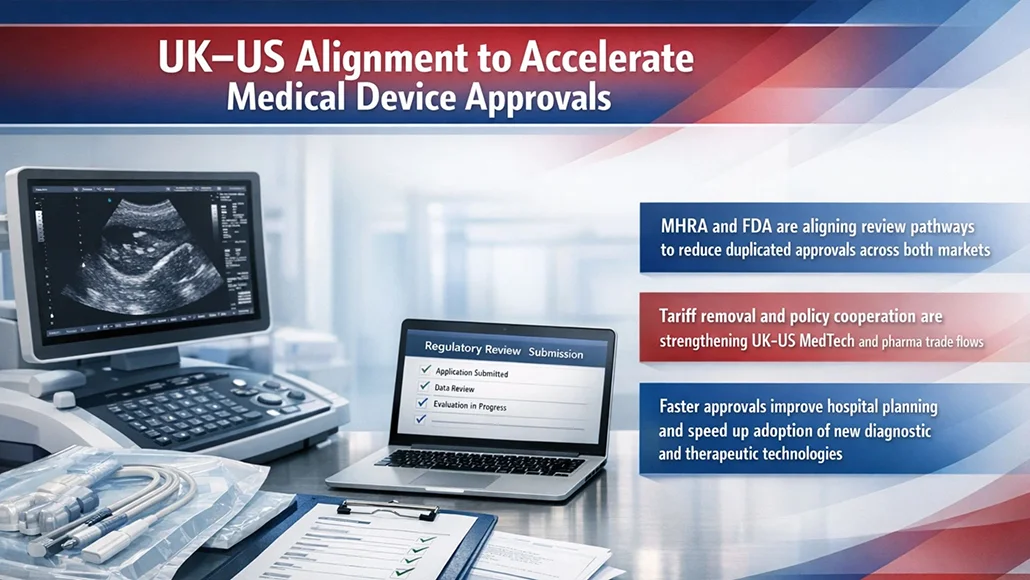

The UK and US have advanced cooperation on medical device approvals, with the Medicines and Healthcare products Regulatory Agency (MHRA) and the US Food and Drug Administration (FDA) strengthening regulatory alignment to accelerate access to healthcare technologies. The initiative builds on a broader US-UK pharmaceutical agreement that removes tariffs on UK medicine exports while encouraging earlier adoption of innovative treatments across healthcare systems.
Alignment Efforts to Streamline Regulatory Pathways
The collaboration focuses on improving and aligning regulatory frameworks governing medical device approvals, with both agencies exploring mutual recognition mechanisms. These mechanisms are intended to allow partial acceptance of each other’s approval processes, reducing duplication and creating more efficient pathways for manufacturers operating across both markets.
Technical discussions are underway to identify areas where regulatory convergence can be implemented without compromising safety, quality, or effectiveness standards. While alignment will increase, both regulators will retain independent authority over final approvals.
According to Lawrence Tallon, the initiative will support faster and more efficient access to advanced medical technologies, reinforcing regulatory efficiency within both healthcare ecosystems.
Policy and Trade Integration
The regulatory developments are closely tied to wider policy changes under the US-UK partnership. The US has lifted tariffs on pharmaceuticals and medical technologies imported from the UK for at least three years, reducing trade barriers and strengthening cross-border supply chains.
In parallel, the UK has outlined plans to increase pharmaceutical spending to 0.6% of GDP by 2035, signalling long-term investment in healthcare innovation. The UK’s pharmaceutical sector, which contributes £28.5 billion annually and exports nearly £21 billion in drug products, underpins this strategic direction.
Operational Impact on Healthcare Systems
From a healthcare management perspective, accelerated medical device approvals are expected to influence system-level operations:
- Shorter timelines for adoption of new diagnostic and therapeutic technologies
- Reduced regulatory complexity for cross-border technology deployment
- Greater predictability in procurement and capital planning
- Enhanced access to innovative MedTech solutions
The UK’s MedTech sector, employing over 195,000 people, stands to benefit from improved regulatory clarity and faster routes to market. Lord Vallance noted that the partnership strengthens regulatory leadership while supporting innovation uptake.
Strategic Implications for Market Access
Industry bodies including the Association of British HealthTech Industries and techUK have highlighted that regulatory alignment will provide more predictable pathways for innovators, particularly small and medium-sized enterprises.
As observed by HHM Global, the initiative reflects a broader shift toward globally connected regulatory systems, where harmonisation reduces friction in bringing new technologies to market while maintaining high safety standards.
Outlook
Ongoing technical work between the MHRA and FDA will determine the scope of future alignment and mutual recognition frameworks. Any resulting agreements will remain subject to stringent regulatory requirements, ensuring that safety and performance benchmarks are upheld.
The advancement of medical device approvals alignment marks a significant step toward more integrated healthcare systems, with implications for regulatory efficiency, procurement strategies, and innovation adoption.