











The concept of a medical team is currently being expanded beyond the traditional scope of physicians, nurses, and technicians to include a new class of collaborative mechanical partners. In modern medical facilities, the integration of human robot synergy healthcare teams is becoming a defining feature of high-efficiency clinical practice. This shift is not about replacing human professionals but about creating a new model of care where the unique strengths of both humans and machines are leveraged to achieve superior patient outcomes. While humans provide the empathy, intuition, and complex decision-making skills that are essential to medicine, robots bring a level of tireless precision, data processing, and physical endurance that human workers cannot match. By fostering a deep sense of collaboration between these two groups, hospitals are finding new ways to address the chronic challenges of staff burnout and the increasing complexity of patient care.
The Rise of Collaborative Robots in Healthcare: Cobots Hospitals
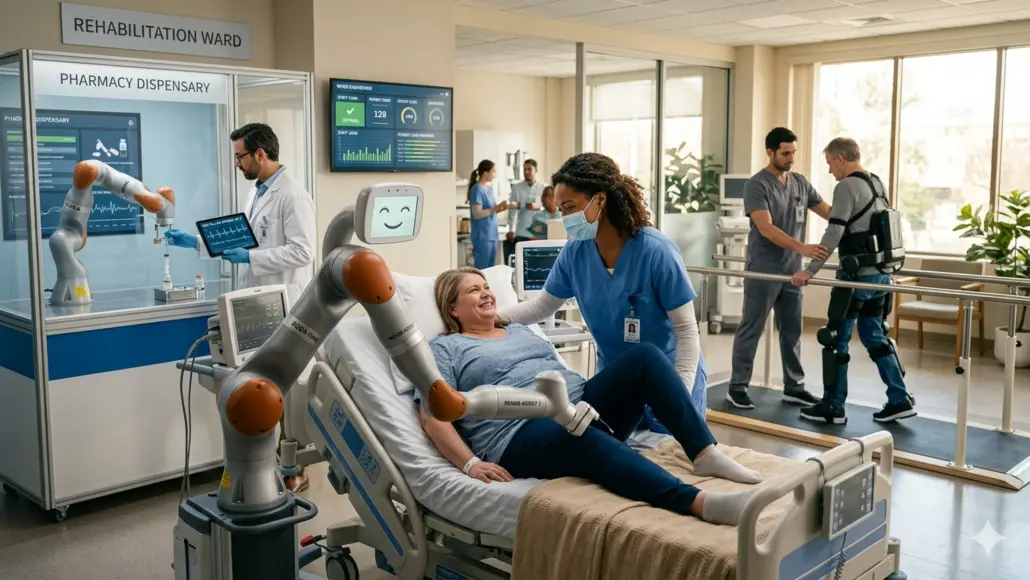
The most significant development in this field is the emergence of “cobots” short for collaborative robots which are designed to work in close proximity to humans without the need for safety cages or physical barriers. In the context of cobots hospitals, these machines are increasingly being used to assist with physically demanding or repetitive tasks that often lead to workplace injuries among nursing staff. For example, a cobot might assist a nurse in repositioning a bariatric patient or help a physical therapist support a stroke survivor during their first steps in rehabilitation. This form of human robot collaboration healthcare is essential for maintaining the physical health and longevity of the healthcare workforce. By taking on the “heavy lifting,” both literally and figuratively, cobots allow human clinicians to focus their energy on the more nuanced aspects of patient interaction and clinical judgment.
Beyond physical assistance, cobots are also being used in sterile environments such as pharmacies and laboratories. These robots can handle high-precision tasks like filling syringes or preparing cultures with a level of consistency that is difficult for human technicians to maintain over an eight-hour shift. In these settings, the cobot acts as a “third hand” for the human operator, performing the repetitive and micro-scale movements while the human focuses on the overarching quality and interpretation of the results. This hybrid approach to healthcare workforce automation ensures that the most critical steps in the clinical process are both accurate and efficient, while still benefiting from the oversight and expertise of a trained professional. The ability of cobots to “learn” from their human partners through demonstration is also a key feature, allowing for rapid deployment and customization in a wide range of hospital departments.
Enhancing Hospital Efficiency Through Robotic Assistance Healthcare
The impact of human robot synergy healthcare teams is also felt in the overall hospital efficiency. Robotic assistance healthcare systems are being deployed to manage the vast quantities of data and materials that flow through a medical facility every day. When a robot is tasked with the autonomous delivery of laboratory samples or the restocking of surgical supplies, it is performing a function that would otherwise take a human staff member away from their primary clinical duties. This redistribution of labor ensures that the highest level of expertise is always directed toward the most critical tasks. Furthermore, the integration of healthcare workforce automation allows for a more consistent and reliable delivery of services. A robot does not experience fatigue or distraction, ensuring that every task is performed with the same level of precision and attention to detail, whether it is the first or the last hour of a shift.
This increased efficiency also extends to the “administrative overhead” of clinical care. Intelligent robotic assistants can assist with real-time documentation, capturing patient data and updating electronic health records through voice recognition and computer vision. This reduces the amount of time that clinicians spend at a computer terminal, a major source of frustration and inefficiency in modern medicine. By providing a seamless and unobtrusive way to manage information, robotic systems allow the healthcare team to remain focused on the patient, improving the quality of the clinical encounter and the overall satisfaction of both the staff and the patient. The ability of these systems to provide “just-in-time” information—such as medication dosage alerts or clinical guidelines directly at the point of care is another significant advantage of human robot collaboration healthcare.
Addressing Staff Burnout with Human Robot Collaboration Healthcare
One of the most pressing issues in modern medicine is the high rate of burnout among healthcare professionals, driven by long hours, high stress, and an overwhelming administrative burden. The introduction of human robot synergy healthcare teams offers a promising solution to this crisis. By automating the more mundane and repetitive aspects of the job such as documentation, inventory management, and basic patient monitoring hospitals can significantly reduce the cognitive load on their staff. This allows nurses and physicians to spend more time engaged in direct patient care, which is the primary source of professional satisfaction for most healthcare workers. The goal of robotic assistance healthcare is to “humanize” the profession by removing the mechanical and clerical barriers that often stand between the clinician and the patient.
Moreover, the physical support provided by robotic systems can significantly reduce the rate of musculoskeletal injuries among nurses and other support staff. Moving and lifting patients is one of the most hazardous aspects of the job, often leading to chronic pain and long-term disability. By using robotic lifts and exoskeletons, hospitals can protect their most valuable assets their people and ensure that they can continue to provide care throughout their careers. This focus on the well-being of the workforce is not just a moral imperative but also an economic one, as the cost of staff turnover and injury-related absences is a major expense for healthcare providers. A healthy and supported workforce is a prerequisite for a high-quality and sustainable healthcare system.
Training for a New Era of Synergy in Medical Care
The transition to a workforce that includes both humans and robots requires a fundamental change in medical education and professional development. Healthcare workers must be trained not only to use these new tools but to understand the principles of human robot synergy healthcare teams. This involves learning how to delegate tasks to robotic partners, how to interpret the data they provide, and how to troubleshoot minor technical issues in real-time. This new curriculum must also address the psychological and ethical aspects of working with autonomous systems. For many patients and staff, the presence of robots in a clinical setting can be unsettling, requiring a focus on communication and empathy to ensure that the technology is accepted and integrated effectively.
Beyond technical skills, the training must also emphasize the importance of teamwork and interdisciplinary collaboration. In a hybrid healthcare environment, the “team” now includes robotic agents, and everyone must understand their respective roles and responsibilities. This requires a cultural shift in healthcare education, moving away from a siloed approach toward a more integrated and holistic model. By fostering a culture of openness and collaboration, hospitals can ensure that the transition to a hybrid workforce is smooth and successful for everyone involved. The ability to work effectively with robotic partners will likely become a core competency for all future healthcare professionals, just as the ability to use a computer or a stethoscope is today.
Overcoming Barriers to Integration in Healthcare Teams
Despite the clear benefits of human robot synergy healthcare teams, the path to full integration is not without its challenges. There are significant technical and logistical hurdles to overcome, including the need for seamless communication between robotic systems and existing hospital software. There is also the issue of cost; while collaborative robots are generally more affordable than large-scale surgical systems, the investment required to deploy them across an entire facility is still substantial. Furthermore, there are important regulatory and legal questions to address regarding the responsibility for robotic actions and the protection of patient privacy in an increasingly automated environment. To overcome these barriers, healthcare leaders must work closely with technology developers, policymakers, and ethical experts to create a framework that supports the safe and effective use of robotics in clinical teams.
The question of “trust” between humans and robots is also a major barrier. For a clinician to rely on a robotic partner, they must have confidence in its safety and reliability. This requires rigorous testing and validation of robotic systems in real-world clinical environments, as well as clear and transparent communication regarding their performance. Building this trust is a slow and deliberate process that involves continuous feedback and improvement. As robotic systems become more capable and their benefits become more evident, the initial skepticism will likely give way to a more collaborative and positive relationship. The goal is to create a partnership where the human and the robot are working toward the same goal: providing the best possible care for the patient.
The Role of Leadership in Fostering a Collaborative Culture
The success of human robot synergy healthcare teams ultimately depends on the vision and commitment of hospital leadership. Administrators must be willing to invest not just in the technology itself but in the cultural change required to make it work. This includes involving clinical staff in the selection and implementation process, ensuring that the technology is designed to meet their specific needs and solve their real-world problems. It also requires a focus on transparency and communication, ensuring that everyone in the organization understands the goals of automation and the benefits it will bring to both staff and patients. By creating an environment where human robot collaboration healthcare is seen as a strategic advantage rather than a threat, leaders can unlock the full potential of their workforce.
Leaders must also prioritize the ongoing education and support of their staff. As the technology evolves, the healthcare team must also evolve, requiring a commitment to lifelong learning and professional development. This may involve the creation of new roles within the organization, such as “Robotic Integration Specialists,” who are responsible for the daily management and optimization of the facility’s robotic agents. By providing the resources and the infrastructure for a technology-enhanced workforce, leadership can ensure that their organization remains at the forefront of clinical excellence and patient-centered care. The transition to a hybrid healthcare model is as much a leadership challenge as it is a technical one, and it requires a proactive and visionary approach.
The Future of the Hybrid Healthcare Workforce
Looking toward the horizon, the role of human robot synergy healthcare teams will only continue to grow. We are likely to see the development of even more sophisticated robots that can assist with complex diagnostic tasks, provide social support to lonely or anxious patients, and even perform minor medical procedures under human supervision. The hospital of the future will be a place where the boundaries between human and machine are increasingly blurred, and where the focus is on the seamless integration of technology and compassion. By embracing the power of synergy, we are not just improving the efficiency of our hospitals; we are creating a more resilient, compassionate, and effective healthcare system that is better equipped to meet the challenges of the twenty-first century.
In the long term, the hybrid healthcare workforce will likely become the global standard, with robotic agents providing a reliable and scalable foundation for care in both developed and developing nations. This will allow for a more equitable distribution of healthcare resources, ensuring that everyone, regardless of their location, has access to the highest quality of clinical care. The synergy between the human heart and the robotic mind is the most powerful tool we have for improving the health and well-being of the world’s population. By continuing to innovate and collaborate, we are building a future where the promise of technology is fully realized in the service of humanity. The journey toward this fully integrated and highly effective healthcare workforce is one of the most exciting and important developments in the history of medicine.