















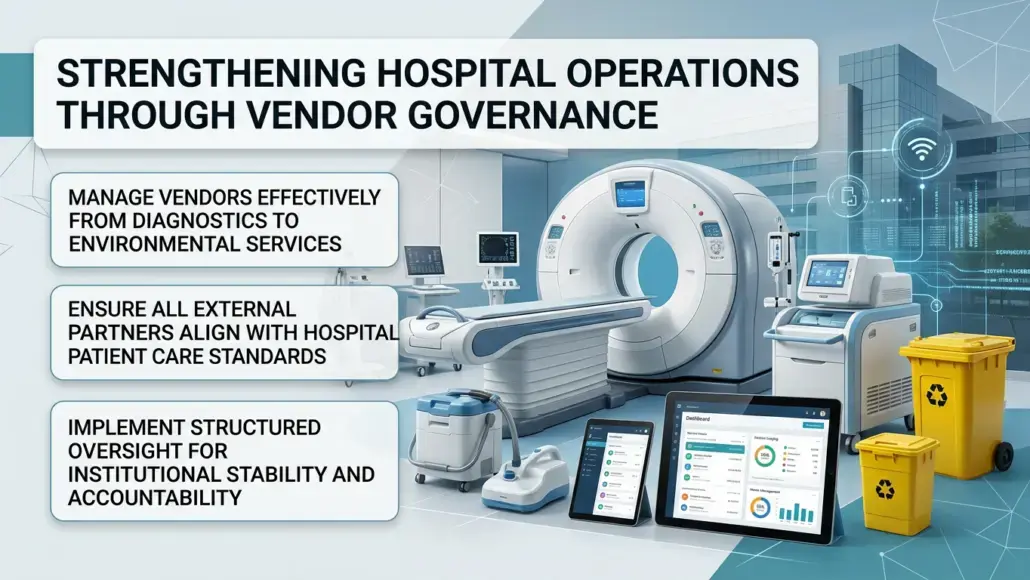

The modernization of hospital operations necessitates a sophisticated approach to managing external service providers who contribute to patient care delivery. As healthcare facilities increase their reliance on specialized vendors for functions ranging from diagnostic imaging to environmental services, the implementation of structured vendor governance becomes a critical component of institutional stability. This framework provides the necessary oversight to ensure that every partner aligns with the hospital’s core mission of safety and efficiency. Without a centralized governance model, hospitals often face fragmented service delivery, where individual departments manage vendors in isolation, leading to inconsistent quality standards and increased operational risk. By establishing a dedicated governance committee, hospital leadership can standardize the selection and monitoring processes, creating a unified expectation of performance across the entire facility.
A successful governance strategy begins with the clear definition of roles and responsibilities between the hospital and the service provider. This clarity is essential for maintaining accountability, particularly when clinical outcomes are at stake. When a vendor provides critical medical equipment maintenance, for instance, the hospital must have a verified mechanism to audit the quality of that work. Effective vendor governance ensures that these audits are not merely periodic formalities but are integrated into the daily operational workflow. This proactive stance allows administrators to identify potential service gaps before they impact patient safety. Furthermore, a well-defined governance structure facilitates better communication, enabling hospital staff to report issues through established channels that guarantee timely resolution and documented follow-up.
In addition to operational oversight, the governance framework serves as the foundation for financial and strategic alignment. Hospitals must ensure that their external partners are not only meeting technical requirements but are also contributing to the long-term sustainability of the organization. Through regular executive reviews, vendor governance allows for the assessment of value beyond simple cost savings. It encourages partners to invest in innovations that improve hospital workflows, such as automated supply chain solutions or advanced patient monitoring technologies. By treating vendors as strategic extensions of the hospital rather than mere commodity providers, administrators can foster a culture of mutual accountability that benefits the patient population and the institution’s bottom line.
Aligning Clinical Requirements with Operational Execution
The integration of outsourced services into the clinical environment requires a precise alignment between the hospital’s medical standards and the vendor’s operational capabilities. Clinical departments rely on external partners to provide essential support that directly influences the patient experience. For example, laboratory services or pharmaceutical supply chains must operate with zero-tolerance for error. To achieve this, the hospital management team focuses on service-level agreements to ensure that all clinical partners meet the required patient safety benchmarks. This alignment is facilitated by vendor governance, which acts as the bridge between high-level hospital policy and the granular details of daily service execution. It ensures that every outsourced task, no matter how small, is performed with the clinical context in mind.
Operational execution must be measured against specific, data-driven indicators that reflect the unique needs of a healthcare setting. Unlike generic commercial environments, hospitals require vendors to adhere to strict infection control protocols and patient privacy regulations. A vendor governance program mandates that these requirements are documented and verified through regular on-site inspections and performance reports. This level of detail is necessary to maintain the integrity of the hospital’s accreditation and to protect the institution from legal liabilities. By embedding clinical experts into the governance process, hospitals can ensure that technical service specifications actually translate into better bedside care. This collaborative approach prevents the “silo effect” where procurement decisions are made without considering the practical impact on nursing or surgical staff.
Furthermore, the governance of these relationships allows for the flexible adjustment of services as the hospital’s needs evolve. Healthcare demands are inherently variable, influenced by seasonal health trends, emergency surges, or technological advancements. A robust vendor governance model provides the agility needed to scale services up or down without compromising quality or accountability. It establishes a framework for continuous dialogue, where vendors are kept informed of the hospital’s changing priorities. This transparency allows providers to anticipate needs, such as increasing staffing during peak flu seasons or upgrading software to comply with new electronic health record standards. Ultimately, this alignment ensures that the vendor remains a reliable partner in the hospital’s effort to provide high-quality care.
Mitigating Compliance Liabilities Through Systematic Oversight
Compliance within the healthcare sector is a multifaceted challenge that involves federal regulations, state laws, and private accreditation standards. When a hospital outsources a service, it does not outsource its legal or ethical responsibility for that service. Therefore, systematic vendor governance is indispensable for mitigating the risks associated with third-party performance. This oversight involves a rigorous process of documentation and verification that proves the hospital is maintaining control over its external environment. Failure to oversee vendors adequately can lead to significant penalties, loss of funding, or damage to the hospital’s reputation.
The systematic oversight process includes several critical components that protect the institution:
- Regular auditing of vendor staff credentials to ensure all personnel have the required certifications for working in a clinical setting.
- Verification of compliance with data protection laws, such as HIPAA, particularly for vendors handling patient information or financial records.
- Documented evidence of vendor adherence to hospital-specific safety training, including fire safety, hazardous material handling, and emergency response.
- Periodic reviews of the vendor’s financial health to prevent service disruptions caused by the provider’s economic instability.
- Strict monitoring of conflict-of-interest disclosures to maintain the integrity of the hospital’s procurement and operational decisions.
These measures ensure that the hospital maintains a high level of accountability, even when services are performed by non-employees. The governance team acts as the final gatekeeper, ensuring that every vendor meets the same rigorous standards applied to internal departments. This is particularly important in areas like medical billing or telehealth, where the risk of data breaches or fraudulent activity is high. By maintaining a centralized database of vendor compliance records, the hospital can provide immediate evidence of oversight during regulatory inspections. This systematic approach not only protects the hospital but also provides the vendor with clear guidelines for maintaining their own compliance standing within the healthcare industry.
Driving Continuous Improvement in Outsourced Healthcare Functions
The ultimate goal of vendor governance is to move beyond mere compliance and achieve a state of continuous improvement. In the rapidly changing healthcare sector, staying stagnant is equivalent to falling behind. Hospitals must challenge their vendors to find more efficient, safer, and more cost-effective ways to deliver services. A governance model that includes regular performance feedback loops encourages vendors to innovate. When providers know that their performance is being tracked and analyzed against industry peers, they are more likely to proactively suggest improvements. This creates a competitive but collaborative environment where the hospital benefits from the latest best practices in the field.
Continuous improvement is driven by the analysis of long-term performance trends. By aggregating data from various departments, the vendor governance team can identify recurring issues that might indicate a systemic problem with a provider’s approach. Conversely, it can also highlight areas of excellence that can be replicated in other parts of the hospital. For instance, if a particular food service vendor has successfully reduced patient wait times through a new digital ordering system, the governance team can investigate how similar technology might be applied to laboratory logistics. This cross-pollination of ideas is only possible when there is a centralized authority overseeing all vendor relationships and identifying opportunities for synergy.

Finally, the commitment to improvement fosters a sense of partnership that is vital for long-term success. Vendors who feel that they are part of the hospital’s success are more willing to go above and beyond during times of crisis. During the global health challenges of recent years, hospitals with strong vendor governance were able to coordinate more effectively with their suppliers to maintain essential stocks and services. This level of trust and coordination is built over time through transparent governance and a shared commitment to excellence. As hospitals continue to evolve, the ability to manage external partners with precision and foresight will remain a defining characteristic of high-performing healthcare organizations. The governance of these third-party relationships ensures that every dollar spent on outsourcing translates into a safer, more efficient, and more accountable service for every patient who walks through the hospital doors.