









Close
Digital Health & Ai Innovation summit 2026
Medical Taiwan 2026

Medovate partners with Medipex to support development of Yorkshire NHS-created medical device innovations

Medovate partners with Medipex to support development of Yorkshire NHS-created medical device innovations

Medovate – a dynamic medical device development company– have partnered with Medipex Healthcare Innovation Hub to support the development of promising new medical device innovations arising from within the NHS.

Medipex – an award-winning healthcare innovation hub which connects the NHS with industry and academia – currently has active engagement with 19 NHS Trusts within the Yorkshire & Humber and East Midlands regions. The company works closely with NHS inventors and innovative clinical groups to develop healthcare innovations that deliver better patient care, improved services and generate cost savings.

Through their new partnership, Medovate and Medipex will provide the foundation and structure for a joint working relationship to support new NHS-created medical device innovations through the full development cycle.

Robert Donald, New Business Manager at Medovate, commented: “We are delighted to be starting this new partnership with Medipex to support the development of inspiring new medical device innovations that can deliver improved patient care. We look forward to building a close relationship with the team as we work towards our joint vision of bringing to life unique innovations from within the NHS.”

Established in 2004, Medipex have a long and successful track history which includes the creation of medical device companies Zilico Ltd (founded through a successful collaboration between the University of Sheffield and Sheffield Teaching Hospitals NHS Foundation Trust), who have developed a revolutionary cancer diagnostics technology; and Organ Preservation Solutions Ltd, who are bringing to market next generation products in the field of organ transplantation (founded through Leeds Teaching Hospitals NHS Trust and the University of Leeds).

Dr Lindsay Georgopoulos, CEO of Medipex, added: “Being at the forefront of NHS innovation, we are excited to enter a new partnership with Medovate, who have extensive experience in successfully bringing to global markets pioneering medical devices that can positively impact healthcare and the economy. Through this agreement Medipex is providing a new route to market for promising new innovations created within our NHS member Trusts. We look forward to building a long, successful partnership and working together to help advance innovations in patient care.”

Medovate is a dedicated commercialisation vehicle for the NHS, working closely with clinical professionals to develop innovative new medical technologies. Working with Medipex will give the company the platform to review and evaluate early concept ideas that are submitted to Medipex by entrepreneurial clinicians. It will also enable them to engage with a wider clinical audience for the development of ground-breaking new medical technologies.

Over the coming years Medovate and Medipex will be working together to foster new technologies sourced by Medipex through their NHS partnerships that can transform patient care, with Medovate working to raise their profile and bring them to a worldwide market.

Medovate were headline sponsor of the recent Medipex NHS Innovation Awards and Showcase – which celebrated innovative activities of NHS staff and their collaborators – where they also formed part of the judging panel alongside Medipex and the Yorkshire and Humber Academic Health Science Network (YHAHSN). Medovate will also be sponsoring a new ‘Innovation Voucher’ competition which will be open to NHS employees working in the Yorkshire, Humber and East Midlands regions, including Medipex member NHS Trusts.

Virgin Pulse to Acquire Welltok to Advance Health Activation Capabilities

Virgin Pulse to Acquire Welltok to Advance Health Activation Capabilities

Virgin Pulse, a leading global provider of tech-enabled wellbeing solutions,  announced its intent to acquire Denver-based consumer activation company, Welltok, a leader in data analytics-based targeting and multi-channel outreach solutions. In addition to providing Virgin Pulse clients with comprehensive data, analytics and multi-channel communications capabilities, this transaction will accelerate the company’s ability to serve substantially more clients, consumers, patients and members across the full healthcare continuum – employer, health plans (commercial, Medicare Advantage, Managed Medicaid), pharmacies/pharmacy benefits managers (PBMs) and health systems. Welltok brings a broad portfolio of clients and capabilities and complements Virgin Pulse’s digital-first platform with the industry’s most comprehensive database and additional communication channels including text/SMS, mail, social and interactive voice response. With this transaction, Virgin Pulse is supercharging its ability to drive tangible outcomes and bend the healthcare cost curve by motivating consumers to initiate and complete meaningful actions that improve their health.

“The addition of Welltok will allow us to deliver new and expanded data, analytics and multi-channel communications capabilities to our current clients while accelerating our ability to deliver a scalable end-to-end health activation and engagement platform that addresses the unique needs of the healthcare industry,” said Chris Michalak, CEO of Virgin Pulse. “Combining Welltok’s ability to identify and motivate consumers to initiate and complete specific health actions, with Virgin Pulse’s ability to engage users in managing and making the best possible decisions about their health and wellbeing every day, will provide clients, consumers, patients and members a clear path to achieving health outcomes and demonstrable cost savings.”

Welltok’s proven health activation blueprint combines clinical and lifestyle data with predictive analytics and multi-channel outreach to connect users with personalized, high-value actions that improve their health and wellbeing. The company currently works with the nation’s top Medicare, Medicaid and commercial plans to deliver meaningful member experiences that create loyalty, close gaps in care, improve medication adherence, deliver critical communications and connect members with appropriate resources. More than 100 health systems and hospitals are also using Welltok’s SmartReach™ to run patient engagement and acquisition campaigns, while also delivering COVID-19 critical communications.

“We are excited to combine forces with Virgin Pulse and look forward to bringing our teams, talents and technology together to deliver the most comprehensive digital health platform to our collective customers,” said Bob Fabbio, Welltok’s CEO. “Together, we have the potential to create modern, scalable healthcare engagement and activation solutions that will greatly increase the value our clients realize by driving meaningful change and outcomes, faster.”

The merger is expected to close later this month, subject to completion of all necessary regulatory approvals and satisfaction of all closing conditions under the definitive agreement. Financial details of the transaction have not been disclosed. Virgin Pulse is backed by Marlin Equity Partners, a global investment firm with over $7.7 billion in capital commitments under management. Evercore acted as financial advisor and Kirkland & Ellis LLP served as legal advisor to Virgin Pulse. UBS Securities LLC acted as financial advisor and Shearman & Sterling LLP served as legal advisor to Welltok.

About Virgin Pulse
Virgin Pulse is a global leader and premier provider of tech-enabled health and wellbeing solutions focused on driving health outcomes and reducing healthcare costs for its clients and members through its Homebase for Health® strategy. Homebase for Health is a personalized ecosystem where Virgin Pulse clients and members can access, navigate and interact with their health, wellbeing and benefits – all in one, trusted and familiar place. Fusing high-tech, high-touch, predictive analytics, AI and data, Homebase for Health aims to simplify and unify health and wellbeing for clients, consumers, patients and members across the entire care continuum —from prevention and wellbeing to pre-chronic and chronic disease management to episodic and acute care. Today, more than 14 million users in more than 190 countries rely on Virgin Pulse’s digital and live solutions to change their lives—and businesses—for good.

About Welltok

Welltok drives consumer actions that matter. Welltok can predict with up to 90% accuracy people’s needs and their likelihood to take action, and engage them with integrated multi-channel outreach to maximize results. By delivering personalized content and resources, Welltok ensures more individuals take critical actions such as scheduling an annual check-up, selecting insurance coverage or refilling medications. As an award-winning consumer activation company, healthcare organizations and others trust Welltok to connect with their populations in meaningful ways.

About Marlin Equity Partners
Marlin Equity Partners is a global investment firm with over $7.7 billion of capital under management. The firm is focused on providing corporate parents, shareholders and other stakeholders with tailored solutions that meet their business and liquidity needs. Marlin invests in businesses across multiple industries where its capital base, industry relationships and extensive network of operational resources significantly strengthen a company’s outlook and enhance value. Since its inception, Marlin, through its group of funds and related companies, has successfully completed over 190 acquisitions. The firm is headquartered in Los Angeles, California with an additional office in London.

Altus Inc expands leadership team

Altus Inc expands leadership team

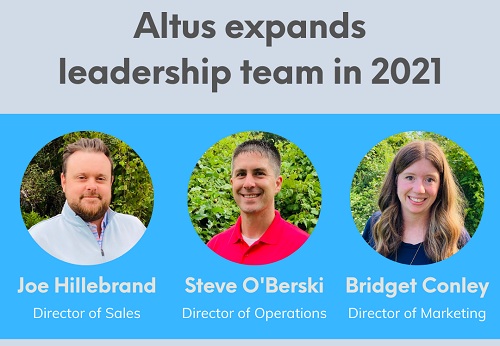
Altus Industries Inc, a west Michigan designer, manufacturer, assembler and marketer of medical, point-of-care workstations used across the healthcare industry, has expanded their leadership team in 2021. Joe Hillebrand was appointed to the Director of Sales role, while Steve O’Berski and Bridget Conley were recently hired as the Director of Operations and Director of Marketing respectively.

“In order to meet and then exceed our growth and innovation targets, it became clear that Altus needed the right people in the right seats when it came to our leadership team,” said Craig VanderHeide, Chief Executive Officer at Altus. “We have already seen effective collaboration and meaningful results since promoting Joe and bringing on Steve and Bridget. I look forward to everything our team will accomplish going forward.”

Joining the company in 2018, Joe Hillebrand began as an outside medical equipment sales representative and then joined full-time in early 2020 as National Sales Director. Hillebrand is filling co-founder Eric Kahkonen’s former position as the Director of Sales for Altus. In his role, Hillebrand leads all sales operations, champions product development initiatives, and ensures a ‘customer first’ approach to service. Hillebrand’s strategic and leadership experience includes several years as a senior trader and a quantitative trader in Chicago, IL. Hillebrand holds a BA in Political Science from the University of Vermont.

Steve O’Berski, the Director of Operations for Altus, is leading end-to-end order fulfillment, supply chain management, quality system governance, and customer satisfaction. His role also includes driving continuous improvement throughout the business and promoting an engaging company culture. O’Berski comes to Altus with extensive experience in operations, supply chain management, and leadership while working for both John Deere and Stryker Corporation.

O’Berski holds a BA in Business Management from Calvin University. As Director of Marketing, Bridget Conley leads the development and execution of the company’s overall marketing strategy. Most recently, Conley was an account manager for a digital marketing agency serving healthcare and manufacturing industries. Before her agency experience, Conley was the marketing manager for a manufacturing and IoT company. Conley holds a BBA in Marketing from Grand Valley State University and an MA in Strategic Communication from Michigan State University.

ABOUT ALTUS, INC.

Altus, Inc. builds durable, ergonomic, and stylish technology workstation solutions to improve the lives of healthcare workers. Since 2001, Altus has studied how real people work to enhance their workflow. Altus technology workstations offer optimized mobility, adjustability, access to patient data, and improved clinician well-being. Altus is based in Walker, Mich. and is one of the only U.S.-based technology workstation companies, with more than 80 percent of its product components manufactured in the United States.

Interview on Renal Denervation (RDN) Therapy and it’s Effects

Interview on Renal Denervation (RDN) Therapy and it's Effects
  1. Describe the inroads created through various forms of clinical trials that have been conducted in the renal denervation (RDN) therapy landscape?

The first-generation studies on RDN were proof-of-concept studies applying radiofrequency energy, high focused ultrasound energy and perivascular injection of alcohol that found substantial decreases in 24-h ambulatory and office BP in patients with treatment resistant hypertension. Subsequently, several randomized, but open-label studies reported a significant reduction (albeit not in all studies) of ambulatory and office BP in the RDN group compared with a control group on antihypertensive medication. However, the drawbacks of this particular study led investigators to improve criteria for including study patients, the run-in phase, and/or analysis of medication adherence. In all recent sham-RCTs (SPYRAL HTN-ON and -OFF trials, RADIANCE HTN-TRIO there were clinically favorable effects of RDN for treatment of uncontrolled hypertension. The great advantage is that the intervention has shown meaningful BP decrease across multiple phenotypes of patients with mild to moderate as well as more severe hypertension in the presence and absence of medication.

Moreover, studies of RDN on diverse clinical settings of heightened sympathetic drive (like in heart failure, atrial fibriallation, metabolic syndrome) have shown promising results and further research efforts are underway.

  1. What are the prime requirements a patient’s body must possess before going ahead with renal denervation (RDN) therapy?

The patient should not have undergone prior RDN treatment and the renal artery anatomy should be eligible for treatment.  This means that there should be at least one renal arterial vessel for each kidney greater than 3 mm and less than 8mm in diameter (including accessory, branch, and main renal arteries), there are no renal artery which contains renal artery stenosis (>50%), renal artery aneurysm, fibromuscular dysplasia, presence of a renal artery stent or calcification. Morever, patients with one kidney and severe renal dysfunction can not currently undergo RDN.

  1. What is the amount of time taken to see visible effects after undergoing renal denervation (RDN) therapy and describe the longevity of the treatment’s effect?

The majority of studies use the time point of 2, 3 or 6 months for the first estimation of BP reduction (both office and ambulatory). However, there are several  patients who have a pronounced BP change right after the RDN.

  1. Describe the long-term effects of renal denervation (RDN) on the Human body? Is there a possibility of a relapse of resistant hypertension as time passes by?

All available evidence from both RCTs as well as registries of RDN support consistently the safety of the procedure short and long term. In the two pivotal trials, no major device-related or peri-procedural related safety events were observed in the SPYRAL HTN-OFF MED pivotal trial and one periprocedural adverse event (access site pseudoaneurysm successfully treated) was adjudicated in the RADIANCE-HTN TRIO trial. Future design of radial artery access systems for RDN has the potential to further diminish any vascular access site complications. Concerning the long-term safety analyses from sham-RCTs and from the Global Symplicity Registry up to 3 years there are no safety issues.

The possibility of relapse of hypertension after RDN is not evident from current data in humans.

  1. Can you elaborate on the innovations taking place in renal denervation (RDN) technology? Also, globally, which are the regions that have adopted the therapy on full scale as of date?

The main innovations concern further research on each type of energy (radiofrequency, ultrasound), of chemical ablation (i.e. alcohol), as well as the design of the catheters and the methodology for the RDN.

There is no region that RDN is adopted at full scale. However, there are globally numerous dedicated hypertension excellence centers and related catheterization laboratories that perform efficaciously and safe RDN procedures mainly in the context of clinical trials. The experience is growing along with the number of patients with improvement of BP control via the RDN procedure.

  1. Invasive renal denervation (RDN) technologies have stamped their presence, however, there is still skepticism amongst health providers due to their inconsistent results. What are your views on it?

There is always skepticism on anything innovative in medicine and this is partly justified. Moreover, the initial inconsistency of the results of the first generation RDN trials has reduced the enthusiasm for the technology. However, given the results of all recent modern RCT’s on the favorable reduction of BP in hypertensive patients with and without drug therapy after RDN, health providers can study the data and conclude that RDN represents an evidence based option to treat hypertension, in addition to lifestyle changes and blood pressure lowering drugs. In other words,  RDN expands therapeutic options to address the key objective of hypertension treatment, that is to effectively achieve BP targets (that still remains an unresolved issue due to that almost half of hypertensive patients remain uncontrolled despite lifestyle amelioration and available drug treatment).

  1. Once treated with renal denervation (RDN), does the patient have to undergo this therapy again; If yes then what would be the timeline for it?

There is no available evidence to propose a second RDN procedure in any patient. Based on GSR the durability of BP lowering effect last atleast three years.

  1. What role does data have to play in the success of renal denervation (RDN) and how is the analysis done considering that this is an alternative treatment?

RDN constitutes an additive and alternative option therapy of uncontrolled hypertension and clearly not a competitive one to structured drug therapy and lifestyle intervention. Accumulation of data will help the medical community to address gaps in knowledge for RDN. Firstly, there is an urgent need to define predictors of BP response to the procedure and there are efforts focusing on diverse parameters both clinical and laboratory. There are data showing that in untreated patients with higher baseline heart rate and plasma renin aldosterone levels RDN are associated with better BP reduction. Moreover, the average and standard deviation of night-time ambulatory BP has been identified as a potential robust predictor, which requires further research. The cost-effectiveness of the procedure for the health systems is an additional point to be studied.

Useful Tips On How To Properly Take Care Of Your Senior Loved Ones

Useful Tips On How To Properly Take Care Of Your Senior Loved Ones

As time goes by, most elderly individuals experience different physical and mental conditions that limit them from performing the tasks they used to in their prime. Whether it is a sudden accident or a long-term disease, your elderly parents or grandparents may have lost some of their abilities and you might have to bear the responsibility of ensuring that they are well provided for.

Of course, nobody wants to go through this at all costs but when there is no other choice, one would put up with it even if it means going through sleepless nights just making sure that someone who matters a lot in your life is being taken care of.

Fortunately, there are many solutions available today on how you can help your senior loved ones to live a better life. Here are some tips.

Make Sure They Are Safe At Home

One of the most challenging parts about caring for the elderly is that they may not be as mobile as you like them to be. They might even lose their ability to walk and it can pose a serious risk especially if your senior loved ones live in a high-rise building or somewhere with lots of stairs, which is not rare when living in Birmingham. If your elderly loved one has mobility issues and lives at least two floors above ground getting them a stairlift could provide great help. When looking for the best straight stairlifts in Birmingham it is best to go for a reliable company that provides quality equipment. Additionally, ensure it is properly installed by professionals that also offer after-sales service.

Other safety issues you must consider include the use of grab rails and handrails to avoid falls. You may also want to consider installing a shower seat, or bath bench which would allow your loved ones to take care of their sanitation.

Ensure They Take Their Medication Regularly

One of the tasks most elderly people with health problems find difficult to accomplish is taking their medication regularly which can pose a threat to their health especially when they mix it up or forget to take several doses in a day. If your loved one has been diagnosed with a medical condition that requires them to take pills regularly, an automated pill dispenser may be the solution. This device can be programmed to open each compartment at certain hours of the day with each pill making sure your loved ones are properly taken care of even if you are not around.

Make Sure They Are Eating Healthy Food

Eating healthy is not just limited to the young but to all ages as well, which means that if your senior loved ones don’t eat healthily you could end up having trouble because of it later. When elderly people have a poor diet they usually have a weak immune system and they easily get sick. To avoid this from happening, you can always include their favorite dishes on your weekly menu and check their teeth for possible signs of cavities or other problems that may be caused by unhealthy eating habits.

If your senior loved ones live alone, try preparing their meals beforehand so you know for sure what they ate during the day and if necessary, remind them about the importance of eating healthy.

Have Them Do Some Sort Of Exercise Often

Not everybody knows that physical activity is just as important for seniors and the only way they can stay healthy and fit is by doing several exercises daily. If your loved ones live in Birmingham, hiring a personal trainer could be affordable and effective at the same time so you don’t have to worry about their safety while doing strenuous activities such as lifting weights or other similar things.

Furthermore, getting senior people involved in outdoor activities such as gardening or dancing also contributes to having a better quality of life which you might want to consider if you are looking for ways your elderly loved ones can spend their time wisely.

Be An Active Listener

One of the most effective solutions that you can employ to care for your senior loved one is simply being an active listener. This means keeping up open communication with them, asking how they are feeling if they are experiencing any discomfort, and showing interest in all aspects of their lives. By doing this, you will be assuring them that you care for them no matter what happens to them.

Moreover, by letting your senior parents know that there is someone out there who cares for them after all these years of being independent, it will help improve their overall feelings about life.

Even though everyone’s story is different and every person on this planet has different needs, caring for a senior loved one is always a difficult task that only gets harder as the years go by. However, if you implement the tips provided in this article, you will be able to take good care of your senior loved ones and ensure that they have a happy and healthy life.

Get BLS Certified With The Help Of This Guide

Get BLS Certified With The Help Of This Guide

Getting BLS certified can be a confusing process, especially if you are trying to do it on your own. BLS certification is not something that you can just pick up off the street or get from any old place. This article will give you all of the information that you need in order to get it.

Take a BLS course

You need to first find a BLS course in your area before you can take it. This may be a bit tricky as not all BLS courses are the same, and they don’t always follow the ABCs of BLS certification. If you’re struggling to find a BLS class near you, read on!

There are many places that provide this course and you should ask around to see where to go. Eventually, you will find the basic life support (BLS) course you want to take and then start attending it. It won’t take too long to go through classes and the rest is up to you.

Find good study materials

Study materials are important in order to get BLS certified. There are many different types of study materials on the market today, from textbooks and eBooks to online practice tests. To choose the best material for you, consider your learning style and your preferred method of studying, whether that’s through reading or watching video tutorials.

You should also look at what level BLS certification is required by law in your state/province/country as well as what training organizations offer BLS courses nearby. Finally, ask yourself how much time you have available to dedicate towards getting BLS certified so that you can ensure a good fit between study resources and individual needs when choosing BLS study materials.

Making sure that any BLS study guide matches up with your BLS certification needs is important in order to get BLS certified.

Talk to people who recently passed the BLS certification test

People who recently passed the BLS certification test will be able to provide you with the most accurate information about what to expect. They also have their own tips and tricks that they learned throughout the process which can help save time when it’s your turn.

However, if talking face-to-face is not an option for you then there are other ways such as emailing or calling BLS certified people directly who might answer some of your questions over a phone call or within an email response. The advantage of this method is that it allows BLS candidates like yourself to ask whatever questions come up without feeling embarrassed or uncomfortable during a conversation in person.

Here’s a list of questions you should ask them:

  • What BLS certification test preparation methods did you use?
  • How many BLS practice questions did you answer before taking the BLS certification exam?
  • Did BLS certification help you in your career afterward? Why or why not?
  • What was the hardest part of BLS certification?
  • What BLS certification study tips did you find the most helpful during BLS certification exam preparation?
  • How long was your BLS certification test?
  • What BLS practice tests did you take before BLS certification exam day? How many questions on BLS exams were similar to BLS certification practice questions?
  • What BLS study materials did you use the most during BLS exam preparation (i.e., BLS study guide)?

Study for the test

You should create a study plan as soon as you enroll in BLS training. There are several BLS certification test study resources available to prepare for your BLS exam. BLS certification requires a BLS Healthcare Provider course and the BLS exam that is administered by the American Heart Association.

Make sure to find time in your BLS certification study plan to review the BLS Provider Manual, which is a comprehensive resource that covers all of the BLS information you will need to know for the test.

Studying BLS flashcards is also an important part of studying well enough to pass your BLS exam. You can make your own BLS flashcards or purchase BLS flashcards that already have BLS material on them. BLS certification test questions are also available online to help you study for the BLS exam.

Do practice tests 

Do as many BLS practice tests as you can before taking the BLS exam. They will help you know what to expect on test day, which means that you won’t be caught off guard by any surprises or difficult questions. Plus, if you do enough BLS certification exams then it’s likely that after a few of these practice tests your score will go up because repetition is key for memorization and recall.

With them, you’ll know what to expect from the real thing and you’ll get the same questions. Try to do a couple of them each day and you’ll finish the test with a perfect score in record time.

There’s no way you won’t be ready for the test once you read this guide. Make sure to find a good course and study hard. Find the right materials and talk to people who recently passed the BLS certification test. Finally, do some practice tests and you’ll be saving lives in no time!

An Easy Guide To Understanding Medical Device Manufacturing

An Easy Guide To Understanding Medical Device Manufacturing

Medical device manufacturing refers to the process of taking an idea or prototype from conception all the way to mass production. This multiphase process has a different set of challenges at every stage. Understanding the process and each step allows a person to be valuable from day one with their new company or job, as well as for future career-advancing opportunities.

1. Research and manufacturing

The first phase of medical device manufacturing is the initial research and development. Since medical devices are regulated, any changes or new products must be approved by government regulators before they can enter the market. This is where entrepreneurs need the most help with outside expertise in everything from design, mechanical engineering, materials science, manufacturing, quality control, and more. Companies like www.polarseal.net have extensive material knowledge, international networks, and vast production lines, and they can meet mass volume orders without hindering the quality required for end-user satisfaction. They are solely focused on medical device contract manufacturing and healthcare material conversion.

2. Designing a prototype

When the idea is proven through extensive research and testing, it’s time to create a prototype. This requires many hours of work for engineers, scientists, researchers, and other experts who can handle all the different parts of the design. Even after this step, the medical device will still require regulatory approval before entering the market. Designing is the first step towards the final product, but it’s only one of many steps.

3. Production engineering and testing

Production engineers take the prototype that was designed by the R&D team and start creating the actual tooling that will be used to mass-produce the medical device. This is where design for manufacturing comes into play, and many changes can happen during this process.  Many medical equipment manufacturers choose Mazatlan in Mexico for this and other steps in the manufacturing process because of the low cost and the availability of skilled labor.

The tooling and other production equipment should be created as the medical device is tested to make sure it performs as expected for real patients.

4. Quality testing and system validation

In order to reach a mass market, the medical device must adhere to FDA guidelines that ensure high-quality standards across all devices of that type before they can hit the shelves, or even be used by doctors in a clinical setting. Medical device manufacturers have several methods for testing their products — everything from bench testing — running it through various pre-determined tests — to full functional system testing, which takes place over weeks or months inside a facility with a mock or actual clinical setting.

5. The final steps: Filling and sterilizing the medical device

After testing and validating that the product works as expected for patients, it’s time to package it and get it ready to be sent to market or used in a clinical setting. Medical device manufacturers often work with pharmaceutical companies who need their devices filled with drugs before they can be shipped out, loaded onto trays at hospitals, or even placed inside syringes during surgical procedures. These are all important steps towards making sure the patient gets the best possible treatment when using these products.

Why is medical device manufacturing hard?

Medical device manufacturing requires a high level of expertise at every step. From research and development to designing the prototype, to production engineering and testing, medical device manufacturers need years of experience in order to create safe products for patients around the world. The material used in creating these devices also adds another layer of complexity. Materials like titanium can be expensive and require special machines for processing, while others like plastic may need specific storage conditions, so they don’t start deteriorating before they can be used.

What do you need to know before you buy a medical device?

Most people have no idea what they are getting when they purchase a medical device unless it’s something simple like an adhesive bandage. Many times the most complicated devices are used in surgeries, most of which are life-saving. The average person can’t grasp the complexities of why medical device manufacturing must go through several steps in order to create a final product that lives up to standards for quality and safety before it reaches the patients who need it most.

What are some examples?

One example is implantable cardioverter defibrillator devices, which are used when doctors want to control someone’s heart rate. They are surgically implanted in their chest cavity in order to give them lifesaving treatment in certain instances when they have abnormally slow or irregular heartbeats. Another common item would be tracheotomy tubes, which are often placed in critically ill children, so they don’t have to spend months in the hospital breathing with an open wound over their trachea (windpipe). These are just two examples of the thousands of medical devices on the market that are constantly being developed and improved upon to provide new treatments or just enhanced features for current items.

The medical device industry is a massive field that is constantly growing and evolving with new technology. There are many types of professionals who work in the field, from engineers to scientists, there are also positions for production workers who make everything possible. All these people come together to create quality products that improve the lives of patients around the world.

Business Security: How to Prevent HIPAA Violations

Business Security: How to Prevent HIPAA Violations

Healthcare is a business that deals with highly sensitive information. Therefore, business owners need to be aware of HIPAA violations and how they can prevent them.

HIPAA stands for Health Insurance Portability and Accountability Act (1996). It is a federal law that protects individuals’ medical data on privacy grounds. The act requires organizations that handle protected health information (PHI) to follow specific safeguards to ensure its integrity and confidentiality.

So how can business owners work to prevent HIPAA violations?

One way to do this is by following our business security guide below. We’ll discuss how you can make sure your business doesn’t fall victim to HIPAA violations. Read on to learn!

Encrypt Data for Information Security

First, business owners need to make sure their business protects all data. This means encrypting any company files that are not publically available on the web.

Encrypting these important business documents will ensure unauthorized persons don’t access them. You should also use an encrypted file sharing service.

If you don’t have the technical skills to do it, don’t worry. There are plenty of software options that can help you encrypt files.

Implement Access Controls

Another security measure business owners should take is to implement access controls. This means you need to know who has what level of access to sensitive business information.

You can do this by using software to track and monitor user activity. It should also set permissions for different employees depending on their roles. By doing so, you’ll know everyone’s workflow is secure from HIPAA violations.

Access controls will also ensure PHI data is only accessed by those who should see it. This means you need to know where business information has traveled. When and how often employees access business files, which devices they’re using, etc.

You also want to implement access controls for your physical office space too. In this case, business owners can use keycards to grant employees access to certain rooms. This will allow you to control who has physical access to your business.

Employee Training

You also need to train employees about HIPAA violations to enhance business privacy. The law requires business owners to provide regular employee education on:

  • The importance of safeguarding PHI data
  • How they should go about doing this
  • what happens if employees do not follow these guidelines

You can do this by having business security policies in place that employees are required to sign. This will ensure your workforce understands the importance of business information protection. And that they follow protocol when it comes to protecting data.

These business security guidelines should also be discussed during employee onboarding. That way, everyone knows what is expected of them right from the beginning.

Employee education helps reduce HIPAA violations since you’re ensuring all business staff understand how PHI data needs to be handled at work. So, you won’t have data ending up in the wrong hands.

Conduct Risk Assessment

A business risk assessment involves evaluating the business tools and identifying any potential risks that could occur. This will enable you to determine what needs protecting and where weaknesses exist in your business security system. It could be from third-party vendors or employees with access who don’t understand their role within HIPAA compliance guidelines.

By conducting a thorough business risk assessment, business owners can put together a business plan for how they’ll improve areas of weakness. So instead of waiting until after a major breach has occurred, you’re looking at finding vulnerabilities early on.

Check out some risk assessment questions you need to answer.

Use Social Media Carefully

When it comes to business security, one area that business owners often forget is social media. Social media channels are great for promoting your business or sharing industry-related news. However, you need to be careful not to share too much information about yourself and the company.

You should never upload business information to social media sites like Facebook or Twitter. This means you should never upload business documents, client lists, financial reports, etc.

In short: do not post any PHI data on your business’ official pages. If a hacker gets their hands on this kind of sensitive information, they could use it for malicious purposes, violating HIPAA guidelines.

So when posting business-related updates online, share general content related to industry news but nothing more than what is publicly available details about the company.

Dispose of Paper Files Properly

When business owners are finished with old business files, they often throw them in the trash. While this may seem like an easy way to get rid of paper documents, it’s a HIPAA violation waiting to happen.

Businesses need to understand that business documents contain a lot of PHI data. This includes patient names, addresses, phone numbers, etc.

So, business owners should never toss PHI files in the trash. It leaves these documents vulnerable to people who shouldn’t be looking at this information.

What you can do is take all business documents and shred them before disposing of business paper waste. That way, no one will ever have access to this sensitive business data again, which means your company won’t run into HIPAA violations.

Boost Business Security To Avoid HIPAA Violations

Business owners should be aware of HIPAA violations since they can lead to costly business penalties. So, it is important that business security policies are in place and all business staff know how to follow these guidelines correctly.

We hope you’ll find these security tips helpful. For more business tips, continue exploring our blog.

7 Things to Know About Risk Management in the Healthcare Industry

7 Things to Know About Risk Management in the Healthcare Industry

The healthcare industry appears to be a preferential target for cybercriminals. And the cascading effects of these attacks have been massive. Right now, the healthcare industry is leading in losses as a result of data breaches.

As a player in this industry, you have to be worried. If you haven’t been a victim, it’s only a matter of time before you become a target of a ransomware attack. But you can mitigate this by integrating a management strategy into your processes.

Enterprise risk management is an obscure concept for most healthcare providers. It’s understandable because your area of specialty is different. These are the seven things you need to know about risk management in healthcare.

  1. Risk Management Starts With an Accurate Assessment of Device Risks

The assessment of risks requires both clinical and cybersecurity expertise. And you must base these assessments on the appropriate context to get the desired results. This necessitates that you identify the various risks your systems might face and their tolerance levels to these threats.

To do this, you’ll need to develop a robust risk management healthcare framework that’ll assist you in making nuanced determinations. These determinations are in the form of the identification and evaluation of the possible risks. From these, you can create a score that’ll help you rank the threats.

The framework has an extra advantage. It helps you to document the risks and their possible controls from your systems configurations.

  1. Vulnerabilities Management

Enterprise risk management for the healthcare industry is different from those of other organizations. The differences arise out of the fact that caregivers often connect IT devices to the patients. In most of the other industries, users don’t have to connect IT devices to their bodies to access services.

You must configure the health system in a way that it can differentiate between the assets that it hosts on its network. For instance, the system should know that it’s safe to scan a printer that you’ve connected to a PC. But it shouldn’t perform the same scan on an infusion pump that you’ve connected to a patient.

The differentiations are critical in managing vulnerabilities that arise out of risk management services. In the absence of these differentiation mechanisms, you won’t perform security patching on your system without a corresponding increase in the risk to care delivery.

  1. Develop Appropriate Mitigations

At this point, your healthcare risk management team has a deep insight into the system’s vulnerabilities. They’ve also set up the system so that it can differentiate the assets on its network. This step involves coming up with policies that will protect your system from attacks.

You have to pay attention to the mitigation policies that you’ll subject the system to. It’s prudent to choose strategies that will resolve more risks and limit the introduction of more latencies to the system. The strategies that you adopt should enhance the delivery of healthcare; not stifle it by inducing more constraints.

You’ll have to collaborate with the team to harmonize the interests of the security of the system with those of care delivery in a clinical environment. This will enable you and your team to develop mitigation measures that avert attack propagation without any interference to the facility’s operations.

  1. Engage in Healthy Clinical Cyber Hygiene Practices

Cyber-criminals are opportunistic individuals who thrive on laxity from their targets to attack them. Your system might have all the strategies that can prevent an attack when need be. But there is a need to review these strategies to seal any loopholes; nothing is perfect.

Additionally, third parties often connect their devices to healthcare systems via services such as telehealth. These parties are the gateways through which cyber-criminals use to infiltrate your systems. You have to re-assess, discover, manage, and seal these loopholes as part of the risk management practices.

This is a continuous process that can save your facilities a lot of money and time lost to ransomware attacks. You must convince the management of the facility to channel resources to this initiative. Most facilities ignore it because the benefits seem intangible, but the consequences can be dire.

  1. Protect All the Aspects of the System – From the Core to the Edge

The delivery of healthcare services continues to fragment and the pandemic has exacerbated the situation. More facilities are offering outpatient services through telehealth medical services. This means that healthcare firms have invested in both inpatient and outpatient networks.

Securing assets on the outpatient network might seem less demanding than those of an inpatient network. Yet, note that an interconnected system is as good as its weakest link. So, there’s a need for you to secure all the components of the system with the same vigor for better protection.

  1. You Need to Operationalize Risk Management for it to be Effective

One of the risk management benefits is its contribution to your firm’s ROI. First, the initiative automates and rids your operations of outdated practices. Eliminating inefficiencies and enhancing workflows has a positive impact on your bottom line.

Second, risk management protects patients’ records from wanton theft. In doing so, the initiative protects you from negligence lawsuits and penalties from regulatory bodies. Such unforeseen expenses can be detrimental to your business’s cash flow.

  1. The Contingency Plan

Risk management in healthcare mitigates the threats, it doesn’t end them. The goal is to lower the probability of a risk materializing as much as possible.

But it happens that sometimes these risks materialize. This is despite the mitigation measures being in place.

That’s where the contingency plan kicks in. This plan will outline the steps that you’ll take if the risk occurs. So that you can shield your operations from the adverse effects.

A proper risk management plan must have this plan in its framework.

Protect Your Operations

Cyber-attacks have been on the rise in the healthcare industry of late. And the situation seems to be getting worse as the days go by. Criminals are targeting both small and large facilities so anyone can be a victim.

A risk management plan will assist you in identifying vulnerabilities in your system. You can then strengthen them on time. Get an expert to help you develop one.

Always remember that your input is valuable in designing the system. That will ensure it’s workable in your environment. Discover more articles like this by browsing through the website.

How the COVID Pandemic Has Impacted Mental Health

How the COVID Pandemic Has Impacted Mental Health

Nobody could have predicted the events of the past two years.

The COVID-19 pandemic has completely changed the way we live our lives and it’s likely that these changes are going to be permanent. Many people across the world are continuing to wear masks even though it’s not a legal obligation anymore. Lots of people are keeping their distance despite the social distancing rules being lifted.

Of course, many of the lockdowns and the associated restrictions were necessary to keep the public safe. This was especially important for those who are immunocompromised and had an increased risk of infection and severe symptoms.

There’s no doubt that the COVID-19 pandemic restrictions helped to keep millions of people physically safe. Unfortunately, the same cannot be said for people’s mental health.

Over half of all adults and around two-thirds of children say that their mental health has deteriorated since the start of the pandemic. Those with pre-existing mental health illnesses say that their conditions have worsened since the first lockdown began.

In particular, it seems that those with depression, PTSD, eating disorders, and OCD was most affected by the pandemic with more severe symptoms and relapses being at an all-time high.

A large component of this decline in people’s overall mental health is the lack of human connection. New restrictions forced everybody to stay at home, unable to perform their usual daily activities or attend social events.

As humans, we crave other people’s company. We are social beings. Due to lockdowns of the COVID-19 pandemic, many people’s social needs were not met, leading to a noticeable decline in global mental health status.

There was also the issue of the unknown. Nobody knew when the pandemic was going to end and there was a lot of uncertainty around when the next lockdown would begin and end. This likely increased people’s symptoms of anxiety and depression, even in those who were not previously diagnosed.

To combat the negative consequences on people’s mental health, more funding has been put into mental health services.

This has enabled new treatments and therapies to be developed. For example, cognitive behavioral therapy is being offered to more and more individuals, and ketamine therapy has been used to treat depression from the COVID pandemic.

As every case is individual, what works for one patient may not work for another. However, the new developments in psychotherapy and other medications to tackle the deterioration in mental health look promising.

It’s important to emphasize that mental health services are available, and treatments and therapies are constantly being re-evaluated to ensure they are the best they can possibly be.

Encouraging people to speak up about their struggles is also vital to tackling the world’s current increasing mental health problems. Many people worry about speaking up due to stigmatization or fear of other people’s judgment.

By raising awareness about mental health and the incredible help that is available to everybody, more people will feel comfortable reaching out to mental health services for advice and support.

By giving more and more people the option to reach out and get the support they need, we can slowly start to reverse the negative effects of the COVID-19 pandemic on global mental health.

Translate »