













Key Takeaways:
- Advanced rehabilitation technologies are revolutionizing patient recovery by offering precision, personalization, and enhanced engagement.
- Robotic rehabilitation provides high-intensity, repetitive therapy crucial for motor recovery and strength building.
- Virtual reality solutions create immersive and motivating environments for cognitive, motor, and balance training.
- Wearable sensors and mobility tracking tools offer objective, real-time data for personalized therapy adjustments and remote monitoring.
- AI and machine learning personalize treatment plans, optimize therapy progression, and predict outcomes, driving significant rehab innovation.
- Tele-rehabilitation, enabled by these technologies, expands access to care, ensuring continuity and reducing geographical barriers.
- These technologies augment, rather than replace, human therapists, fostering a collaborative approach for superior patient outcomes.
The journey to recovery following an injury, stroke, surgery, or chronic condition is often arduous, demanding immense resilience from patients and unwavering dedication from healthcare professionals. For decades, the cornerstone of rehabilitation has been intensive, hands-on physical and occupational therapy, a human-centric approach that remains invaluable. However, we are witnessing a profound transformation in this critical field, propelled by the integration of groundbreaking technological advancements. Today, advanced rehabilitation technologies supporting recovery are not merely augmenting traditional methods; they are reshaping the very paradigm of how individuals regain function, mobility, and independence, paving the way for faster, more effective, and profoundly personalized outcomes. This evolution marks a pivotal moment, promising a future where recovery is not just possible, but optimized with precision and compassion.
The Dawn of a New Era in Recovery Support
Traditional rehabilitation, while effective, often encounters limitations related to therapist fatigue, the need for highly repetitive movements, and the subjective nature of progress assessment. The advent of advanced rehabilitation technologies has stepped in to address these challenges, offering solutions that extend the reach and efficacy of therapy. This new wave of recovery support technology encompasses a diverse array of tools, from sophisticated robotics and immersive virtual environments to intelligent sensors and AI-driven analytics. These innovations are designed to enhance therapeutic intensity, provide objective feedback, increase patient engagement, and ultimately accelerate the recovery trajectory. They are transforming what was once a largely manual process into a data-rich, highly interactive, and often more enjoyable experience for patients.
Robotic Rehabilitation: Precision and Intensity Redefined
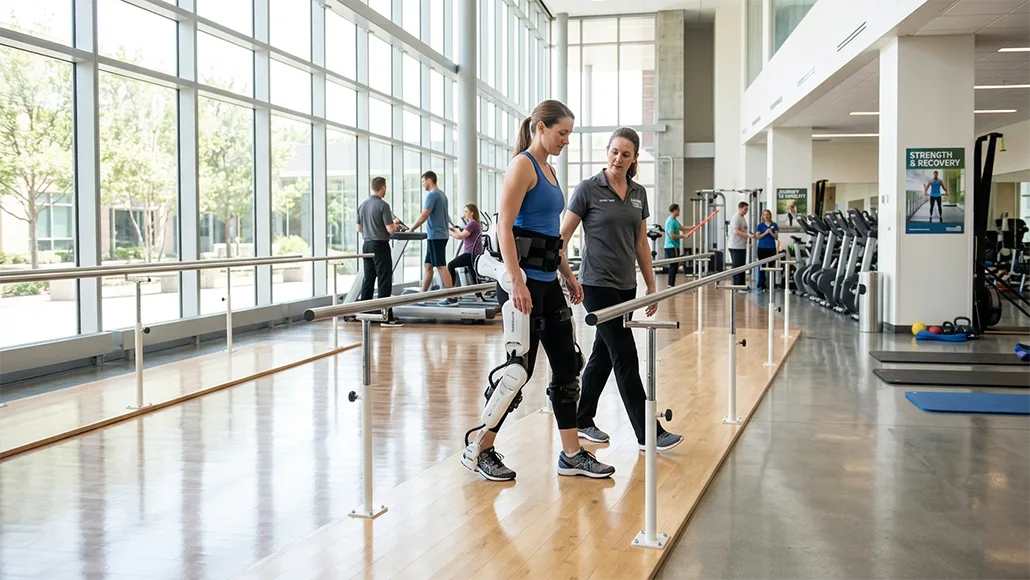
Among the most impactful advanced rehabilitation technologies supporting recovery are robotic systems. These marvels of engineering provide unparalleled precision and the capacity for high-intensity, repetitive movements that are often crucial for neurorehabilitation and motor learning. Consider, for instance, exoskeletons that assist patients with spinal cord injuries or stroke survivors in gait training, enabling them to practice walking patterns with correct biomechanics. These robotic devices provide partial body weight support while guiding limb movements, allowing for thousands of repetitions – a feat impossible for human therapists alone.
Similarly, robotic arms and hand devices are revolutionizing upper limb therapy. Patients can engage in targeted exercises designed to improve fine motor skills, strength, and range of motion. The beauty of robotic rehabilitation lies not just in its ability to deliver consistent, tireless therapy, but also in its capacity to objectively measure performance. Therapists can track metrics like force output, range of motion, and movement accuracy over time, providing concrete data on progress and allowing for dynamic adjustment of therapy parameters. These devices act as powerful patient recovery tools, offering consistent, quantifiable intervention that can significantly accelerate functional gains.
Immersive Worlds: Virtual Reality in Rehabilitation
The realm of virtual reality (VR) has moved beyond gaming to become a powerful therapeutic modality. Virtual rehab solutions immerse patients in interactive digital environments, turning often monotonous exercises into engaging, goal-oriented tasks. For individuals recovering from stroke, traumatic brain injury, or balance disorders, VR can provide a safe and controlled space to practice movements, cognitive tasks, and balance strategies without the fear of falling or injury.
Imagine a patient practicing reaching for virtual objects to improve upper limb coordination, navigating a virtual supermarket aisle to enhance cognitive planning, or walking on a simulated tightrope to improve balance and proprioception. These scenarios can be customized to match individual patient needs and progress levels, offering immediate feedback and increasing motivation. The engaging nature of VR significantly boosts patient adherence to therapy programs, making it an invaluable recovery support technology that fosters neuroplasticity and skill acquisition in an enjoyable manner. The psychological benefits of feeling a sense of accomplishment within these virtual worlds cannot be overstated, contributing positively to overall well-being during a challenging recovery period.
Wearable Sensors and Mobility Tracking: Quantifying Progress
The proliferation of wearable technology has brought objective data collection directly to the patient, both within and outside the clinical setting. Mobility tracking devices, often in the form of small, discreet sensors worn on the body, can continuously monitor various parameters such as gait speed, stride length, balance sway, activity levels, and even joint angles. This provides a comprehensive, real-time picture of a patient’s functional capabilities and how they evolve over time.
For therapists, this objective data is transformative. Instead of relying solely on observational assessments, they can analyze precise movement patterns, identify subtle improvements, or pinpoint areas requiring more intensive intervention. This data-driven approach allows for highly personalized adjustments to physical therapy technology programs, optimizing efficacy. Furthermore, these wearables facilitate remote monitoring, extending the reach of rehabilitation beyond the clinic walls. Patients can perform exercises at home while their progress is tracked, allowing therapists to provide feedback and adjust protocols remotely, enhancing continuity of care and providing valuable patient recovery tools that empower individuals to take an active role in their healing journey.
Gamification and Interactive Platforms: Engaging the Patient
One of the persistent challenges in rehabilitation is maintaining patient engagement, especially during long-term recovery processes. The repetitive nature of many exercises can lead to boredom and decreased motivation. This is where gamification, integrated into advanced rehabilitation technologies, plays a crucial role. By turning therapeutic exercises into game-like experiences with scores, levels, challenges, and rewards, these platforms make rehabilitation more enjoyable and less like a chore.
Interactive platforms can include apps that guide patients through their home exercise programs, providing visual demonstrations, tracking completion, and offering encouraging feedback. This not only improves adherence but also gives patients a sense of agency and achievement. The personalized feedback loops and adaptive difficulty levels inherent in these systems mean that the therapy evolves with the patient, keeping them challenged but not overwhelmed. Such innovative approaches are fundamental to creating effective patient recovery tools that maintain engagement over the long haul.
AI and Machine Learning: Personalizing the Recovery Journey
The true power of rehab innovation lies in the intelligent processing of the vast amounts of data generated by these technologies. Artificial intelligence (AI) and machine learning algorithms are emerging as game-changers, enabling unparalleled personalization in rehabilitation. By analyzing data from robotic sessions, VR interactions, wearable sensors, and clinical records, AI can identify intricate patterns, predict potential recovery trajectories, and even recommend optimal treatment adjustments.
For example, an AI system might detect subtle inefficiencies in a patient’s gait pattern that are not immediately obvious to the human eye, suggesting specific exercises to correct them. It can adapt the difficulty of a VR game in real-time based on the patient’s performance or predict when a patient might be approaching a plateau, prompting therapists to introduce new challenges. This level of data-driven insight allows for highly dynamic and optimized treatment plans, ensuring that each patient receives the most effective and personalized intervention possible. AI transforms generic protocols into bespoke recovery pathways, making advanced rehabilitation technologies supporting recovery incredibly precise and effective.
Tele-rehabilitation: Expanding Access and Continuity of Care
The integration of advanced rehabilitation technologies has significantly bolstered the capabilities of tele-rehabilitation, making high-quality care accessible to a wider population. Through secure digital platforms, patients can engage in virtual therapy sessions from the comfort of their homes, eliminating geographical barriers and reducing the burden of travel. This is particularly beneficial for individuals in rural areas, those with limited mobility, or those with compromised immune systems.
Tele-rehabilitation combines live video consultations with remote monitoring tools, interactive exercise platforms, and even VR applications. Therapists can guide patients through exercises, assess their form, and provide immediate feedback, much like in an in-person session. The data collected by wearable sensors can be transmitted directly to the therapist, allowing for continuous oversight and adjustment of the home exercise program. This continuity of care, facilitated by advanced rehabilitation technologies supporting recovery, is vital for sustained progress and preventing setbacks, ultimately making rehabilitation more inclusive and efficient.
The Interplay of Technology and Human Touch
It is crucial to understand that advanced rehabilitation technologies are not designed to replace the human element of therapy, but rather to augment and empower it. The compassionate touch, clinical expertise, empathetic understanding, and skilled problem-solving of a human therapist remain irreplaceable. Technology serves as a powerful ally, providing therapists with sophisticated patient recovery tools and data-driven insights that enhance their ability to deliver superior care.
By automating repetitive tasks and providing objective data, these technologies free up therapists to focus on higher-level clinical reasoning, patient motivation, and complex problem-solving. The collaboration between human intuition and technological precision creates a synergistic environment where patients receive the best of both worlds. This symbiotic relationship ensures that the future of rehab innovation will always be centered on the patient, leveraging technology to amplify the effectiveness of human care.
Conclusion
The evolution of rehabilitation is undeniable, and advanced rehabilitation technologies supporting recovery are at the forefront of this revolution. From the precision of robotic systems and the immersive engagement of virtual reality to the data-driven insights of wearable sensors and AI, these innovations are fundamentally transforming the recovery journey. They offer unparalleled personalization, enhance motivation, provide objective progress tracking, and expand access to care, ultimately leading to faster, more complete, and sustainable outcomes for countless individuals. As these technologies continue to advance, the future promises an even more optimistic landscape for recovery, where the path back to independence is guided by intelligent tools, compassionate care, and unwavering hope. The era of empowered rehabilitation is truly upon us, driven by a relentless pursuit of better patient lives through cutting-edge rehab innovation.