















Close
Digital Health & Ai Innovation summit 2026
Medical Taiwan 2026

MHRA Advances AI Airlock with £3.6 Mn Multi-Year Funding

Note* - All images used are for editorial and illustrative purposes only and may not originate from the original news provider or associated company.

Subscribe

- Never miss a story with notifications

- Gain full access to our premium content

- Browse free from any location or device.

Media Packs

Expand Your Reach With Our Customized Solutions Empowering Your Campaigns To Maximize Your Reach & Drive Real Results!

– Access the Media PackNow

– Book a Conference Call

Leave Message for Us to Get Back

Related stories

UK-US Regulators Align on Faster Medical...

The UK and US have advanced cooperation on medical...

Healthcare Wearables Driving Preventive Care Strategies...

Healthcare wearables are profoundly reshaping the landscape of modern medicine, moving the focus from reactive treatment to proactive prevention. This article explores how these sophisticated devices, through real-time health tracking, advanced wellness monitoring, and early risk detection, empower individuals and medical professionals alike to implement smarter, more effective preventive care strategies, ultimately fostering a healthier, more informed populace.

Digital Health Technologies Enhancing Modern Care...

Digital health technologies are fundamentally reshaping how healthcare is delivered, moving beyond traditional models to offer more efficient, accessible, and patient-centered solutions. From the widespread adoption of telehealth platforms to the seamless integration of Electronic Health Records (EHR) and the proactive insights gained from remote patient monitoring, these innovations are not merely incremental improvements but represent a profound healthcare digital transformation. This article delves into how these advanced digital health technologies are enhancing care delivery, optimizing clinical workflows, and fostering a new era of proactive, personalized patient care, ultimately driving better outcomes for individuals and healthcare systems alike.

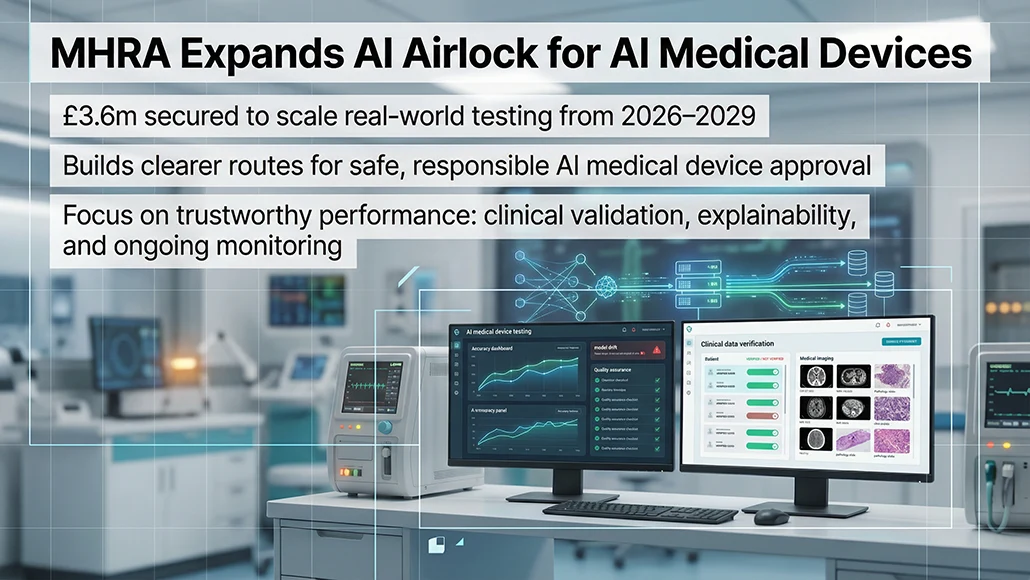
The Medicines and Healthcare products Regulatory Agency (MHRA) has secured a £3.6 million funding commitment over three years to expand its AI Airlock programme, reinforcing its position at the forefront of regulatory innovation in healthcare. The initiative, recognised as the UK’s first regulatory sandbox for Artificial Intelligence as a Medical Device (AIaMD), will receive £1.2 million annually from 2026 to 2029 following approval from the Department of Health and Social Care (DHSC). This financial backing allows the programme to move beyond annual funding limitations and pursue more advanced, long-term testing frameworks for emerging technologies.

With the expanded funding, AI Airlock is expected to scale its operations and support the development of sustainable regulatory pathways for AI-driven medical technologies. Delivered through collaboration between MHRA, DHSC, the NHS AI Team, and Team AB, the programme aligns with broader government strategies, including the AI Opportunities Action Plan, the Regulatory Action Plan, the 10-Year Health Plan, and the Life Sciences Sector Plan.

Commenting on the development, James Pound, Executive Director, Innovation and Compliance, said:
“Securing this multi-year funding boost marks a pivotal moment for AI Airlock and for the safe and responsible advancement of AI in healthcare.
The programme has already shown how collaborative, real-world testing can uncover regulatory challenges early and help innovators bring high-quality, safe technologies to patients faster.
This additional investment will allow us to scale up and ultimately strengthen our ability to ensure that AI-powered medical devices can reach patients safely, efficiently and with the confidence of robust regulatory oversight.”

The AI Airlock programme has evolved steadily since its pilot launch in 2024, followed by a second phase in 2025 that broadened its scope. Early findings highlighted new regulatory complexities associated with AI medical devices, particularly around risk management, accuracy, and the need to anchor model outputs in verified clinical data. It also underscored the importance of explainability in AI systems to strengthen clinician trust, alongside the necessity for continuous post-market monitoring to detect performance shifts or over-reliance.

Building on these insights, the second phase has examined specific regulatory challenges, including AI-powered diagnostic tools, pre-determined change control plans (PCCPs), and evolving use cases of AI systems. The programme has tested a wide spectrum of technologies such as large language models, voice-enabled tools, and advanced diagnostics targeting cancer and rare diseases. Outputs from this phase, including reports and case studies, are expected in Summer 2026 and will guide the design of phase three. Findings are also feeding into the National AI Commission’s work on shaping future regulatory frameworks. As AI Airlock expands, it continues to play a central role in strengthening collaboration between regulators and industry, supporting safe innovation while maintaining a robust and future-ready regulatory environment for medical devices.

MEDICAL FAIR ASIA 2026

Latest stories

Related stories

UK-US Regulators Align on Faster Medical Device Approvals

The UK and US have advanced cooperation on medical...

Healthcare Wearables Driving Preventive Care Strategies Today

Healthcare wearables are profoundly reshaping the landscape of modern medicine, moving the focus from reactive treatment to proactive prevention. This article explores how these sophisticated devices, through real-time health tracking, advanced wellness monitoring, and early risk detection, empower individuals and medical professionals alike to implement smarter, more effective preventive care strategies, ultimately fostering a healthier, more informed populace.

Digital Health Technologies Enhancing Modern Care Delivery

Digital health technologies are fundamentally reshaping how healthcare is delivered, moving beyond traditional models to offer more efficient, accessible, and patient-centered solutions. From the widespread adoption of telehealth platforms to the seamless integration of Electronic Health Records (EHR) and the proactive insights gained from remote patient monitoring, these innovations are not merely incremental improvements but represent a profound healthcare digital transformation. This article delves into how these advanced digital health technologies are enhancing care delivery, optimizing clinical workflows, and fostering a new era of proactive, personalized patient care, ultimately driving better outcomes for individuals and healthcare systems alike.

Telehealth Licensure Reform Initiative by Johns Hopkins, ATA

Johns Hopkins Medicine and American Telemedicine Association have unveiled...

Subscribe

- Never miss a story with notifications

- Gain full access to our premium content

- Browse free from any location or device.

Media Packs

Expand Your Reach With Our Customized Solutions Empowering Your Campaigns To Maximize Your Reach & Drive Real Results!

– Access the Media Pack Now

– Book a Conference Call

Leave Message for Us to Get Back

Translate »