







The global AI in Healthcare Market is projected to grow from USD 35.96 billion in 2025 to USD 305.96 billion by 2033, registering a compound annual growth rate (CAGR) of 30.1% during the forecast period from 2026 to 2033. The rapid expansion reflects accelerating adoption of artificial intelligence technologies across healthcare systems, pharmaceutical research, diagnostics, clinical operations, and patient management platforms.
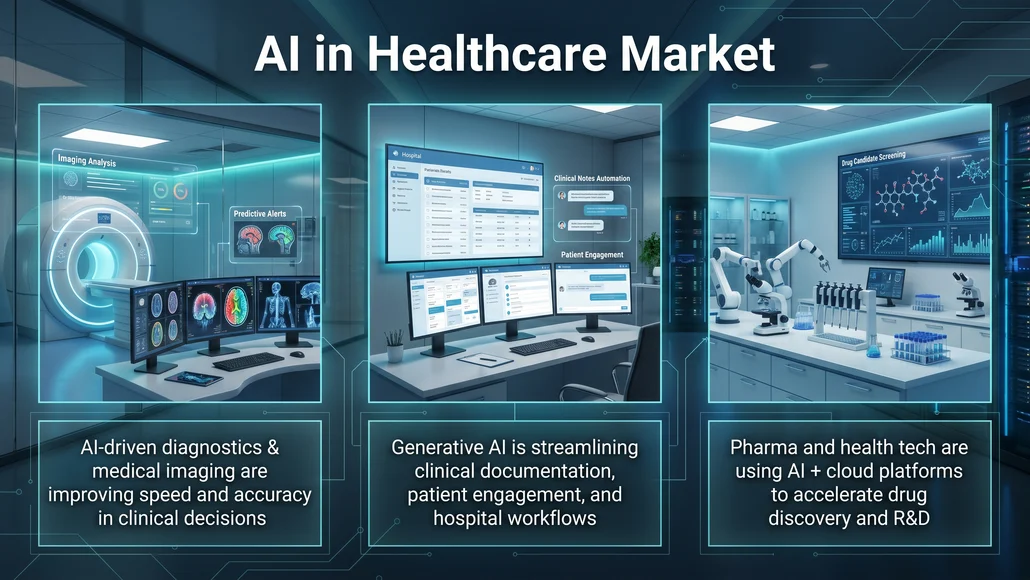
Artificial intelligence is increasingly being integrated into healthcare workflows to improve diagnostic accuracy, optimize treatment planning, support predictive analytics, automate administrative tasks, and accelerate drug discovery processes. Technologies including machine learning, natural language processing, computer vision, and AI-enabled decision support systems are becoming central to digital healthcare transformation strategies adopted by hospitals, pharmaceutical companies, and healthcare providers globally.
The market is being driven by rising healthcare digitization, growing volumes of clinical and patient data, increasing demand for personalized medicine, and the need for more efficient healthcare delivery systems. Healthcare organizations are also investing in AI tools to reduce operational burdens, improve workflow automation, and strengthen data-driven clinical decision-making. The growing use of generative AI in clinical documentation, patient engagement, and healthcare analytics is further contributing to market expansion.
Key Market Drivers
- Increasing adoption of AI-powered diagnostics and medical imaging technologies
- Rising demand for personalized and data-driven healthcare solutions
- Growing investments in healthcare digital transformation initiatives
- Expansion of AI applications in drug discovery and pharmaceutical R&D
- Rising focus on workflow automation and operational efficiency in hospitals
Industry Developments
Several major healthcare and technology companies have expanded AI-related initiatives during 2026 as competition intensifies across diagnostics, cloud-based healthcare systems, and pharmaceutical innovation.
In April 2026, Roche agreed to acquire PathAI to strengthen capabilities in AI-powered pathology and precision medicine. During the same month, Merck announced a multi-year collaboration with Google Cloud to integrate generative AI and cloud technologies into drug discovery and manufacturing operations.
Also in April 2026, CVS Health partnered with Google Cloud to launch an AI-enabled healthcare engagement platform focused on personalized healthcare management and integrated health data access.
In Japan, healthcare institutions accelerated deployment of AI technologies across hospital operations and patient management systems. In March 2026, Fujitsu Japan and Teikyo University Hospital initiated a joint demonstration project using AI-OCR and healthcare analytics to improve referral management and hospital efficiency. Earlier in February 2026, JCHO Osaka Hospital, Fujitsu Japan, and Fortience Consulting launched a generative AI initiative focused on discharge summaries and nursing handovers.
In April 2026, ŌURA acquired Galen AI to strengthen AI-powered health data interpretation capabilities integrating wearable insights, medication histories, and medical records into preventive healthcare applications.
In January 2026, OpenAI acquired healthcare startup Torch as part of efforts to expand development of AI-enabled healthcare technologies and medical AI applications.
Competitive Landscape
The AI in Healthcare Market remains highly competitive, with technology companies, healthcare providers, pharmaceutical firms, and digital health specialists expanding investments across diagnostics, cloud computing, automation, and clinical analytics.
Major companies operating in the market include Intel Corporation, Koninklijke Philips N.V., Microsoft, Siemens Healthcare GmbH, NVIDIA Corporation, GE Healthcare, Medtronic, Oracle, IQVIA, and Cognizant.
Future Outlook
The AI in healthcare sector is expected to continue expanding as healthcare providers and pharmaceutical companies increase adoption of automation, predictive analytics, and AI-driven clinical tools. Advancements in generative AI, cloud computing, medical imaging, and digital health infrastructure are expected to support broader integration of AI technologies across healthcare systems worldwide.