










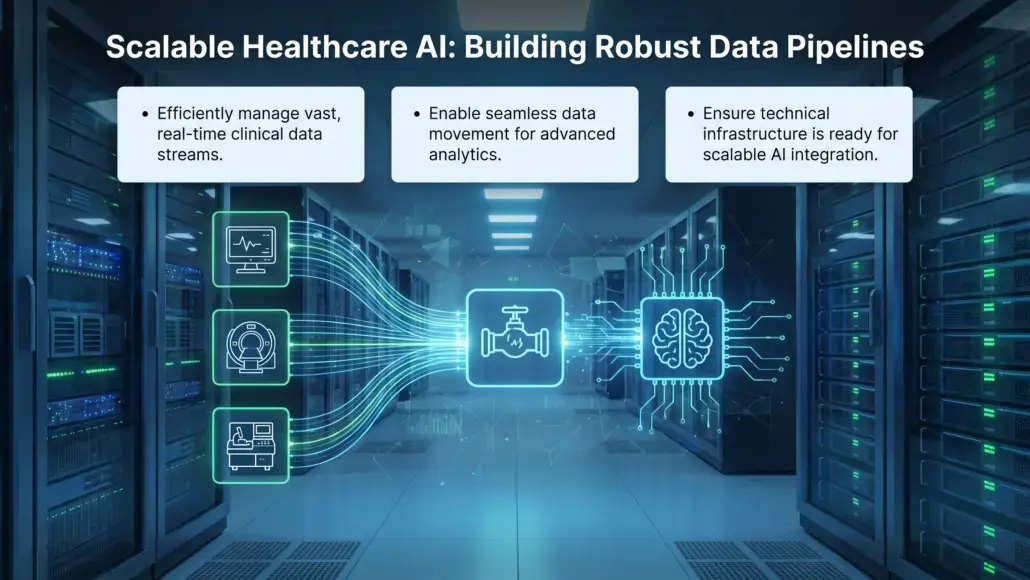

Modern medical facilities are generating vast amounts of information every second, from vital signs monitored at the bedside to high resolution imaging and laboratory results. The challenge for these institutions is not just the collection of this information, but the efficient movement and processing of it to support advanced analytical tools. By developing clinical data pipelines supporting scalable healthcare AI, organizations can ensure that their technical infrastructure is capable of handling the continuous flow of information required for real time diagnostic support. These pipelines act as the vascular system of the digital hospital, transporting raw data from various sources to centralized processing hubs where it can be refined and analyzed. The reliability of these systems is paramount, as any interruption in the data flow can lead to delays in clinical decision making.
Effective pipeline design focuses on high throughput and low latency, ensuring that information is available to clinicians when it is most needed. This requires a shift away from batch processing toward streaming architectures that can handle data in motion. In a clinical setting, where minutes can impact patient outcomes, the ability to process information as it is generated is a significant advantage. These pipelines must be built to accommodate the diversity of medical data, which ranges from highly structured diagnostic codes to complex, unstructured physician notes. Integrating these disparate data types into a single, cohesive stream allows for a more comprehensive analysis of the patient’s condition, providing a solid foundation for intelligent systems to operate.
Engineering High Throughput Ingestion for Clinical Environments
The first stage of any successful data pipeline is the ingestion process. In a medical environment, this involves gathering information from hundreds or even thousands of connected devices and software applications. Clinical data pipelines supporting scalable healthcare AI must be engineered to handle this high volume of ingestion without compromising the integrity of the data. This often requires the use of message queuing systems that can buffer incoming data during periods of high activity, ensuring that no information is lost. The ingestion layer must also be capable of handling various communication protocols, as different medical devices often use different standards for data transmission.
Security is a critical consideration during the ingestion phase. As information moves from the bedside to the processing hub, it must be protected from unauthorized access or tampering. This involves the use of encryption protocols that secure data both at rest and in transit. The ingestion process must include authentication mechanisms to ensure that only authorized devices can transmit information to the pipeline. By establishing a secure ingestion layer, healthcare organizations can maintain the privacy and confidentiality of patient information while enabling the flow of data needed for advanced analytics.
Monitoring the health of the ingestion layer is also essential for maintaining the reliability of the overall system. Organizations should implement real time dashboards that track data volume, ingestion rates, and any errors that occur during the process. This visibility allows technical teams to identify and resolve issues before they impact clinical operations. The goal is to create a background process that is both resilient and transparent, providing a consistent stream of high quality information for downstream analysis.
Protocols for Data Normalization and Clinical Accuracy
Once data has been ingested, it must be normalized to ensure that it is consistent and comparable across the entire system. In a clinical setting, information is often recorded using different formats or units of measurement. For example, blood pressure might be recorded in different ways depending on the device used. Clinical data pipelines supporting scalable healthcare AI incorporate sophisticated normalization protocols that translate these diverse data points into a standardized format. This process is essential for ensuring that analytical models are comparing like with like, which is critical for maintaining diagnostic accuracy.
Normalization also involves the resolution of semantic differences in medical terminology. Different departments or facilities may use different codes to represent the same diagnosis or procedure. By mapping these local codes to standardized terminologies like SNOMED CT or ICD-10, the pipeline ensures that information is interpretable across the entire enterprise. This semantic consistency is a prerequisite for the development of large scale models that aggregate data from multiple sources. Without normalization, the insights generated by intelligent systems would be fragmented and potentially misleading.
In addition to normalization, the pipeline must also include data cleaning steps to identify and remove errors or duplicates. Medical records are often prone to human error, such as typos or incorrect data entry. Automated cleaning protocols can flag these inconsistencies for review or correct them based on predefined rules. By ensuring that the data being processed is accurate and reliable, healthcare organizations can improve the quality of the insights generated by their analytical tools. The focus on data integrity throughout the normalization process is a key differentiator of a high performance clinical infrastructure.
Automation Strategies in Large Scale Clinical Processing
The sheer volume of information generated in a modern medical center makes manual data processing impossible. Automation is therefore a core component of clinical data pipelines supporting scalable healthcare AI. By automating repetitive tasks like data extraction, transformation, and loading, organizations can significantly reduce the time and resources required to manage their information assets. Automation also reduces the risk of human error, ensuring that data is processed consistently and accurately every time. This efficiency is crucial for maintaining the responsiveness of the system, particularly in high pressure clinical environments.
Scalable processing also relies on the use of distributed computing frameworks that can parallelize tasks across multiple servers. This allows the pipeline to handle increasing workloads by simply adding more computational resources. In a medical setting, where the amount of data can fluctuate throughout the day, the ability to scale processing power up or down is a major advantage. This flexibility ensures that the system remains performant during peak periods, such as a surge in emergency department visits, while minimizing costs during quieter times.
The integration of automated decision support tools into the pipeline is another significant advancement. For instance, the pipeline can be configured to automatically alert clinicians if a patient’s vital signs fall outside of a specific range. These automated alerts can be informed by predictive models that analyze the patient’s history and current status to identify early warning signs of deterioration. By embedding intelligence directly into the data flow, healthcare organizations can provide more proactive care and improve patient outcomes. The combination of automated processing and intelligent alerting creates a more responsive and effective clinical environment.
Monitoring Integrity and Pipeline Health in Real Time
Maintaining the continuous operation of a data pipeline requires constant monitoring and maintenance. Clinical data pipelines supporting scalable healthcare AI must include comprehensive monitoring tools that track the flow of information at every stage. This involves monitoring throughput, latency, and error rates to ensure that the system is functioning as expected. Automated alerts should be configured to notify technical teams immediately if any performance metrics fall below predefined thresholds. This proactive approach to maintenance ensures that potential issues are addressed before they can disrupt clinical workflows.
Data integrity must also be monitored throughout the pipeline’s lifecycle. This involves performing regular audits to ensure that the information being processed remains accurate and consistent. Techniques like data lineage tracking can be used to trace the path of a specific data point from ingestion to analysis, providing a clear record of any transformations or changes that occurred. This level of transparency is essential for maintaining the trust of clinicians and meeting regulatory requirements for data management.
The use of predictive maintenance for the pipeline itself is an emerging area of interest. By analyzing performance data, organizations can identify patterns that suggest a potential failure or bottleneck in the system. This allows for preventive measures to be taken, such as reallocating resources or updating software, before a problem occurs. The focus on long term stability and reliability ensures that the pipeline remains a dependable foundation for the organization’s intelligent systems.
Scaling Throughput for Multi Facility Medical Operations
As healthcare organizations grow through mergers and acquisitions, they must be able to scale their data pipelines across multiple facilities. Pipelines are designed to handle the complexity of multi site operations, providing a centralized platform for managing information from diverse locations. This requires a highly flexible architecture that can accommodate different technical environments and workflows at each site. By centralizing data processing, organizations can achieve greater consistency in care and improve operational efficiency across the entire enterprise.
Managing data exchange between facilities also requires strong interoperability standards. The pipeline must be capable of translating information between different electronic health record systems and other clinical applications used at each site. The use of standardized exchange protocols ensures that patient information can follow the individual as they move between different parts of the healthcare system. This continuity of care is a primary goal of modern health informatics and is made possible by the underlying data pipeline.
The ability to aggregate data from multiple facilities also provides a richer dataset for the development of intelligent models. By including information from a wider variety of patient populations and clinical settings, organizations can build models that are more representative and less biased. This leads to better diagnostic accuracy and more effective treatment plans for all patients. The scale provided by multi facility operations is a significant asset for any organization looking to lead in the field of intelligent medicine.