










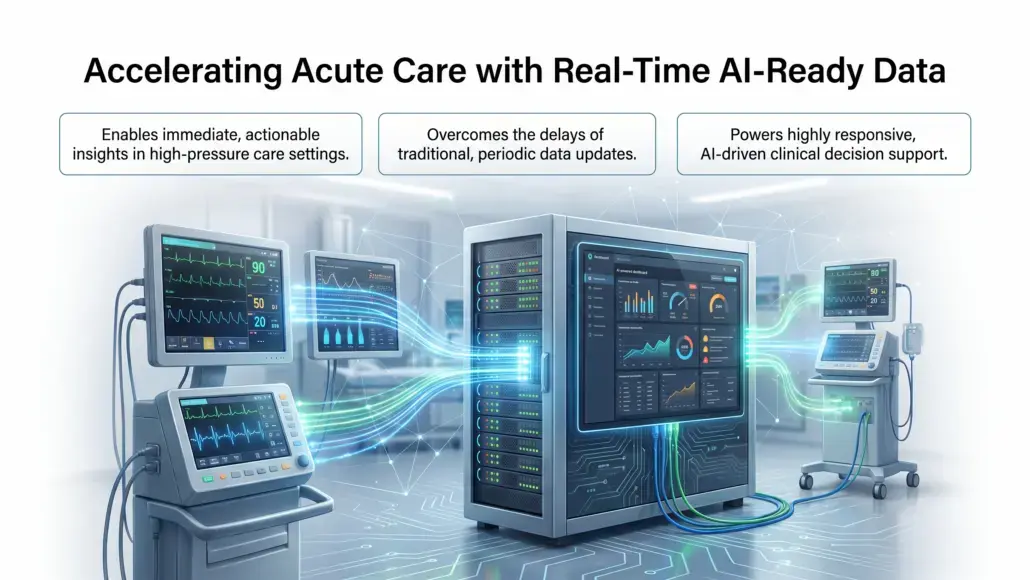

The ability to process and act upon information in the moment it is generated is becoming a cornerstone of modern medicine. In high pressure environments like intensive care units or emergency departments, every second counts. Traditional data systems, which often rely on periodic updates or batch processing, are increasingly insufficient for the demands of acute care. By implementing real-time clinical data infrastructure supporting AI applications, healthcare providers can create a highly responsive environment where diagnostic tools operate at the speed of clinical need. This infrastructure ensures that data from patient monitors, ventilators, and other bedside devices is immediately available for analysis, allowing for instantaneous feedback and intervention.
Real-time capabilities transform the nature of patient monitoring. Instead of simply recording vital signs for later review, the system can actively analyze trends as they occur. For example, a sudden change in heart rate or blood pressure can be detected and flagged within milliseconds, alerting the care team to a potential crisis. This level of responsiveness is only possible when the underlying technical structure is designed to minimize latency and maximize throughput. The transition to real-time operations requires a rethink of how information is stored and processed, moving away from centralized databases toward more distributed and agile architectures.
Latency Requirements for Bedside Artificial Intelligence
Reducing latency is the most critical technical challenge in building a system for real-time analysis. In a clinical context, latency refers to the time it takes for a data point to move from the source device to the analytical engine and back to the clinician. High latency can render even the most sophisticated model useless in an emergency. Real-time clinical data infrastructure supporting AI applications must be optimized to handle thousands of concurrent data streams with minimal delay. This often involves the use of in-memory data processing, where information is stored in a high speed cache rather than on a traditional hard drive.
Network optimization is another essential component of low latency infrastructure. Hospital networks are often crowded with a wide range of traffic, from administrative tasks to patient entertainment systems. To support critical clinical applications, organizations must prioritize medical data traffic, ensuring it has the bandwidth and reliability it needs. The use of software defined networking can help manage this complexity, allowing for the dynamic allocation of resources based on the urgency of the data. By creating a dedicated high speed path for clinical information, healthcare centers can ensure that their intelligent systems remain responsive even during periods of heavy network usage.
The location of processing power also impacts latency. While cloud computing offers significant advantages in terms of scale and flexibility, the time it takes for data to travel to a remote server and back can be prohibitive for real-time applications. Many organizations are therefore turning to edge computing, where processing occurs closer to the source of the data. By placing analytical engines directly within the hospital network, or even on the medical devices themselves, providers can achieve the sub-second response times required for acute care interventions.
Stream Processing Architectures for Patient Monitoring
Traditional database systems are designed to store data and allow for complex queries after the fact. In contrast, stream processing is designed to analyze data as it flows through the system. The infrastructure relies on stream processing to manage the continuous influx of information from patient monitoring devices. These architectures allow for the implementation of complex event processing, where the system looks for specific patterns or sequences of events that indicate a clinical change. For instance, the combination of rising temperature and falling blood pressure might trigger an alert for potential sepsis.
Stream processing also facilitates the integration of diverse data sources. A patient monitor provides a continuous stream of vital signs, while an electronic health record provides historical context. By combining these streams in real time, the system can provide a more accurate and nuanced analysis of the patient’s condition. This multi source integration is essential for reducing false alarms, which are a major source of alert fatigue among clinical staff. When a model can cross reference current readings with historical data, it can distinguish between a minor fluctuation and a significant clinical event.
The scalability of stream processing architectures is another key benefit. As more devices are added to the network, the system must be able to handle the increased load without a decrease in performance. Distributed stream processing frameworks allow for the workload to be spread across multiple servers, ensuring that the infrastructure can grow with the needs of the facility. This flexibility is crucial for large medical centers that manage hundreds of beds and thousands of connected devices.
Integrating Real-Time Feeds with Electronic Health Records
For real-time analysis to be effective, it must be informed by the patient’s clinical history. Integrating live data streams with the electronic health record is a complex but necessary task. Real-time clinical data infrastructure supporting AI applications must be capable of pulling historical information, such as allergies, medications, and previous diagnoses, and combining it with current physiological data. This integration provides the context needed for models to make informed recommendations. Without this historical context, a model might interpret a reading incorrectly, leading to inappropriate clinical suggestions.
The technical challenge of integration lies in the different formats and speeds of the two systems. Electronic health records are typically designed for slow, structured updates, while monitoring feeds are fast and unstructured. Bridging this gap requires the use of middleware that can translate and synchronize the information. Standardized exchange protocols, such as FHIR, play a vital role in this process by providing a common language for both systems to communicate. By establishing a seamless connection between the record and the real-time feed, healthcare organizations can create a truly comprehensive intelligence environment.
Data consistency is also a major concern when integrating these systems. It is vital to ensure that the patient identity is correctly matched across all data sources. Mismatched records can lead to dangerous clinical errors, such as a model providing recommendations based on the wrong patient’s history. Strong identity management protocols and the use of unique patient identifiers are essential for maintaining the safety and integrity of the integrated system. By prioritizing data accuracy and consistency, healthcare providers can build a reliable foundation for real-time intelligence.
Fault Tolerance and Resilience in Critical Clinical Systems
When clinical decisions are informed by real-time systems, the reliability of those systems becomes a matter of patient safety. Real-time clinical data infrastructure supporting AI applications must be designed with high levels of fault tolerance and resilience. This means that the system must continue to function even if a component fails. Redundancy is a key strategy for achieving this, involving the use of backup servers, network paths, and power supplies. In a critical care environment, a system failure can have immediate and severe consequences, so the infrastructure must be built to withstand a wide range of potential disruptions.
Disaster recovery planning is also an essential part of maintaining system resilience. Organizations must have clear protocols for restoring operations in the event of a major failure, such as a cyberattack or a natural disaster. This involves regular data backups and the ability to failover to a secondary site if the primary location becomes unavailable. Testing these recovery protocols regularly is vital to ensure that they will work as expected when they are needed. A resilient infrastructure provides the peace of mind that intelligent tools will be available when they are most needed.
The monitoring of system health is a continuous process that involves tracking thousands of variables in real time. Automated monitoring tools can identify early warning signs of a component failure, such as an increase in error rates or a decrease in processing speed. By addressing these issues proactively, technical teams can prevent a minor problem from escalating into a major system outage. The focus on long term stability and reliability is a hallmark of a mature clinical data environment, ensuring that technology remains a supportive partner in patient care.
Operational Impact of Real-Time Intelligence in Acute Care
The implementation of real-time systems has a profound impact on the daily operations of a medical facility. Real-time clinical data infrastructure supporting AI applications allows for more efficient resource management and improved patient flow. For example, predictive models can be used to identify patients who are ready for discharge or transfer to a lower level of care, freeing up beds in the intensive care unit. This proactive approach to capacity management helps hospitals operate more efficiently and reduces wait times for patients in the emergency department.
Improving communication among the care team is another significant benefit of real-time intelligence. When a clinical alert is generated, it can be sent directly to the relevant staff members’ mobile devices, ensuring that they are aware of the situation immediately. This reduces the time spent searching for information and allows for a faster coordinated response. By providing everyone on the team with the same real-time view of the patient’s condition, the system supports a more collaborative and effective clinical environment.
The long term benefits of real-time infrastructure extend to the continuous improvement of clinical protocols. By analyzing the data collected during patient encounters, organizations can identify areas where care can be improved. For instance, the system might reveal that a certain intervention is more effective when delivered at a specific time. These insights can be used to update clinical guidelines and train staff, leading to better outcomes for future patients. The combination of immediate feedback and long term analysis creates a virtuous cycle of improvement that is driven by high quality real-time data.