









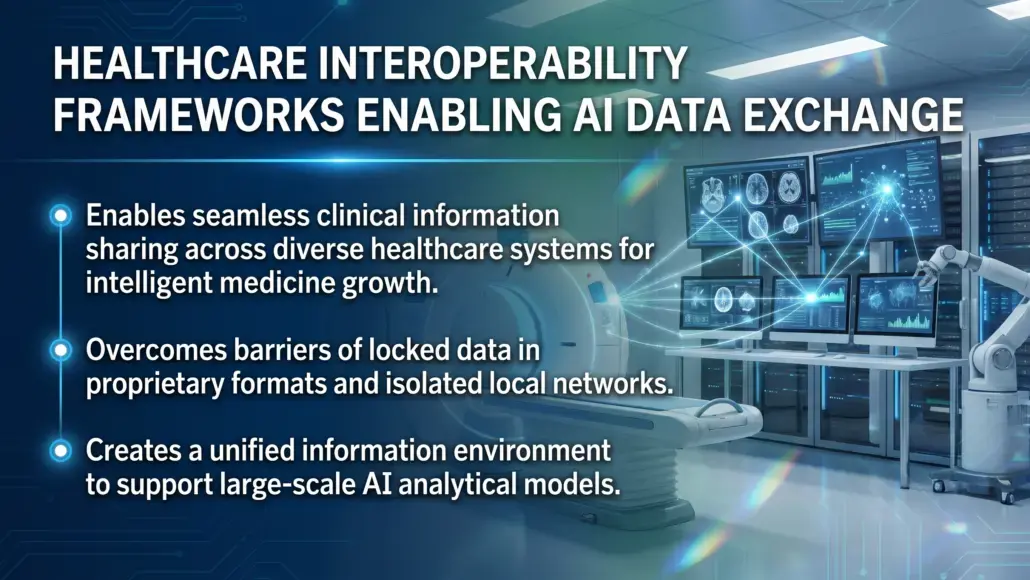

The ability to share clinical information across different systems and organizations is a fundamental requirement for the growth of intelligent medicine. In many healthcare systems, data is locked within proprietary formats or isolated local networks, preventing the development of large scale analytical models. By adopting healthcare interoperability frameworks enabling AI data exchange, medical institutions can overcome these barriers, creating a unified information environment that supports advanced research and clinical care. These frameworks provide the standardized protocols and data models necessary for diverse software applications to communicate effectively, ensuring that patient information is both accessible and interpretable wherever it is needed.
Interoperability is not just a technical challenge but a strategic necessity for modern healthcare providers. As patients move between different parts of the care continuum, their medical history must follow them to ensure continuity and safety. A lack of interoperability can lead to fragmented records, redundant testing, and a higher risk of diagnostic errors. By establishing a common language for data exchange, organizations can improve the quality of care and optimize their operational efficiency. The transition toward open data standards is a major trend in health informatics, driven by the recognition that information sharing is essential for the future of clinical intelligence.
Standardizing Data Exchange Through FHIR and Global Protocols
The development of global standards for data exchange has been a critical catalyst for healthcare interoperability. Fast Healthcare Interoperability Resources, or FHIR, has emerged as a leading standard for modern medical data exchange. It uses a modular approach, representing clinical concepts as discrete resources that can be easily shared between systems. Healthcare interoperability frameworks enabling AI data exchange often rely on FHIR to provide the technical foundation for information sharing. By using standardized web technologies, FHIR makes it easier for developers to build applications that can interact with various electronic health record systems.
The adoption of FHIR also facilitates the development of a more vibrant ecosystem of clinical applications. When data is accessible through standardized interfaces, third party developers can create tools that integrate directly into the clinical workflow. This allows healthcare providers to choose the best analytical tools for their specific needs, rather than being locked into a single vendor’s ecosystem. The flexibility provided by open standards is essential for a rapidly evolving field like medical intelligence, where new techniques and models are constantly emerging. By prioritizing interoperability, organizations can ensure that they remain at the forefront of technical innovation.
Other protocols, such as HL7 and DICOM, continue to play a vital role in specific clinical domains. HL7 is widely used for administrative and clinical messaging, while DICOM is the global standard for medical imaging. A comprehensive interoperability framework must reconcile these different standards, providing a unified view of the patient’s data regardless of its source or format. This involves the use of terminology mapping and data transformation tools that translate diverse data points into a common model. By creating a cohesive information environment, healthcare centers can maximize the full potential of their data assets.
Technical Challenges in Achieving Semantic Interoperability
While technical interoperability focuses on the movement of data between systems, semantic interoperability focuses on the meaning of that data. It is not enough for two systems to exchange a data point; they must both understand what that data point represents in a clinical context. For example, a code for a specific medication must be interpreted correctly by both the sending and receiving systems. Healthcare interoperability frameworks enabling AI data exchange must address these semantic challenges by incorporating standardized medical terminologies like SNOMED CT, LOINC, and RxNorm. These terminologies provide a universal language for representing clinical concepts, ensuring that information is consistent and comparable across different facilities.
Achieving semantic consistency is a complex task that requires significant effort in data mapping and validation. Many local systems use idiosyncratic codes or abbreviations that are not easily understood by other applications. Mapping these local codes to global standards is a labor intensive process but is essential for the reliability of analytical models. Without semantic interoperability, a model might misinterpret a clinical reading, leading to incorrect diagnostic suggestions. The focus on data meaning ensures that the insights generated by intelligent systems are accurate and clinically relevant.
Data quality is another critical aspect of semantic interoperability. Even when standardized terminologies are used, variations in how data is recorded can lead to inconsistencies. For instance, the same clinical observation might be recorded with different levels of detail or at different frequencies in different systems. An effective interoperability framework must include data profiling and cleaning tools to identify and resolve these variations. By ensuring that the information being exchanged is of high quality, organizations can improve the performance of their analytical tools and the safety of their clinical interventions.
Regulatory Compliance and Open Data Standards in Medicine
The push for interoperability is also driven by regulatory requirements at both the national and international levels. In many jurisdictions, laws have been enacted to prevent information blocking and encourage the sharing of patient records. Healthcare interoperability frameworks enabling AI data exchange are essential for organizations to comply with these regulations while maintaining the privacy and security of patient information. Compliance involves not only the adoption of technical standards but also the implementation of policies and procedures that govern how data is accessed and shared. Protecting patient privacy is a primary concern, and interoperability frameworks must incorporate strong authentication and authorization mechanisms.
Regulatory alignment also requires transparency in how data is used and shared. Patients should have a clear understanding of who has access to their information and for what purpose. An effective interoperability framework provides the tools needed to manage patient consent and track data usage across the enterprise. This level of transparency is essential for building and maintaining the trust of the community, which is a prerequisite for the successful implementation of any large scale data initiative. By prioritizing ethical data management, healthcare providers can ensure that their interoperability efforts are both legally and socially sustainable.
The transition toward open data standards is a global movement that is reshaping the healthcare industry. Organizations that embrace these standards are better positioned to collaborate with research institutions, public health agencies, and other healthcare providers. This collaboration is essential for addressing large scale health challenges, such as the management of chronic diseases or the response to a public health crisis. By creating a more connected and open information environment, healthcare institutions can improve health outcomes not just for their own patients, but for the population as a whole.
Strategic Implementation of Cross Institutional Data Sharing
Expanding interoperability beyond the walls of a single institution is a major goal for many healthcare systems. Cross institutional data sharing allows for a more comprehensive view of the patient’s journey, particularly for those with complex or chronic conditions. The frameworks provide the infrastructure needed to link disparate facilities, from primary care clinics to specialist hospitals and long term care centers. This connectivity ensures that clinical information is available at every point of care, reducing the need for redundant tests and improving the efficiency of the overall healthcare system.
Managing data exchange across multiple institutions requires strong governance and a shared commitment to data standards. Organizations must work together to establish common protocols for identity management, data quality, and security. This collaboration is often facilitated by health information exchanges (HIEs), which act as a central hub for information sharing within a specific region or network. By participating in these exchanges, healthcare providers can access a richer dataset for their analytical models, leading to better diagnostic accuracy and more effective treatment plans.
The benefits of cross institutional sharing extend to clinical research and population health management. By aggregating data from a wide variety of sources, researchers can identify trends and patterns that are not visible within a single facility. This large scale analysis is essential for the development of new therapies and the improvement of clinical guidelines. Public health agencies can use this information to monitor the spread of diseases and evaluate the effectiveness of public health interventions. The combination of clinical and population level insights is a powerful tool for improving health outcomes on a large scale.
Future Proofing Exchange Protocols for Intelligent Systems
As the field of medical intelligence continues to evolve, the requirements for data exchange will also change. Healthcare interoperability frameworks enabling AI data exchange must be designed with future scalability and flexibility in mind. This involves the adoption of modular architectures that can be easily updated to incorporate new standards or technologies. For example, as new types of diagnostic data, such as genomic information or data from wearable devices, become more common, the framework must be able to accommodate these new formats. Future proofing also involves the implementation of automated tools for monitoring and managing the exchange process, ensuring that the system remains performant as workloads increase.
The integration of advanced analytics directly into the exchange process is another emerging trend. For instance, the framework could be configured to automatically perform data cleaning or normalization as information is being exchanged. This real time processing ensures that the receiving system always receives high quality, standardized data, reducing the need for downstream processing. By embedding intelligence into the infrastructure itself, healthcare organizations can create a more efficient and responsive information environment.
The long term success of interoperability efforts depends on the continuous commitment of all stakeholders to open data standards and collaborative information sharing. While the technical and regulatory challenges are significant, the potential benefits for patient care and operational efficiency are immense. By building a sustainable foundation for data exchange, healthcare providers can ensure that they are prepared for the future of intelligent medicine. The focus on connectivity and transparency will remain a central theme in health informatics for years to come, driving innovation and improving health outcomes for patients everywhere.