













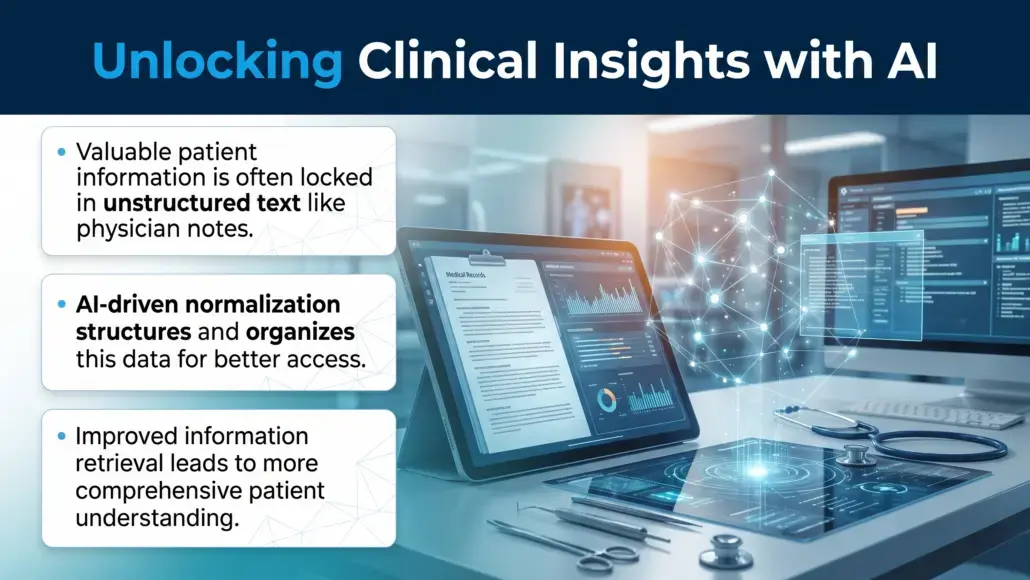

Clinical documentation is the lifeblood of medicine, yet a significant portion of the most valuable information is locked within unstructured text. Physician narratives, operative reports, and discharge summaries contain rich details about a patient’s condition, treatment response, and social determinants of health that are often missed by traditional data analysis tools. The implementation of ai-driven data normalization improving clinical information retrieval addresses this challenge by applying advanced natural language processing to extract and structure this vital information. By identifying clinical concepts, temporal relationships, and negation within free text, AI models can convert messy narratives into a standardized format that is easily searchable and analyzable. This process is essential for creating a truly comprehensive view of the patient, allowing clinicians to access the right information at the right time to make informed decisions.
The complexity of medical language, with its extensive use of jargon, abbreviations, and varied sentence structures, makes manual data normalization an impossible task at scale. Autonomous systems can process millions of documents in a fraction of the time it would take a human, maintaining a level of consistency that is difficult to achieve manually. These systems utilize deep learning architectures, such as transformers, which are trained on vast corpora of medical literature and clinical records. This training allows them to understand the nuances of clinical communication, distinguishing between a patient’s past medical history and their current symptoms. By bridging the gap between what is written and what is actionable, healthcare organizations can improve the accuracy of their data and the effectiveness of their clinical workflows.
Additionally, structured data enables the automation of clinical reporting and quality measurement. Instead of clinicians spending hours manually abstracting data for regulatory requirements, AI systems can automatically identify and extract the necessary information. This reduces the administrative burden on clinical staff and ensures that reporting is both timely and accurate. As the healthcare industry moves toward value based care models, the ability to demonstrate high quality outcomes is becoming increasingly important. Structured, normalized data provides the objective evidence needed to support these claims, allowing organizations to thrive in a shifting reimbursement environment. The transition from unstructured narratives to structured data is a fundamental step in the digital transformation of healthcare.
Implementing Semantic Terminology Services for Unified Clinical Language
A primary barrier to effective information retrieval in healthcare is the lack of a unified language. Different hospitals, and even different departments within the same hospital, often use different terms to describe the same clinical concepts. This fragmentation leads to confusion, errors, and significant difficulties in data integration. The use of ai-driven data normalization improving clinical information retrieval involves the implementation of semantic terminology services that map disparate terms to international standards such as SNOMED CT and LOINC. These services act as a universal translator, ensuring that a diagnosis of myocardial infarction in one system is recognized as the same condition in another, regardless of the specific terminology used by the clinician.
Semantic mapping is not a simple one to one process; it requires a deep understanding of the relationships between different clinical concepts. AI models can analyze the context in which a term is used to determine its most accurate mapping. For example, the term “cold” could refer to a common viral infection or a physical sensation. By analyzing the surrounding text, an AI system can distinguish between these two meanings and assign the appropriate code. This level of precision is essential for ensuring that clinical information is retrieved accurately and that patients receive the correct treatment. Additionally, standardized terminologies facilitate the exchange of data between different healthcare providers, supporting the goal of true interoperability across the entire continuum of care.
Beyond simple mapping, terminology services can also support clinical decision making by identifying related concepts and potential interactions. For instance, an AI system could flag a potential drug allergy by recognizing that a prescribed medication belongs to the same class as one the patient is allergic to, even if the names are different. This proactive identification of risks is a powerful way to improve patient safety. By providing a unified clinical language, organizations can create a more cohesive and efficient healthcare system where information is easily accessible and always reliable. The investment in these services is an investment in the clarity and accuracy of the entire medical record.
Accelerating Research and Population Health through Standardized Phenotyping
Clinical research and population health management depend on the ability to identify cohorts of patients with specific characteristics. Traditional methods for identifying these cohorts, such as manual chart review or simple keyword searches, are slow, expensive, and often inaccurate. The application of ai-driven data normalization improving clinical information retrieval allows for the creation of sophisticated digital phenotypes that combine data from multiple sources to identify patients with high precision. By analyzing structured data, unstructured notes, and laboratory results, AI models can identify patients who meet complex criteria, such as those with a specific genetic marker and a particular response to a previous treatment.
Standardized phenotyping is particularly valuable for identifying patients who are eligible for clinical trials. By automatically screening the entire patient population, researchers can identify potential participants much more quickly than through traditional methods. This accelerates the recruitment process and reduces the time and cost of bringing new treatments to market. Additionally, digital phenotypes can be used to monitor the safety and efficacy of new medications in the real world, providing valuable evidence that can inform clinical guidelines and regulatory decisions. The ability to quickly and accurately identify specific patient populations is a fundamental requirement for the advancement of precision medicine.
In the context of population health, normalized data allows for more effective risk stratification and targeted interventions. Healthcare organizations can identify groups of patients who are at high risk for developing chronic conditions, such as diabetes or heart disease, and then implement proactive programs to manage their care. For example, an AI system could identify all patients with uncontrolled hypertension and automatically schedule them for follow up appointments or enroll them in a remote monitoring program. This proactive approach to health management can lead to significant improvements in outcomes and a reduction in the overall cost of care. By providing a clear and standardized view of the population, AI driven normalization enables organizations to focus their resources where they will have the greatest impact.
Enhancing Diagnostic Accuracy with Comprehensive Patient History Reconstruction
Diagnostic errors are a significant cause of patient harm and increased healthcare costs. Many of these errors occur because clinicians do not have access to the patient’s full clinical history or because the information is buried in unstructured notes. The deployment of ai-driven data normalization improving clinical information retrieval enables the reconstruction of a comprehensive patient history by aggregating and structuring data from all available sources. This longitudinal view of the patient’s health journey allows clinicians to identify patterns and trends that might otherwise be missed, leading to more accurate and timely diagnoses.
For example, an AI system could identify a subtle change in a patient’s laboratory results over several years, alerting the clinician to the possibility of an early stage chronic disease. It could also identify previous treatments that were unsuccessful, helping to guide the selection of a more effective therapy. By providing a clear and organized summary of the patient’s history, AI models can reduce the cognitive load on clinicians, allowing them to focus their attention on the most critical aspects of the patient’s condition. This is particularly important in complex cases where the patient may have multiple comorbidities and a long list of medications.
In addition, comprehensive history reconstruction can improve the efficiency of clinical consultations. When clinicians have immediate access to a clear and accurate summary of the patient’s history, they can spend more time discussing the patient’s concerns and developing a treatment plan and less time searching for information in the medical record. This improves the quality of the interaction between the patient and the provider, leading to higher levels of satisfaction for both. By ensuring that every diagnosis is based on the most complete and accurate information available, healthcare organizations can significantly reduce the risk of errors and improve the overall quality of care. The ability to reconstruct a patient’s story from disparate data points is one of the most powerful applications of AI in modern medicine.
Future Proofing Health Systems through Intelligent Information Management
As the volume of healthcare data continues to grow at an exponential rate, the traditional methods for managing that data are becoming increasingly inadequate. Organizations must adopt intelligent information management strategies that utilize artificial intelligence to ensure that their data remains accessible, accurate, and secure. The ongoing implementation of ai-driven data normalization improving clinical information retrieval is a key component of these strategies. By creating a standardized and structured data foundation, healthcare systems can ensure that they are prepared for the challenges and opportunities of the future, including the integration of genomic data, wearable sensor data, and other emerging sources of health information.
Intelligent information management also involves the continuous monitoring and improvement of data quality. AI systems can automatically identify and correct errors in the medical record, such as duplicate entries or inconsistent information. They can also identify gaps in documentation and alert clinicians to the need for additional information. This proactive approach to data quality ensures that the medical record remains a reliable source of truth for both clinical care and research. In addition, intelligent management systems can help to ensure compliance with evolving data privacy regulations, such as the General Data Protection Regulation and the Health Insurance Portability and Accountability Act, by automatically identifying and protecting sensitive health information.
Ultimately, the goal of intelligent information management is to create a healthcare system where information flows smoothly and securely to the people who need it most. By embracing the power of AI to normalize and structure their data, healthcare organizations can build a foundation for innovation that will support the delivery of high quality, personalized care for generations to come. This transition requires not only an investment in technology but also a commitment to cultural change, as organizations learn to value data as a strategic asset. Those that successfully manage this transition will be well positioned to thrive in the increasingly data driven world of 21st century medicine. The journey toward intelligent information management is a continuous process of learning and adaptation, but the rewards in terms of improved patient outcomes and organizational efficiency are well worth the effort.