















According to the American Academy of Pediatric Dentistry, early childhood caries remains the most common chronic disease affecting children in the United States — and it’s largely preventable. Yet many toddlers don’t see a dentist until a visible problem already exists, often because parents aren’t sure when to go, what to expect, or how to make the experience anything other than terrifying for a two-year-old. That gap between recommended care and actual care has real consequences, not just for primary teeth that “fall out anyway,” but for the developmental foundation those teeth provide.
The first dental visit tends to loom larger in parents’ imaginations than it does in reality. Most toddler appointments are brief, gentle, and designed around earning a child’s trust rather than performing heroic dentistry. Understanding what actually happens — and doing a little preparation in the days leading up to it — transforms a potentially stressful outing into a routine part of childhood healthcare. This article covers why early visits matter, how the appointment actually unfolds, what you can do to prepare your child, and how to find the right dentist for this stage of development.
Why Early Dental Visits Matter
The AAPD’s standing recommendation is that a child’s first dental visit occur by their first birthday, or within six months of the first tooth erupting — whichever comes first. That guidance often surprises parents who assumed dental care was a school-age concern. But primary teeth begin appearing as early as six months, and the conditions that cause decay begin long before parents notice any visible damage.
Early childhood caries — tooth decay affecting children under five — doesn’t just cause pain. It can disrupt eating, sleep, and speech development, and in more advanced cases may require restorative treatment under sedation. The earlier a dentist establishes a relationship with a child and provides preventive guidance to parents, the more effectively that trajectory can be changed. Research published in *Pediatrics* (Savage et al., 2004) found that children who had their first dental visit before age one had significantly lower dental costs and fewer restorative procedures in early childhood compared to those whose first visit came later.
There’s also a behavioral dimension to timing that’s easy to overlook. A toddler who visits the dentist before any problem exists — before there’s pain, drilling, or urgency — has the chance to associate the dental office with calm, routine care rather than discomfort. That association matters. Children who have positive early dental experiences are more likely to maintain regular care throughout their lives, which compounds preventive benefits over decades.
For many families, access and cost are real barriers worth acknowledging. Most state Medicaid programs cover dental care for children, and pediatric dental offices often work with families on scheduling and financial options. Understanding the structural stakes makes the motivation to navigate those barriers feel more grounded in evidence rather than anxiety.
What Happens at the First Visit
Walking into a pediatric dental office with a toddler often feels more uncertain than the appointment itself turns out to be. Most first visits are designed to be exploratory and relationship-building rather than procedurally intensive — the goal is for your child to leave having had a neutral or positive experience, not a comprehensive treatment plan.
Check-in and intake typically involve a brief health history review, discussion of feeding habits, pacifier or thumb use, and any specific parental concerns. Staff in pediatric practices are trained to engage with children at their level from the moment they walk through the door — using simple language, getting down to a child’s eye level, and letting toddlers hold or examine tools before they’re used. The office environment itself is usually designed with children in mind: bright colors, books, and play areas that lower the ambient stress of waiting.
From there, the exam follows a predictable flow, described in more detail below. Afterward, the dentist will typically discuss findings with parents, explain any preventive recommendations, and establish a recall schedule — usually every six months for most toddlers, though higher-risk children may be seen more frequently.
The first first pediatric dental appointment rarely involves surprises for parents who know what to expect — and that predictability itself is calming.
Typical Exam Steps for Toddlers
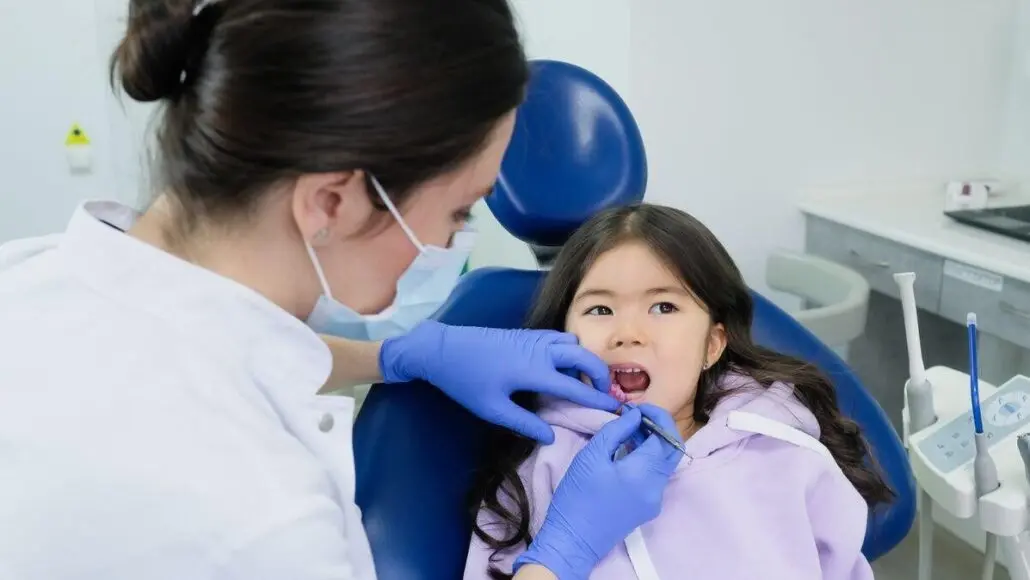
The most distinctive feature of a toddler dental exam is often the knee-to-knee position. Rather than having the child lie alone in the dental chair, the dentist and parent sit facing each other with knees touching, and the toddler sits in the parent’s lap facing the parent before leaning back to rest their head in the dentist’s lap. This keeps the child physically close to their caregiver while giving the dentist clear access to the mouth — a setup that meaningfully reduces distress compared to the traditional reclined chair position.
The exam itself involves counting teeth, checking the gums and soft tissues, assessing bite development, and looking for any early signs of decay. A quick cleaning or polishing may be performed, depending on the child’s tolerance and what the dentist observes. Pediatric dentists adapt their pacing and language throughout — narrating what they’re doing in child-friendly terms (“Let’s count your teeth like a little shark!”) and pausing when needed. The entire clinical interaction for a first visit rarely exceeds 15 to 20 minutes.
Fluoride, X-Rays, and Visit Length
Fluoride varnish is commonly applied at toddler visits as a preventive measure. The varnish — a concentrated fluoride coating painted directly onto tooth surfaces — has strong evidence behind it for reducing early childhood caries, and the American Academy of Pediatric Dentistry’s 2023 clinical guidelines support its use in children at elevated decay risk. Application takes about a minute and feels like a brush stroke on the teeth; toddlers are asked to avoid eating or drinking for 30 minutes afterward.
Dental X-rays at a first toddler visit are not routine unless there’s a specific clinical reason — typically a concern about decay between teeth that isn’t visible during the exam. When X-rays are taken for young children, lead aprons and modern digital sensors minimize radiation exposure significantly. The full visit, including check-in, exam, fluoride, and any parent discussion, typically wraps up in 30 to 45 minutes.
How to Prepare Your Child Beforehand
Knowing what happens during the visit sets realistic expectations for parents; preparing your toddler is a separate project that starts at home, in the days before the appointment. Toddlers process new experiences best when they’ve encountered them in a low-stakes form first — which means the preparation you do before arrival matters as much as anything that happens in the chair.
The core principle here is familiarity. Toddlers between 18 months and three years are developmentally in a stage where novelty and lack of control are primary anxiety triggers. A dental office is full of both: unfamiliar faces, sounds, smells, and equipment, combined with a situation where adults ask them to hold still and open wide. Preparation strategies that build familiarity before the visit directly address those triggers.
Keep the framing positive but honest. Telling a toddler “it won’t hurt” sets up a potential trust violation; instead, describing the visit as “the dentist counts your teeth and keeps them healthy” gives an accurate, non-threatening preview.
Role Play and Desensitization Activities
Playing dentist at home is one of the most effective preparation tools available, and it requires nothing more than a toothbrush and a stuffed animal. Let your toddler be the dentist first — examining the toy’s teeth, counting them, and “cleaning” them with a brush. Then switch roles and let your child be the patient while you narrate what you’re doing in simple terms. This kind of rehearsal helps children build a mental script for the experience so nothing feels entirely new.
Social stories — short, sequential narratives about what will happen, told in the second person (“First, we drive to the dentist. Then you sit with Mommy. The dentist counts your teeth…”) — are a technique borrowed from developmental psychology and used widely with toddlers and children with sensory sensitivities. Reading or telling the story two or three times in the days before the visit helps the child form an internal map of the experience.
Some pediatric practices also offer pre-visit tours, allowing a child to see the waiting room and operatory before any clinical contact. If this is an option, it’s worth requesting.
Day-Of Routines and Calming Strategies
On the day of the visit, predictability helps. Keep the morning routine as normal as possible — a rushed or disrupted morning raises baseline stress before you’ve even left the house. Schedule the appointment during a time when your child is typically well-rested and fed; a pre-nap visit with a hungry toddler is setting the stage for difficulty.
Bring a comfort object — a favorite stuffed animal or small toy — that the child can hold during the exam. Many pediatric dentists will incorporate the toy into the visit (“Should we check Bunny’s teeth first?”), which provides both distraction and a sense of agency. Avoid lengthy explanations in the car; simple, warm language works better: “We’re going to meet the tooth doctor today. They’re going to count your teeth and you can hold Bear the whole time.”
During the visit, follow the dentist’s lead on whether to talk to your child or stay quietly present. Pediatric dentists are trained in nonpharmacologic behavior management — techniques like tell-show-do, positive reinforcement, and distraction — and parents who mirror calm confidence rather than anxious hovering make those techniques more effective.
How to Choose and Work with a Pediatric Dentist
Not all dentists who see children have the same training. Board-certified pediatric dentists complete two to three years of specialty training after dental school, focused specifically on child development, behavior management, and the clinical differences between treating primary and permanent dentition. A general dentist may see children in their practice, but for toddlers and young children — especially anxious ones — a pediatric specialist brings additional tools and experience.
When evaluating practices, a few questions reveal a lot. Ask how the practice handles a child who becomes significantly distressed mid-exam: do they use tell-show-do and positive reinforcement, or is physical restraint (known as protective stabilization) ever used, and under what circumstances? Ask about their approach to fluoride and whether they follow current AAPD guidelines. Ask how they communicate findings and recommendations to parents, and what their process is for a dental emergency outside of office hours.
Reviews and referrals from other parents of young children in your community are a practical starting point, but they work best when combined with a brief phone consultation to ask clinical questions directly. The relationship you build with a pediatric dentist in the toddler years ideally carries forward for a decade or more — meaning the fit you establish now has compounding value.
Once you’ve chosen a practice, position yourself as a partner in your child’s care rather than a passenger. Share relevant health history, ask questions about preventive care between visits, and reinforce at home what the dentist recommends. Parents who model positive attitudes about dental care — brushing together, talking about teeth matter-of-factly — raise children who are significantly less anxious in the dental chair. That’s preparation that never really stops.