














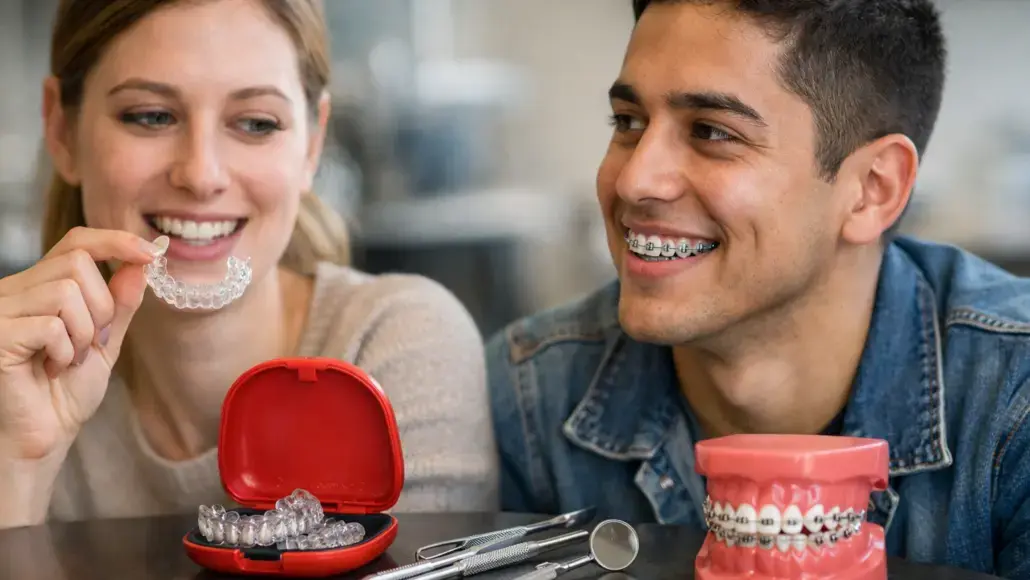

Most people decide between clear aligners and braces based on one factor — how they’ll look during treatment. That’s understandable, but it’s also how people end up in the wrong treatment for their specific situation. The American Association of Orthodontists estimates that more than four million people in the United States are currently in orthodontic treatment, and the range of devices, providers, and clinical approaches available today is wider than it’s ever been. That breadth creates real opportunity, but also real potential for mismatched choices.
The decision isn’t simply cosmetic versus traditional. It involves clinical complexity, treatment mechanics, daily compliance demands, cost structures, and what happens after the active treatment phase ends. A choice that’s ideal for a working adult with mild crowding may be genuinely wrong for a teenager with a skeletal bite problem — and the difference between those two cases comes down to biology and biomechanics, not preference. This article walks through four dimensions of that decision: why the stakes are higher than most people assume, how each system actually moves teeth, what the comparative evidence shows about outcomes, and how to weigh the practical factors that make the difference in real-world situations.
Why Choosing Aligners or Braces Matters
The framing most people bring to this decision — which option looks better during treatment — captures only a fraction of what’s actually in play. What matters clinically is whether the chosen method can reliably achieve the intended tooth movement in your specific case, hold that result long-term, and do so within a timeframe and lifestyle structure you can realistically sustain.
Treatment duration is a good example of a factor that looks simple but isn’t. Mild cases treated with aligners can sometimes finish faster than the same cases treated with braces because digital planning allows precise staging from the start. But moderate-to-complex cases often take longer with aligners than braces — or produce incomplete corrections — because fixed appliances can apply continuous force and torque that removable trays cannot consistently replicate. For someone expecting an 18-month treatment and landing at 30 months with multiple refinement rounds, that miscalibration has real consequences: cost overruns, frustration, and sometimes a result that still requires further intervention.
Daily life tradeoffs also matter more than they appear upfront. Aligners require removal before eating or drinking anything other than water, consistent 20–22 hours of daily wear, and disciplined cleaning routines. That’s manageable for a motivated adult but genuinely challenging for adolescents whose compliance can fluctuate week to week. Fixed braces impose dietary restrictions and hygiene demands of their own — but because they’re not removable, they enforce treatment progress regardless of patient motivation.
Long-term stability deserves its own consideration. Both options require retention after active treatment, but relapse patterns differ and depend partly on which mechanics were used to move the teeth. Understanding this before choosing a system helps set realistic expectations for the decade or more following treatment — not just the active phase.
How Aligners and Braces Move Teeth
The core mechanical difference between these two systems explains most of the variation in what they can treat, how long treatment takes, and where each approach has limits. Both apply force to teeth to trigger the biological process of bone remodeling, but how they generate and sustain that force is fundamentally different.
How Clear Aligners Move Teeth
Clear aligner therapy works through a series of custom-fabricated, thermoplastic trays — each tray representing a small incremental movement toward the final planned position. The treatment plan is built digitally before a single tray is made, mapping out every tooth movement in sequence. Patients progress through trays on a schedule, typically every one to two weeks, with each new tray applying light pressure to reposition teeth a fraction of a millimeter at a time.
For many tooth movements, aligners require attachments — small composite bumps bonded to tooth surfaces that give the tray a physical grip point to create rotation, extrusion, or more complex torquing forces. Interproximal reduction (IPR), the careful removal of tiny amounts of enamel between teeth, is also frequently used to create space without extractions.
The system’s effectiveness depends heavily on two things: the precision of the digital treatment plan and patient compliance with wear time. When both are strong, aligners perform well for mild-to-moderate spacing, crowding, and some bite corrections. When compliance is inconsistent, or when the planned movements exceed what the tray geometry can reliably achieve, results diverge from projections and refinement trays become necessary.
How Braces Move Teeth
Traditional fixed braces work through a continuous-force system: metal or ceramic brackets bonded to each tooth connect via an archwire, which is progressively adjusted during in-office appointments to guide teeth into alignment. The archwire threads through slots in each bracket, and the friction and tension in that system apply force constantly — regardless of what the patient eats or how motivated they feel on a given day.
The clinical advantage of fixed appliances lies in torque control and the ability to handle complex, three-dimensional tooth movements. Orthodontists can apply different wire types and gauges, use elastics to correct bite relationships, and make precise adjustments to individual teeth that go beyond what aligner staging can typically achieve. For cases involving significant rotations, severe crowding requiring extraction mechanics, skeletal discrepancies, or intrusion and extrusion of specific teeth, braces offer a level of control that aligners currently can’t match.
In-office adjustment appointments typically occur every four to eight weeks. That regular clinical contact also means orthodontists are monitoring progress frequently and can intervene early if a tooth isn’t responding as planned.
Effectiveness and Long-Term Results
Understanding the mechanical differences between aligners and braces raises an obvious question: which one actually produces better outcomes? The answer, unsurprisingly, is “it depends on case complexity” — but the research is specific enough to be genuinely useful.
Research on Aligner and Brace Success Rates
For mild-to-moderate malocclusions, peer-reviewed evidence suggests aligners and braces produce broadly comparable outcomes. A 2019 systematic review published in the *European Journal of Orthodontics* found no statistically significant difference in overall occlusal outcomes between aligner therapy and fixed appliances for cases of low-to-moderate complexity, though braces showed advantages in specific tooth movement types, particularly rotation and torque control.
Where aligners tend to underperform relative to braces is in complex cases — significant crowding requiring extractions, large overbite or underbite corrections, and cases involving vertical control. These situations require the kind of continuous, three-dimensionally precise force that fixed mechanics deliver more predictably. Many orthodontists note that the revision rounds (“refinements”) common in aligner treatment for complex cases extend total treatment time in ways that aren’t always communicated clearly upfront.
Treatment duration for straightforward cases is fairly comparable between the two systems, though individual variation is wide. What’s more predictable is that complex cases treated with braces tend to finish closer to original time estimates than complex cases treated with aligners, where refinements can add months to the timeline.
Long-Term Outcomes and Relapse Risk
Both aligner-treated and brace-treated patients face the same fundamental post-treatment reality: without consistent retention, teeth will shift. The bone and periodontal tissue that remodeled during treatment continue to respond to biological and mechanical forces afterward, and relapse is a genuine risk for both groups.
Where the paths diverge is in what relapse looks like. A 2020 study in the *Angle Orthodontist* found that aligner-treated patients showed slightly higher rates of anterior crowding relapse compared to brace-treated patients when both groups used removable retainers — possibly because some of the original tooth movements in aligner cases were less fully expressed at the bone level. Fixed (bonded) retainers behind the front teeth are increasingly recommended for both groups to reduce this risk, particularly for patients who had significant initial crowding.
Retainer compliance after treatment matters enormously and is independent of which appliance was used. The research consistently supports indefinite retainer wear — typically nightly after an initial full-time phase — as the most reliable way to preserve results from either system.
How to Choose for Your Situation
With the mechanical and clinical picture in place, the decision becomes a matter of matching those realities to your specific case, age, lifestyle, and budget. No framework works universally, but the variables that matter most are knowable before you commit.
Age, Case Severity, and Suitability
For adults with mild-to-moderate crowding, spacing, or minor bite issues — and a track record of self-discipline — aligners are a clinically sound option that also offers the lifestyle benefit of removability. Invisalign treatment and similar systems have produced reliable outcomes in this patient profile, and for those already considering it, providers offering Invisalign treatment can assess case suitability based on digital scans rather than impressions.
For teenagers, the calculus shifts. Adolescent compliance with 22-hour daily wear is inconsistent enough that many orthodontists recommend braces as the default unless the patient and family have a specific, motivated reason for aligners. Some aligner systems include compliance indicators to help monitor wear time, but they can’t substitute for intrinsic motivation.
For any patient — adult or teen — with severe malocclusion, significant skeletal involvement, or complex rotation and torque requirements, braces remain the clinical standard. Attempting to treat these cases with aligners typically results in longer treatment, more refinements, and outcomes that fall short of what fixed appliances could have achieved. A clear-eyed assessment from a board-certified orthodontist before committing to either path is the single most valuable step in this decision.
Cost Factors, Daily Care, and Retainers
Cost for both systems varies significantly by case complexity, geographic market, and provider type. General dentists offering aligner therapy typically charge less than orthodontists, but may have less experience managing complex tooth movements or identifying when a case has exceeded aligner capability. More complex cases cost more regardless of appliance type, and aligner refinements — while sometimes included in treatment contracts — can add expense if they fall outside the original scope.
Daily maintenance differs in practical terms. Aligners require removal before meals and thorough cleaning of both trays and teeth before reinsertion. Fixed braces require more careful brushing and flossing technique around brackets and wires. Neither is especially burdensome, but both require consistent habits to avoid decalcification or gum issues during treatment.
Post-treatment, retainer investment is non-negotiable. Bonded lingual retainers offer passive, compliance-free retention for the front teeth and are widely recommended following either treatment type. Removable retainers cover the full arch and allow ongoing monitoring but depend on patient behavior. Choosing a provider who builds a clear retention protocol into the treatment plan — not an afterthought conversation on the day braces come off — is one of the most practically important factors in long-term outcome stability.
The question to bring to your orthodontic consultation isn’t “which option looks better?” It’s: “Given my specific tooth movements and case complexity, which system is more likely to finish on time, finish completely, and stay that way?”