












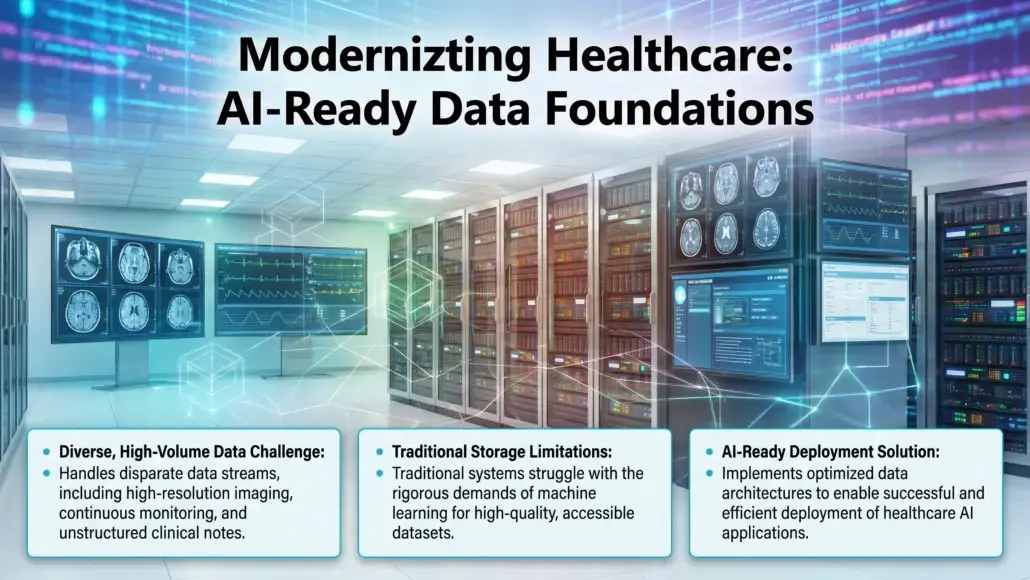

The modern healthcare facility operates within a digital environment that generates vast quantities of disparate data points every second. From high resolution medical imaging to continuous physiological monitoring and unstructured clinical notes, the volume and variety of information are staggering. Traditional storage methods often fail to meet the rigorous demands of machine learning models which require high quality, labeled, and accessible data sets. The implementation of ai-ready data architectures improving deployment of healthcare ai applications represents a fundamental shift from static storage to dynamic, intelligence-first frameworks. These structures prioritize low latency access to longitudinal patient records, allowing algorithms to process information in contexts that reflect the actual clinical environment. Without these specialized architectures, even the most sophisticated neural networks remain confined to research silos, unable to perform effectively in the high pressure atmosphere of a hospital or clinic.
A foundational element of these architectures is the transition to cloud native environments that offer elastic scalability. Healthcare organizations must move away from rigid on premises servers that struggle to handle the computational bursts required for training and deploying large scale models. By adopting microservices and containerized applications, IT departments can ensure that their infrastructure remains flexible enough to accommodate evolving AI requirements. This modularity allows for the isolation of specific data streams, ensuring that a surge in genomic sequencing data does not impede the flow of real time cardiac monitoring alerts. Additionally, the decoupling of storage and compute resources enables more efficient resource allocation, which is critical for maintaining budget stability in an industry characterized by tight margins and increasing operational costs.
The role of data labeling and metadata enrichment cannot be overstated in this context. AI models are only as effective as the data they are fed, and in healthcare, the quality of that data often depends on the richness of its associated metadata. Modern architectures incorporate automated pipelines for tagging and cleaning data as it enters the system, reducing the manual burden on clinical staff and data scientists. These pipelines utilize natural language processing to extract meaningful features from physician narratives, converting free text into structured formats that are ready for analysis. By embedding these capabilities directly into the data layer, organizations can maintain a continuous supply of high fidelity information, thereby facilitating the rapid iteration and improvement of clinical models.
Integrating Legacy Systems with Modern Vector Databases
One of the most significant hurdles in the digital transformation of healthcare is the presence of legacy systems that were never designed to interact with modern artificial intelligence. These older platforms often store data in proprietary formats, creating silos that prevent a holistic view of the patient journey. To address this, organizations are increasingly looking toward hybrid solutions that bridge the gap between traditional relational databases and contemporary vector databases. The use of ai-ready data architectures improving deployment of healthcare ai applications involves creating sophisticated middleware layers that can ingest data from legacy electronic health records and transform it into high dimensional vectors. This process allows for semantic search and complex pattern recognition that is simply not possible with standard SQL queries.
Vector databases are particularly useful for handling the multimodal data sets that define modern medicine. By representing images, text, and genomic data as vectors in a shared space, healthcare providers can perform similarity searches that identify patients with comparable clinical profiles. This capability is essential for precision medicine, where treatment plans are tailored to the individual characteristics of a patient. Integrating these databases requires a careful strategy for data synchronization, ensuring that information remains consistent across all systems. Organizations must establish clear protocols for data ingestion and version control to avoid the pitfalls of data drift, which can lead to inaccurate model predictions and potential patient safety issues.
Additionally, the integration process must prioritize data integrity and lineage. In a clinical setting, it is vital to know the origin of every data point and the transformations it has undergone. This transparency is necessary for regulatory compliance and for building trust among clinicians who rely on AI driven insights. Modern architectures incorporate blockchain or distributed ledger technologies to create immutable records of data access and modification. This level of accountability ensures that any errors can be traced back to their source, facilitating rapid resolution and preventing the recurrence of similar issues. By creating a transparent and reliable data foundation, healthcare systems can more confidently deploy advanced analytics that improve patient outcomes.
Ensuring Interoperability through Standardized Data Liquidity
The ability of different systems to communicate and exchange data is a cornerstone of effective healthcare delivery. For AI to reach its full potential, data must be able to move freely across the entire continuum of care, from primary care offices to specialized surgical centers. The adoption of international standards like Health Level Seven International Fast Healthcare Interoperability Resources (FHIR) is critical for achieving this level of liquidity. When ai-ready data architectures improving deployment of healthcare ai applications are built upon FHIR standards, they enable a common language that simplifies the integration of third party AI tools. This standardization reduces the time and cost associated with custom API development, allowing for more rapid deployment of innovative solutions.
Interoperability also extends to the way data is represented within the AI models themselves. By using standardized terminologies such as SNOMED CT and LOINC, organizations can ensure that their models are portable and can be validated across different clinical sites. This consistency is essential for conducting large scale clinical trials and for generating real world evidence that can inform regulatory decisions. Additionally, standardized data architectures facilitate the creation of synthetic data sets, which can be used to train models without compromising patient privacy. These synthetic data sets are particularly valuable for rare disease research, where the number of actual patient cases may be insufficient for training deep learning algorithms.
The movement toward open data architectures encourages collaboration between healthcare providers, technology vendors, and academic researchers. By breaking down the barriers to data sharing, the industry can accelerate the pace of innovation and more quickly address the most pressing challenges in patient care. However, this openness must be balanced with rigorous security measures to protect sensitive health information. Modern architectures utilize advanced encryption and anonymization techniques to ensure that data remains private even as it is shared for research purposes. This dual focus on liquidity and security is what makes these architectures truly ready for the demands of 21st century medicine.
Security and Governance in Federated Learning Environments
As healthcare data becomes more centralized and accessible, the risks associated with cyberattacks and data breaches increase. Protecting patient privacy is not just a legal requirement but a moral imperative that is central to the physician patient relationship. Consequently, ai-ready data architectures improving deployment of healthcare ai applications must incorporate security by design. This involves implementing zero trust security models where every user and device must be authenticated and authorized before accessing any part of the network. Multi factor authentication, end to end encryption, and continuous monitoring are standard components of a modern, secure healthcare data infrastructure.
Federated learning is emerging as a powerful strategy for training AI models while keeping data localized and secure. In a federated learning environment, models are sent to the data rather than the other way around. Each participating institution trains the model on its own local data and then sends only the updated model parameters back to a central server. This approach minimizes the risk of data exposure during transit and allows institutions to collaborate without sharing raw patient records. Building the architecture to support federated learning requires significant investment in orchestration tools that can manage the complex workflows across multiple sites. It also requires a comprehensive governance framework to ensure that all participants adhere to the same standards for data quality and security.
Governance is equally important within the walls of a single institution. Healthcare organizations must establish clear policies for data ownership, access, and usage. This includes creating data ethics committees to oversee the development and deployment of AI models, ensuring that they are fair, transparent, and unbiased. The data architecture should support these governance efforts by providing tools for auditing and reporting on data usage. By creating a culture of accountability and transparency, healthcare systems can build the trust necessary for AI to be widely accepted by both patients and providers.
Optimizing Data Pipelines for Real Time Clinical Inference
The final test of any healthcare AI architecture is its ability to deliver actionable insights at the point of care. For this to happen, data pipelines must be optimized for real time inference, processing incoming data and generating predictions in seconds. This requires a high performance computing environment that can handle the intensive mathematical operations involved in neural network execution. Many organizations are turning to edge computing, where AI models are deployed on devices close to the patient, such as bedside monitors or wearable sensors. This proximity reduces latency and allows for immediate response to critical changes in a patient’s condition.
Real time inference also necessitates a shift in how data is processed. Instead of batch processing, where data is collected over time and analyzed in large chunks, organizations must adopt stream processing techniques. Stream processing allows for the continuous analysis of data as it is generated, enabling early detection of trends and anomalies. This is particularly valuable in intensive care units, where minutes can make the difference between life and death. The data architecture must be able to handle these high velocity streams while maintaining the accuracy and reliability of the AI models.
In addition, the output of AI models must be integrated into the clinical workflow in a way that is intuitive and useful for clinicians. This involves designing user interfaces that present AI generated insights alongside other patient data, providing a comprehensive view of the clinical situation. It also requires mechanisms for feedback, allowing clinicians to validate or challenge the AI predictions. This human in the loop approach is essential for ensuring that AI remains a tool that supports, rather than replaces, clinical judgment. By optimizing every step of the process from data ingestion to clinical action, healthcare organizations can truly realize the benefits of the intelligence age.
The transition to sophisticated data frameworks is not merely a technical challenge but a strategic necessity for the future of medicine. As the volume of clinical data continues to grow, only those institutions with the right infrastructure will be able to turn that data into knowledge and that knowledge into better patient outcomes. The investment in these architectures is an investment in the health and well being of the entire population, ensuring that the promise of artificial intelligence is fulfilled in every hospital and clinic across the globe. By focusing on scalability, interoperability, and security, the healthcare industry can build a foundation that supports innovation for decades to come.