










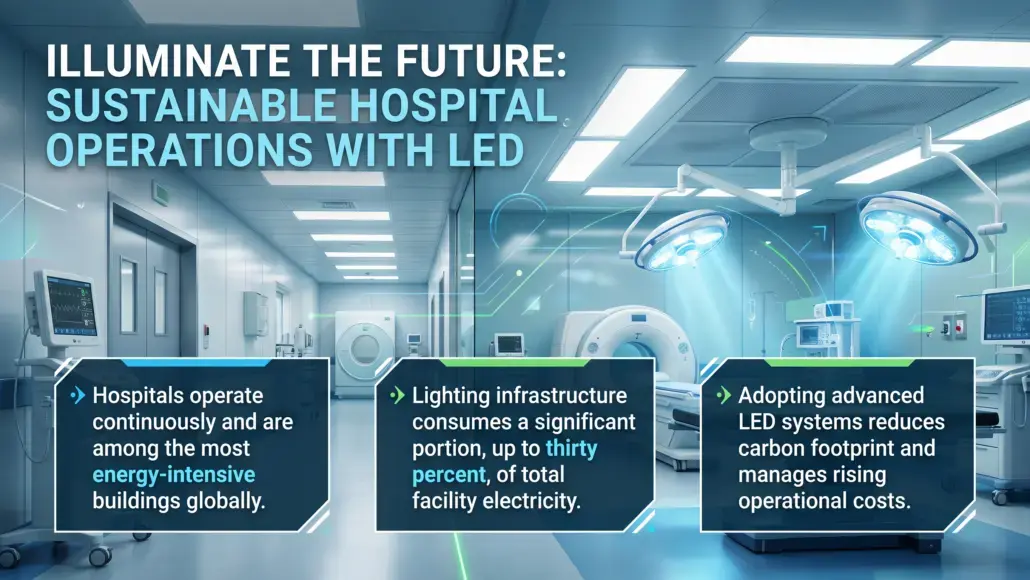
Healthcare institutions are among the most energy-intensive buildings in the world, operating continuously to provide life-saving care and critical medical services. The lighting infrastructure in these facilities accounts for a significant portion of their total electricity consumption, often representing up to thirty percent of the building’s energy load. As the healthcare sector faces increasing pressure to reduce its carbon footprint and manage rising operational costs, the adoption of advanced illumination technologies has become a strategic priority. The shift toward solid-state lighting, particularly through the use of light-emitting diodes, offers a path to substantial energy savings without compromising the quality of the clinical environment. This transition is a cornerstone of modernizing energy-efficient LED systems, providing a foundation for sustainable facility management.
The move to LED technology is not merely a replacement of old bulbs with new ones but a comprehensive upgrade of the entire lighting ecosystem. Unlike legacy systems such as fluorescent or halogen lighting, LEDs offer unparalleled control over light output, allowing for precise dimming and spectral adjustment. This flexibility means that hospitals can provide high-intensity light in surgical suites while maintaining much lower, more efficient levels in corridors and administration offices. The inherent efficiency of these systems translates directly into lower utility bills, which is a major concern for administrators who must balance clinical excellence with financial viability. By reducing the energy required for illumination, facilities can redirect these savings toward direct patient care and medical innovation.
Additionally, the environmental impact of these systems is significant. By consuming less electricity, hospitals reduce their indirect greenhouse gas emissions, contributing to regional and national climate goals. Additionally, LEDs do not contain hazardous materials like mercury, which is commonly found in fluorescent tubes, making them easier and safer to dispose of at the end of their life cycle. This holistic approach to sustainability is essential for healthcare organizations that seek to uphold the principle of “do no harm,” extending their mission of health to the broader environment. The integration of sustainable infrastructure is thus a reflection of a commitment to both fiscal responsibility and environmental stewardship.
Maximizing Operational Efficiency Through LED Technology Integration
The integration of LED technology into a hospital’s operational framework allows for a more granular approach to energy management. One of the most significant advantages of LEDs is their ability to work in harmony with advanced control systems. Unlike older technologies that could be damaged by frequent switching or dimming, LEDs are perfectly suited for use with occupancy sensors and daylight harvesting protocols. In areas like storage rooms, restrooms, and staff break areas, sensors can ensure that lights are only active when someone is present. This eliminates the common problem of lights being left on in unoccupied spaces, which is a major source of energy waste in large medical complexes.
Daylight harvesting is another key technique for maximizing efficiency. Many modern hospitals are designed with large windows to provide natural light for patient wellbeing. LED systems equipped with photosensors can automatically adjust their output based on the amount of sunlight entering the room. On bright days, the system can dim the electric lights to a minimum, maintaining a constant light level while saving significant amounts of power. This seamless coordination between natural and artificial light ensures that the facility remains perfectly lit while minimizing the consumption of electricity. This level of optimization is a core component of how modern illumination is managed in clinical buildings.
Beyond simple energy reduction, the high quality of LED light can improve the efficiency of clinical tasks. Improved color rendering and the absence of flicker can reduce eye strain for surgeons and diagnostic staff, potentially leading to faster and more accurate procedures. When staff can see more clearly, they can work more effectively, which is a significant operational benefit. The reliability of these systems also means that there are fewer instances of light failure during critical moments, enhancing the overall safety and performance of the facility. The operational benefits of LED technology thus extend far beyond the utility bill, influencing the daily productivity of the entire medical team.
The Impact of Energy-Efficient Illumination on Facility Sustainability
Sustainability in healthcare is a multi-faceted challenge that encompasses energy use, waste management, and the creation of a healthy indoor environment. Energy-efficient lighting is a critical piece of this puzzle. By reducing the overall demand on the electrical grid, hospitals can help stabilize local energy systems and reduce the need for fossil fuel-based power generation. This is particularly important for large academic medical centers that serve as anchor institutions in their communities. By leading the way in energy efficiency, these organizations set a standard for other public buildings to follow, demonstrating that sustainability is both achievable and beneficial in a demanding clinical context.
The heat dissipation characteristics of LEDs also contribute to facility sustainability. Legacy lighting systems generate a significant amount of heat as a byproduct of light production, which in turn increases the load on the hospital’s HVAC system. Because LEDs are much cooler to the touch and convert more energy into light rather than heat, they help maintain a more stable indoor temperature. This reduces the energy required for cooling, especially during the summer months or in regions with warm climates. The synergy between lighting and climate control is a significant factor in the overall energy profile of the building, and the use of LED systems is a key strategy for optimizing this relationship.
In addition, the long-term sustainability of the facility is enhanced by the reduced need for material replacements. A typical LED fixture can last for fifty thousand to one hundred thousand hours, compared to only ten thousand to fifteen thousand hours for high-quality fluorescent tubes. This means that far fewer fixtures are manufactured, transported, and disposed of over the life of the building. The reduction in the consumption of raw materials and the minimization of waste are essential aspects of a circular economy in healthcare. By choosing modern lighting solutions, facilities managers are making a long-term investment in the environmental health of their community.
Maintenance and Longevity Benefits in 24-Hour Clinical Settings
Maintenance in a hospital setting is a complex and often disruptive process. Replacing a failed light fixture in a sterile operating room or a busy intensive care unit requires significant preparation, including the temporary relocation of patients and the re-sterilization of the space. The extreme longevity of LED systems drastically reduces the frequency of these interventions, minimizing the downtime of critical clinical areas. This reliability is a major advantage for facilities teams who are tasked with maintaining a safe and operational environment around the clock. By reducing the “maintenance burden,” staff can focus their attention on more complex infrastructure systems that require regular oversight.
The predictable lifecycle of LEDs also allows for better planning and budgeting. Modern LED fixtures often incorporate self-diagnostic capabilities that can report their status to a central management system. This allows maintenance teams to identify fixtures that are reaching the end of their useful life before they actually fail. Instead of reacting to emergency failures, the team can schedule replacements during planned maintenance windows, ensuring that the facility remains fully illuminated at all times. This shift from reactive to proactive maintenance is a hallmark of professional facility management and is made possible by the digital nature of solid-state lighting.
Additionally, the durability of LED components makes them well-suited for the demanding physical environment of a hospital. They are resistant to vibration and impact, which is important in areas where medical carts and heavy equipment are frequently moved. The lack of glass envelopes or delicate filaments means that there is a much lower risk of breakage and the subsequent release of hazardous materials or sharp fragments. This inherent safety is a key consideration in the selection of modern fixtures, providing peace of mind for both the facilities staff and the clinical teams who rely on the lighting for their daily work.
Financial Justification and ROI of Large-Scale LED Upgrades
The primary barrier to large-scale LED upgrades is the initial capital cost, which can be significant for a multi-building hospital complex. However, the financial justification for these projects is strong when viewed through the lens of total cost of ownership. The return on investment is driven by three main factors: direct energy savings, reduced maintenance costs, and potential utility rebates. In many cases, the energy savings alone are enough to pay back the initial investment within three to five years. When the avoided costs of labor and materials for maintenance are included, the payback period is often even shorter. For an institution with a long-term horizon, the cumulative savings over ten or twenty years are immense.
Many utility companies and government agencies offer financial incentives for energy efficiency projects, which can significantly offset the upfront costs. These rebates are designed to encourage large institutions to reduce their demand on the grid, especially during peak hours. By partnering with these organizations, hospitals can secure the funding needed to accelerate their lighting upgrades. Also, the availability of lighting-as-a-service models allows facilities to implement LED systems with little to no upfront capital, instead paying for the lighting out of their operational budget. This creative financing makes it possible for even resource-constrained facilities to benefit from the latest technology.
The financial benefits also extend to the value of the building itself. A facility with a modern, energy-efficient infrastructure is more attractive to investors and more resilient to future increases in energy prices. As energy regulations become stricter, hospitals that have already upgraded their systems will be better positioned to comply with new standards without incurring additional costs. The investment in sustainable infrastructure is therefore a sound financial strategy that protects the institution’s assets and ensures its long-term stability. The ability to demonstrate a clear ROI is essential for securing the approval of hospital boards and executive leadership for these vital infrastructure projects.
Strategic Integration of Energy-Efficient LED Systems
Successful implementation of an LED strategy requires more than just buying the most efficient fixtures. It requires a strategic approach that considers the specific needs of each department and the overall goals of the facility. This involves working with lighting designers, engineers, and clinical staff to develop a comprehensive plan that balances efficiency with the quality of care. The plan should include a detailed audit of the existing lighting, a clear set of performance specifications, and a timeline for implementation that minimizes disruption to hospital services. By taking a holistic view, facilities can ensure that the new systems provide the maximum possible benefit to the organization.
The selection of the right control system is just as important as the choice of fixtures. A sophisticated control network allows the hospital to fine-tune its energy use based on real-time data, ensuring that no watt is wasted. This involves setting up schedules, defining zones, and integrating the lighting with other building systems. The data collected by these systems can also provide valuable insights into how the facility is being used, allowing for even further optimizations over time. This data-driven approach is a key part of how modern energy-efficient LED systems are evolving to meet the challenges of the future.
Finally, the education of staff and patients is a critical component of the strategy. While the systems are largely automated, people still need to understand how to interact with the lighting in their environment. Providing simple instructions on how to use bedside controls or explaining the benefits of the new lighting can help ensure that the systems are used effectively. By involving the entire hospital community in the energy-saving mission, the facility can create a culture of sustainability that extends beyond the lighting system. The transition to energy-efficient lighting is a visible and powerful symbol of a hospital’s commitment to a healthier future for its patients, its staff, and the planet. The ongoing evolution of these systems will continue to play a vital role in the success and sustainability of the healthcare sector.