










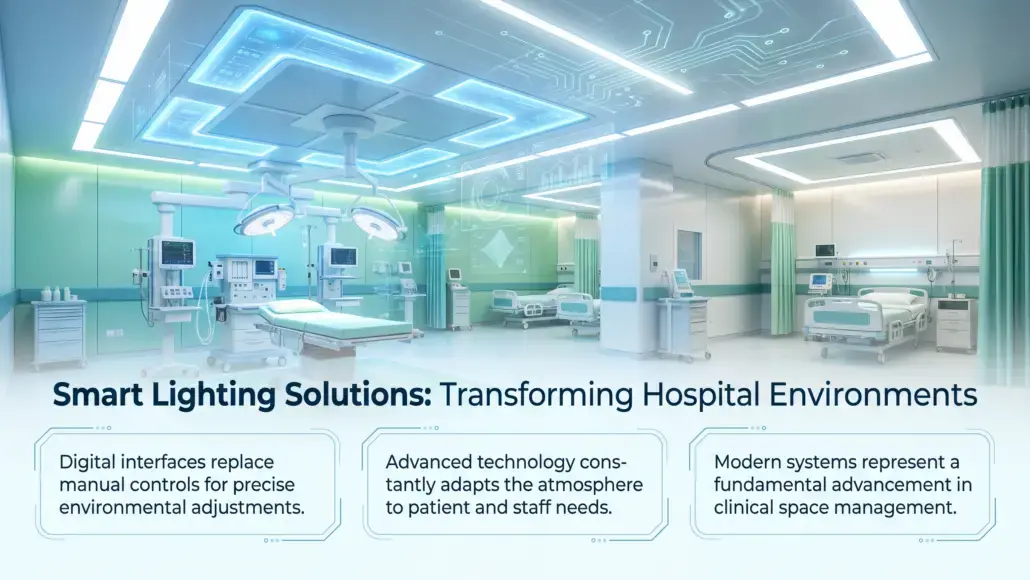
The transition from manual switches to sophisticated digital interfaces in healthcare facilities represents a fundamental advancement in how clinical spaces are managed. Modern medical environments require a level of environmental precision that legacy systems simply cannot provide. By employing advanced technologies, facilities can ensure that the internal atmosphere is constantly adjusted to meet the specific needs of patients, medical staff, and administrative operations. These systems go beyond simple on-off functions, offering granular control over every aspect of the lighting output, including intensity, duration, and spectral distribution. This level of oversight is essential in a setting where the environment can directly influence physiological parameters and the accuracy of critical medical tasks.
Implementing advanced control architectures allows for the creation of a responsive ecosystem that adapts to the real-time conditions of the facility. Sensors placed throughout the building monitor occupancy, daylight levels, and even specific clinical activities to provide the optimal amount of light at all times. This proactive management reduces the cognitive load on staff, who no longer need to manually adjust settings during their busy shifts. Additionally, by centralizing the management of these assets, facilities managers can gain valuable insights into how energy is being consumed and how different areas are being utilized. This data-driven approach is a key component of modernizing infrastructure, ensuring that resources are used efficiently while maintaining the highest standards of care.
The use of advanced systems improves clinical outcomes by providing the necessary flexibility to accommodate a wide variety of medical environmental needs. For instance, a single room may need to transition from a low-light resting state to a high-intensity surgical setting in a matter of seconds. Digital control systems make this possible through pre-programmed scenes that can be activated via touchscreens, voice commands, or automated triggers. This versatility ensures that the environment is always aligned with the clinical requirements of the moment, facilitating better outcomes and a more professional workspace. As these technologies continue to evolve, they are becoming an indispensable part of the healthcare design process, bridging the gap between physical infrastructure and digital management.
Implementing Networked Systems for Dynamic Environmental Control
Advanced networks form the backbone of modern hospital environmental management, connecting thousands of individual fixtures into a unified, controllable grid. This connectivity allows for a level of coordination that was previously impossible. Through a centralized server or cloud-based platform, managers can set global policies for lighting behavior, such as dimming levels for corridors during overnight hours or mandatory safety illumination in emergency exits. This global control is balanced by the ability to drill down to individual rooms or even specific fixtures, allowing for highly localized adjustments. This dual-layered approach ensures that the facility remains compliant with safety standards while still meeting the specific needs of each department.
The communication protocols used in these networks, such as DALI (Digital Addressable Lighting Interface) or Zigbee, are designed for reliability and scalability. In a large hospital complex, where interference from medical equipment is a concern, selecting the right communication standard is vital. These systems must be able to handle vast amounts of data without latency, ensuring that commands are executed instantly. In addition, the integration of these networks with other building management systems, such as HVAC and security, allows for a more holistic approach to facility operations. When the lighting system detects that a room is unoccupied, it can signal the HVAC system to reduce airflow, further optimizing the energy profile of the building.
The deployment of networked systems also facilitates predictive maintenance, which is a significant advantage in a 24-hour clinical setting. By monitoring the performance and health of every fixture in real time, the architecture can identify potential failures before they occur. This allows maintenance teams to schedule repairs during off-peak hours, minimizing disruptions to patient care. This proactive stance on infrastructure management is a direct result of the visibility provided by digital controls. It ensures that the facility remains fully operational at all times, supporting the rigorous demands of medical practice.
Smart Lighting Controls in Specialized Medical Treatment Zones
In specialized areas such as operating theaters, intensive care units, and diagnostic imaging suites, the requirements for lighting are exceptionally stringent. These zones demand precision automation that can react to the specific tasks being performed. For example, during a surgical procedure, the ambient lighting must be dimmed to enhance the visibility of monitor screens, while the surgical lights provide focused, high-intensity illumination. Advanced digital controls in these spaces allow for the seamless transition between these states through pre-defined clinical protocols. This automation ensures that the medical team can focus entirely on the patient without being distracted by the environmental settings.
Diagnostic imaging suites, such as those housing MRI or CT scanners, require specialized non-ferrous lighting components and controls that do not interfere with sensitive magnetic fields. The ability to program specific lighting sequences in these rooms can also help reduce patient anxiety. By using soft, colored light and gentle transitions, the system can create a more soothing atmosphere for patients undergoing stressful procedures. This use of light as a therapeutic tool is made possible by the granular control offered by digital systems. It demonstrates how technology can be used to improve the patient experience while still meeting the technical requirements of the medical equipment.
Additionally, in neonatal intensive care units, the lighting must be carefully managed to protect the developing eyes and nervous systems of premature infants. Automated systems can provide very low light levels with specific spectral properties, mimicking the environment of the womb. These systems can also incorporate “dawn-dusk” cycles that are much gentler than standard indoor lighting, helping to establish early circadian patterns. This level of precision is only achievable through the use of dedicated lighting controllers that can operate at the very low end of the dimming curve. It highlights the importance of choosing high-quality control components that are specifically rated for clinical use.
Integrating Lighting Controls with Hospital Data Ecosystems
The convergence of lighting systems with broader hospital data ecosystems is opening new possibilities for facility optimization. By treating the lighting network as a data-gathering infrastructure, hospitals can collect information on occupancy patterns, staff movement, and asset location. Many modern LED fixtures are equipped with sensors that can track Bluetooth or Wi-Fi signals, allowing the facility to monitor the flow of people and equipment in real time. This data can be used to optimize cleaning schedules, improve patient throughput, and ensure that critical equipment is always where it is needed. Lighting is no longer just a source of illumination; it is a vital part of the hospital’s nervous system.
Integrating these data streams with the electronic health record system can even allow for personalized environmental settings based on the patient’s clinical status. For instance, if a patient’s records indicate a history of light-sensitive migraines, the system can automatically limit the maximum brightness in their recovery suite. While this level of integration is still in the early stages of adoption, the underlying technology is already available. The ability to link the physical environment with clinical data represents the next frontier in personalized medicine, where the room itself becomes an active participant in the healing process.
Security and privacy are paramount when integrating lighting controls with hospital data. These networks must be protected by the same level of encryption and firewalls as the rest of the medical infrastructure. Ensuring that the data collected by the lighting sensors is used ethically and in compliance with patient privacy laws is a critical responsibility for hospital administrators. However, the benefits of this integration, in terms of operational efficiency and improved care, are too significant to ignore. By embracing a data-centric approach to lighting, healthcare facilities can achieve a level of optimization that was previously unimaginable.
The Role of User-Centric Controls in Patient Recovery Suites
In patient recovery suites, the focus shifts toward providing the individual with a sense of control over their environment. Studies have shown that giving patients the ability to adjust their own lighting, temperature, and window shades can lead to higher levels of satisfaction and lower perceived stress. Effective digital interfaces offer intuitive controls, such as bedside tablets or simplified wall panels, that allow patients to choose their preferred settings. This empowerment is particularly important for long-term patients who may feel a loss of autonomy during their hospital stay.
These user-centric controls must be designed with accessibility in mind. Large buttons, high-contrast displays, and voice activation are all features that can make the system easier to use for patients with varying levels of physical or cognitive ability. For nursing staff, the system can provide an “override” function that allows them to instantly return the room to a clinical setting when necessary. This balance between patient comfort and clinical necessity is a key design challenge in modern recovery suites. By providing a flexible lighting environment, hospitals can create a space that feels more like a home and less like an institution.
Beyond individual room control, smart systems can also provide “wellness” modes that are designed to help patients relax or focus. For example, a “reading” mode might provide a focused beam of light on the bed while dimming the rest of the room, while a “night” mode might provide very low-level amber light for safe movement to the bathroom without disrupting sleep. These pre-programmed scenes make it easy for patients to find the right setting for their activities, further enhancing their comfort. This attention to the human experience is what sets modern healthcare lighting apart from the purely functional systems of the past.
Future Directions for Smart Lighting Controls and Automation
As we look toward the future, the role of lighting controls in healthcare will only continue to expand. The development of Li-Fi technology, which uses light waves to transmit data, could provide a more secure and interference-free alternative to Wi-Fi in sensitive clinical areas. This would allow for even more seamless integration between medical devices and the hospital network, all powered by the lighting infrastructure. Additionally, the use of artificial intelligence to analyze the data collected by lighting sensors could lead to even more sophisticated forms of automation. An AI-driven system could learn the typical patterns of a specific department and proactively adjust the environment to optimize for efficiency and staff wellbeing.
Another area of growth is the use of bio-feedback in lighting control. By connecting wearable devices to the lighting system, it may be possible to adjust the environment based on a patient’s real-time physiological data, such as heart rate or skin conductance. This would create a truly responsive healing environment that adapts to the patient’s needs second by second. While these technologies are still being researched, the potential for improving clinical outcomes is immense. The hospital of the future will be a highly intelligent, interconnected space where the environment is as carefully managed as the medical treatment itself.
Ultimately, the evolution of lighting controls in healthcare is driven by a desire for greater precision, efficiency, and human-centric design. By moving toward digital, networked systems, hospitals can create environments that are not only more comfortable for patients and staff but also more effective at supporting the core mission of healing. The ability to optimize smart lighting controls is a critical capability for any modern healthcare facility. As technology continues to advance, the link between the lighting environment and medical excellence will only grow stronger, ensuring that hospitals remain at the cutting edge of clinical care and facility management. The ongoing investment in these systems reflects a broader commitment to creating the best possible environment for health and recovery.