









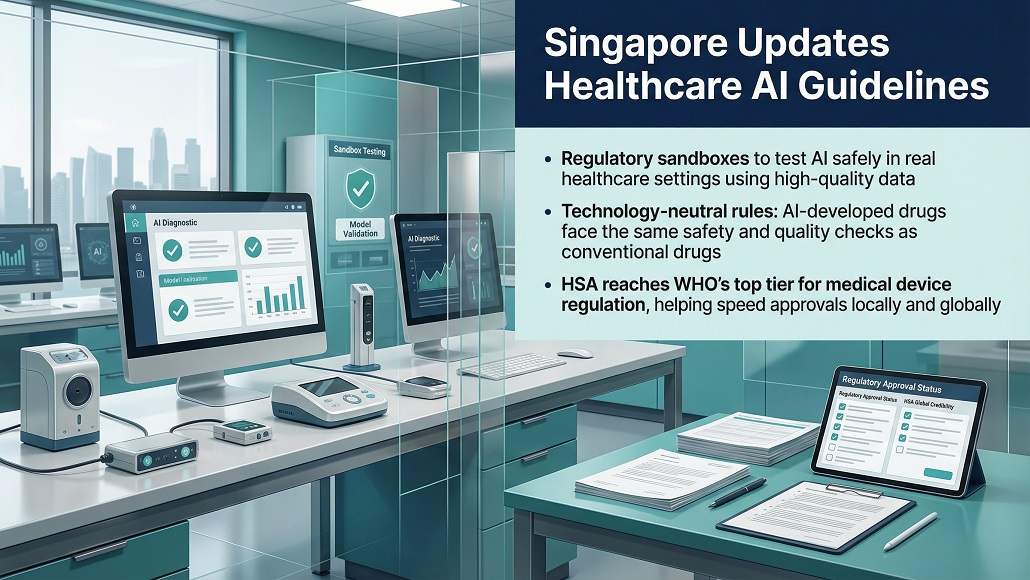

Singapore has introduced updated healthcare AI guidelines aimed at accelerating innovation in the medical sector, with a particular focus on strengthening workforce capabilities and enabling faster delivery of new drugs to patients. Speaking on March 10, Minister for Health Ong Ye Kung said the revised healthcare AI guidelines were jointly developed by the Ministry of Health (MOH) and the Health Sciences Authority (HSA), incorporating advancements such as generative AI while maintaining strict safety and quality standards. The announcement was made during the opening of the International Medical Device Regulators Forum at NTUC Centre.
The revised framework introduces regulatory sandboxes that allow AI solutions to be tested in real-world healthcare environments, ensuring systems are trained on high-quality, real-life datasets. Ong noted that while HSA has yet to receive any registration applications for AI-developed drugs, it remains open to such submissions. He also emphasised that HSA “will take a technology-neutral approach to regulation, applying the same rigour to AI-developed drugs as it does to conventional drugs”. This approach comes as AI continues to reshape drug development, particularly through the use of simulated laboratory data that can replace early-stage clinical trials, which are often costly and time-intensive.
In parallel, HSA has achieved a significant milestone by becoming the first national regulatory authority to reach the World Health Organization’s highest level of medical device regulation. This designation allows HSA to act as a global reference point for other regulators. Ong highlighted that several jurisdictions—including Australia, Hong Kong, Malaysia, the Philippines, South Africa, Sri Lanka, Switzerland, Thailand and the United Kingdom—already reference HSA approvals to accelerate their own regulatory processes. At the same time, HSA aligns its standards with major regulatory systems such as those in the US, European Union, UK and Japan, reinforcing its international credibility.
Singapore is also part of a consortium with Australia, Canada, Switzerland and the UK that facilitates the approval of new therapeutic products, helping improve access to safe and effective pharmaceuticals. Ong stated that these initiatives position Singapore as more than a domestic market, expanding its relevance to hundreds of millions globally. Adjunct Professor Raymond Chua added that HSA’s WHO recognition supports its evolving economic role in strengthening the biomedical sector. He said: “The future of healthcare will not be shaped by innovation alone, but by the wisdom with which we govern it.” Moving forward, Singapore plans to integrate regulatory functions and align product development with priority disease areas such as cardiovascular diseases, diabetes and metabolic disorders, supporting simultaneous progress in regulatory approval, clinical development and health technology assessment.