
















The New Science of Restoration: Intelligence in Physical Medicine
The field of physical medicine and rehabilitation has long been characterized by labor-intensive, manual therapies that depend heavily on the physical strength and time of the therapist. While the human element remains irreplaceable, the emergence of smart rehabilitation technology improving recovery is augmenting these traditional methods with unprecedented levels of precision, repetition, and data-driven insight. We are transitioning from a model of subjective assessment and generalized exercises toward a paradigm of “precision rehabilitation,” where every movement is measured, analyzed, and optimized to the specific neurological and physical needs of the patient.
This evolution is driven by the understanding that the brain and body possess a remarkable capacity for neuroplasticity the ability to reorganize and form new neural connections in response to injury. However, to trigger this process effectively, patients often require thousands of precise repetitions of a specific movement. Smart rehabilitation technology allows for this level of high-intensity training, providing the consistent feedback and physical support necessary to drive functional recovery in patients with stroke, spinal cord injury, or orthopedic trauma.
Robotic Therapy Systems: Precision and Power
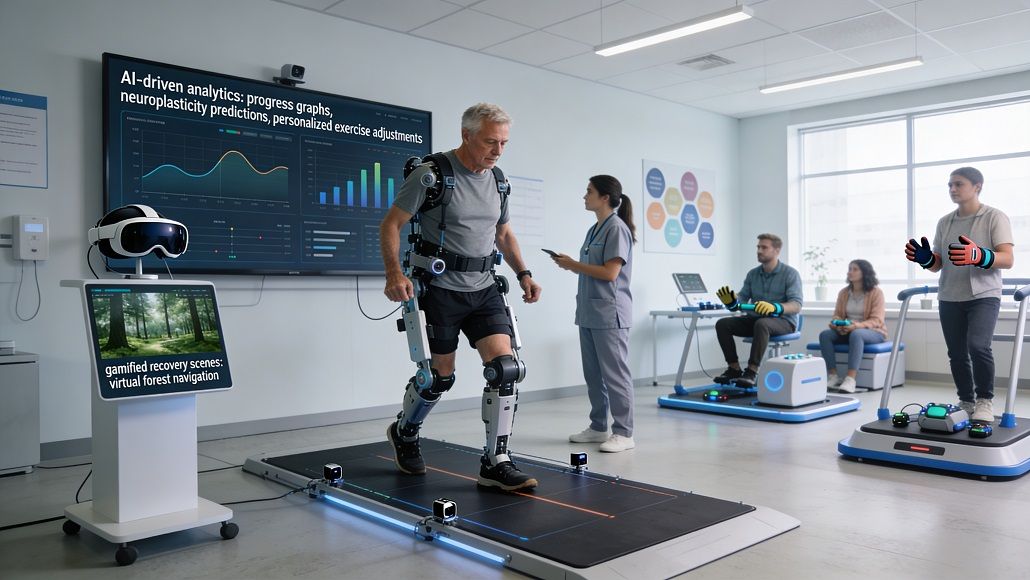
The most visible symbols of this transformation are robotic therapy systems. These advanced machines, which range from full-body exoskeletons to specialized hand and arm trainers, provide the mechanical assistance needed to perform complex movements. For a patient who has lost the ability to walk, a robotic gait trainer can support their body weight and guide their legs through a perfect walking pattern. This allows the patient to experience the sensation of walking and begin the process of neural retraining long before they would have the strength to do so unaided.
The primary benefit of robotic systems is their ability to provide “assist-as-needed” support. Unlike a human therapist, who might inadvertently provide too much or too little help, a robotic system can sense the exact amount of force the patient is contributing and provide only the necessary amount of assistance to complete the movement. This ensures that the patient is always working at the very edge of their capability, which is the optimal state for driving neuroplastic changes. Through this synergy of machine power and human effort, smart rehabilitation technology improving recovery is pushing the boundaries of what is possible in functional restoration.
Motion Tracking Healthcare: Measuring the Path to Healing
Underlying the mechanical power of these systems is a sophisticated layer of motion tracking healthcare. Using high-speed cameras, wearable inertial sensors, and pressure-sensitive mats, therapists can now capture a patient’s movement with millimeter precision. This allows for the detection of subtle compensatory patterns such as a patient “hiking” their hip to clear their foot during walking that might be invisible to the naked eye but can lead to long-term joint damage or inefficient gait.
This objective data is a game-changer for clinical decision-making. In traditional rehabilitation, progress is often measured by qualitative scales that can be subjective and prone to variation between therapists. With smart rehabilitation technology improving recovery, progress is measured in degrees of joint range, Newton-meters of force, and milliseconds of reaction time. This level of granular detail allows therapists to refine their treatment plans with surgical precision, ensuring that every session is contributing directly to the patient’s specific recovery goals.
AI Rehabilitation Platforms and Personalized Care Models
The massive amount of data generated by robotic systems and motion tracking is now being harnessed by AI rehabilitation platforms. These intelligent systems act as a “co-pilot” for the therapist, analyzing the patient’s performance in real-time and suggesting adjustments to the intensity or type of exercise. For example, if the AI detects that a patient’s movement quality is deteriorating due to fatigue, it can automatically reduce the difficulty of the task or suggest a rest period, preventing overexertion and injury.
These platforms are also enabling the development of truly personalized care models. By comparing an individual patient’s progress against data from thousands of similar cases, AI can predict the most effective therapeutic pathway and estimate the time required to reach specific milestones. This “predictive rehabilitation” helps patients and families manage their expectations and allows healthcare systems to allocate resources more efficiently. As we move forward, the integration of AI will allow for a level of customization that was previously impossible, ensuring that every patient receives the exact “dosage” of therapy they need at every stage of their recovery.
Virtual Reality and the Psychology of Recovery
Rehabilitation is as much a psychological challenge as a physical one. The path to recovery can be long, repetitive, and often discouraging. Smart rehabilitation technology improving recovery is addressing this by incorporating Virtual Reality (VR) and gamification. By placing the patient in a compelling digital environment where they might be catching virtual objects or navigating a digital forest the focus shifts from the difficulty of the exercise to the engagement of the game.
This “distraction therapy” has been shown to increase patient motivation and pain tolerance, allowing for longer and more productive sessions. Furthermore, VR allows for the practice of “activities of daily living” (ADLs) in a safe, controlled environment. A patient can practice the movements required to cook a meal or cross a busy street without any real-world risk. This bridge between the clinic and the home is essential for building the confidence and functional independence that are the ultimate goals of any rehabilitation program.
Expanding Access through Home-Based Smart Tech
The next frontier of smart rehabilitation technology improving recovery is the move from the clinic to the home. The high cost and large footprint of first-generation robotic systems meant they were restricted to specialized inpatient centers. However, we are now seeing the rise of portable, affordable devices designed for home use. These include smart gloves for hand therapy, sensor-based exercise platforms, and tablet-based AI coaches that guide patients through their home exercise programs.
These home-based systems are vital for addressing the “rehab cliff” the common drop-off in recovery that occurs when a patient is discharged from intensive inpatient care. By providing professional-level feedback and monitoring in the home environment, these tools ensure that the recovery process continues long after the patient has left the hospital. For those living in rural areas or with limited access to transport, this technology is a lifeline that ensures they are not denied the opportunity for a full recovery due to their geography.
The Ethical Imperative of Human-Centered Design
As we embrace the power of robotics and AI, it is essential that the technology remains a tool for human empowerment, not a replacement for human care. Smart rehabilitation technology improving recovery must be developed through a process of “human-centered design,” involving therapists and patients at every stage. The technology should be intuitive, comfortable, and, most importantly, respectful of the patient’s dignity and autonomy.
There is also the critical issue of equity. As these advanced systems become the new standard of care, we must ensure that they are accessible to all patients, regardless of their socioeconomic status. The goal of recovery innovation is to raise the floor of care for everyone, not just to raise the ceiling for a few. Healthcare systems and insurers must work together to ensure that the long-term benefits of smart rehabilitation including reduced disability and faster return to work are recognized and reflected in their reimbursement models.
A Future of Boundless Potential in Recovery
The transformation of physical medicine through technology is an ongoing journey of discovery. We are only beginning to tap into the potential of combined therapies, such as the use of brain-computer interfaces (BCIs) to control robotic limb trainers, effectively allowing a patient to move their paralyzed limbs with their thoughts. This “cybernetic” approach to rehabilitation represents the ultimate synergy between man and machine.
By combining the precision of robotics, the insight of AI, and the compassion of human care, we are building a world where the word “permanent” is less and less applicable to physical disability. The goal of smart rehabilitation technology improving recovery is to ensure that every individual has the tools they need to reclaim their life and their independence. In this new era of physical medicine, the focus is not on what has been lost, but on the boundless potential of what can be regained.