















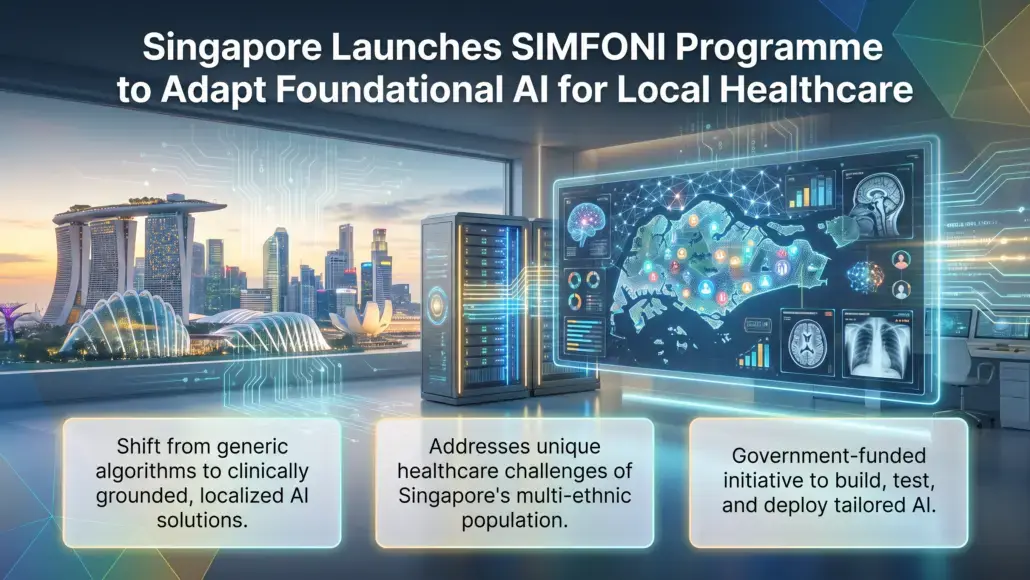

The global advancement of generative and multimodal computing has necessitated a shift from generic algorithms toward clinically grounded, localized solutions that reflect specific demographic and regional disease patterns. In a significant move to address the unique challenges of its multi-ethnic population, Singapore has launched a national initiative known as SIMFONI (Consortium for Clinical Research and Innovation, Singapore). The government-funded programme is designed to build, test, and deploy healthcare foundation models that can be adapted across various clinical settings. By collaborating with academic partners and regulators, SIMFONI aims to establish a standardized dataset and governance framework to ensure the safe and responsible use of AI tools. This initiative arrives as the national health system faces the “triple whammy” of an aging population, an increasing chronic disease burden, and an overstretched clinical workforce.
Rather than developing technology from scratch, SIMFONI focuses on adapting and deploying existing healthcare foundation models to better suit local clinical workflows and guidelines. Most existing foundational models are trained on datasets primarily from Western populations, which may not fully reflect Singapore’s local disease patterns. “These models may not fully reflect Singapore’s multi-ethnic population, local disease patterns, healthcare guidelines and clinical workflows,” the team, led by executive director and professor Robert Morris, told Healthcare IT News. By integrating different sources of clinical information, these models are expected to more closely mirror how clinicians synthesize multiple forms of patient data to make complex decisions at the point of care.
Initial Focus on Cardiometabolic and Ophthalmic Care
The SIMFONI programme will initially prioritize two high-impact areas: clinical decision support for cardiometabolic conditions and multimodal AI for eye diseases. Cardiometabolic diseases, including diabetes, hypertension, and hyperlipidemia, constitute a significant portion of Singapore’s chronic disease burden. The proposed AI-enabled support system will draw on validated prediction risk models and national clinical guidelines to assist primary care clinicians in delivering personalized, evidence-based care. By providing timely insights, the system aims to optimize long-term management strategies for patients within the public health network.
Simultaneously, the programme is developing a multimodal AI model for eye diseases such as cataracts, retinal diseases, and glaucoma. Because the eye can provide critical insights into systemic conditions like neurological disorders and cardiovascular disease, the team envisions expanding this model to other medical specialties in the future. The tool is expected to support more precise diagnoses and improved risk stratification, ultimately allowing for a more accurate triage of specialist referrals. SIMFONI eventually expects to embed these tools directly within the national electronic medical record (EMR) system to serve as an integrated clinical decision support tool covering a broader range of conditions.
Strategic Integration and Regulatory Oversight
The initiative is supported by the Singapore Ministry of Health through the National Medical Research Council (NMRC) Office at MOH Holdings Pte Ltd. It aligns with the country’s broader strategic goals of enhancing population health and promoting preventive care. The SIMFONI team has emphasized that the transition from research to pilot implementation will require rigorous validation and alignment with national health priorities. “SIMFONI is developing a portfolio of tools for different clinical needs, and these will mature at different times rather than launching all at once,” the team shared.
This programme builds on Singapore’s extensive history of data-driven health initiatives, including the 10-year National Precision Medicine programme and SingHealth’s development of the Healthy Longevity Panel. In 2024, the government announced a five-year, $150 million investment to scale AI development across the national healthcare system, further supported by partnerships between the national health tech agency, Synapxe, and global tech leaders like Google Cloud and OpenAI. By establishing a localized foundation for AI adoption, Singapore aims to improve the sustainability of its public healthcare system while ensuring that innovation remains grounded in the specific needs of its citizens.