











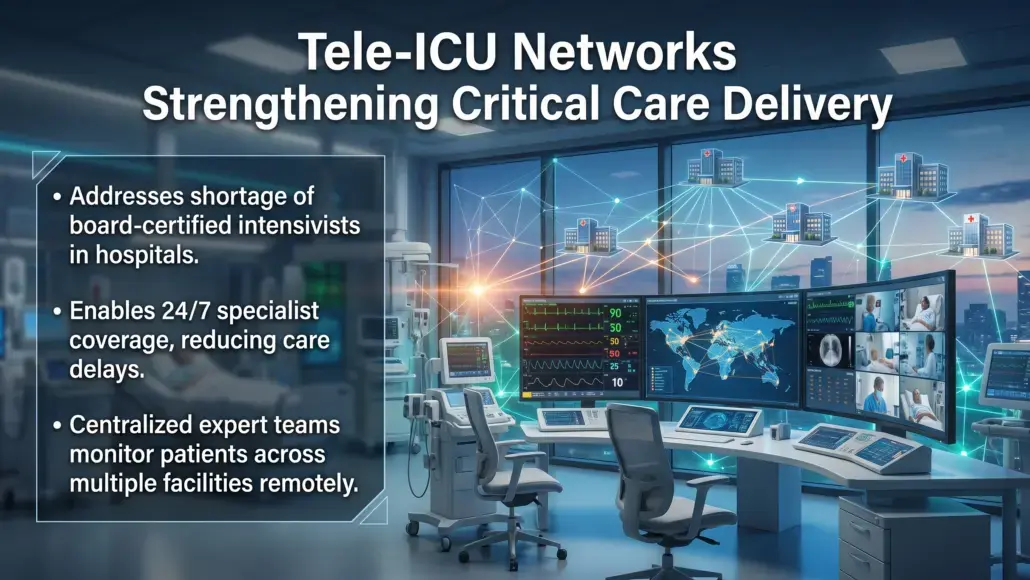

The growing complexity of critical care management, coupled with a persistent shortage of board-certified intensivists, has necessitated a fundamental shift in how hospitals staff their intensive care units. Many smaller or regional facilities struggle to provide 24/7 specialist coverage, which can lead to delays in identifying physiological deterioration. Tele-ICU networks have emerged as a powerful solution to this challenge, allowing a centralized team of experts to monitor patients across multiple locations in real-time. By utilizing high-definition video, audio, and integrated data streams, these remote specialists can support the local bedside team with advanced clinical guidance. This model ensures that even the most remote facilities can provide a level of critical care that is comparable to large academic medical centers.
The central hub of these networks acts as a continuous safety net, providing an extra layer of clinical oversight that is essential for patient safety. The remote intensivists and nurses are trained to recognize subtle shifts in hemodynamics or respiratory status that might be missed during the busy routine of a physical ICU. When an issue is identified, the tele-ICU team can immediately communicate with the bedside staff, facilitating prompt interventions that can prevent major adverse events. For hospital administrators, the implementation of tele-ICU networks is a strategic investment in quality assurance. It allows the organization to optimize its limited specialist resources while maintaining a high standard of care throughout the entire network of hospitals.
Enhancing Patient Safety with Real-Time Data Analytics
The effectiveness of remote critical care is deeply dependent on the quality of the data that is transmitted from the bedside to the monitoring hub. Modern tele-ICU platforms are designed to aggregate information from a wide variety of sources, including ventilators, bedside monitors, and the electronic health record. Advanced analytics engines process this data in real-time, providing the remote team with a prioritized view of the most unstable patients. This allows for a more proactive approach to critical care, where interventions are initiated based on physiological trends rather than waiting for a critical alarm to sound. The use of tele-ICU networks effectively transforms the intensive care unit from a reactive environment into a predictive one.
This data-driven approach also facilitates the adherence to evidence-based clinical protocols. The remote monitoring team can track compliance with specific bundles of care, such as those for sepsis management or ventilator-associated pneumonia prevention. If a particular facility is falling behind on these metrics, the tele-ICU specialists can provide real-time coaching and support to get the bedside team back on track. This continuous focus on protocol adherence leads to more consistent care and better clinical outcomes for the patients. By bridging the gap between clinical knowledge and bedside practice, these networks ensure that every patient receives the best possible care, regardless of which facility they are admitted to.
Improving Financial Outcomes and Operational Efficiency
While the primary goal of implementing remote monitoring systems is to improve patient care, the financial benefits are equally significant. Research has consistently shown that tele-ICU networks can lead to a reduction in the average length of stay in the intensive care unit. By identifying and treating complications sooner, the clinical team can stabilize patients faster and move them to lower-acuity floors more efficiently. This increased throughput allows the hospital to treat more patients with the same number of ICU beds, which is a major driver of operational efficiency. The cost savings associated with shorter stays and reduced complication rates often outweigh the initial investment in the tele-ICU infrastructure.
Furthermore, the remote monitoring model can help reduce the high rates of burnout among bedside critical care staff. By providing an additional layer of support and reducing the cognitive burden of continuous monitoring, tele-ICU networks allow bedside nurses and physicians to focus on the physical and emotional needs of their patients. This improved work environment can lead to higher staff retention rates and lower recruitment costs for the hospital. The ability to offer remote work options for experienced intensivists who may no longer wish to work long nights at the bedside also helps the organization retain valuable clinical expertise. In this way, the tele-ICU model addresses both the clinical and the human resource challenges of modern critical care management.
Integrating Remote Care into the Hospital Ecosystem
The successful operation of a tele-ICU system requires more than just advanced technology; it requires a culture of collaboration and trust between the remote and the bedside teams. Hospital leaders must work to ensure that the tele-ICU specialists are seen as valued partners in the care process rather than as remote observers. This involves clearly defining the roles and responsibilities of each team and establishing clear communication protocols. When the bedside staff feels supported by the remote team, they are more likely to engage with the system and utilize the expertise provided by the monitoring hub. Regular inter-disciplinary meetings and shared training sessions can help build this necessary rapport.
Technical integration is also a critical factor. The tele-ICU platform must be fully interoperable with the hospital’s existing IT infrastructure to ensure a seamless flow of information. Any friction in the data transmission or communication process can lead to delays that undermine the effectiveness of the system. This requires a strong partnership between the hospital’s clinical leadership, the IT department, and the technology vendors. By taking a comprehensive approach to integration, organizations can ensure that their tele-ICU networks are a core component of their critical care delivery strategy. The goal is to create a unified care environment where the distance between the patient and the specialist is irrelevant to the quality of care provided.
The Future of Critical Care in a Connected World
As healthcare continues to evolve, the role of tele-ICU networks will likely expand to cover other high-acuity areas of the hospital, such as the emergency department and the post-operative recovery units. The expertise concentrated in the monitoring hub can be utilized to support clinicians throughout the entire patient journey. We may also see the integration of more advanced artificial intelligence tools that can provide even more precise predictions of patient deterioration. These tools will allow the tele-ICU team to manage even larger numbers of patients without compromising the quality of their oversight. The evolution of critical care is moving toward a more distributed and data-intensive model, with remote monitoring serving as the primary coordinating mechanism.
For hospital administrators, the decision to invest in tele-ICU technology is a commitment to the future of their institution. It is a recognition that the traditional model of isolated, facility-based critical care is no longer sufficient to meet the needs of a modern patient population. By embracing the connectivity and expertise provided by these networks, hospitals can ensure that they remain competitive in an increasingly demanding healthcare market. They can provide their patients with the highest level of safety and clinical excellence while also addressing the systemic challenges of staffing and resource management. The journey toward a fully connected critical care system is complex, but the benefits for patients, clinicians, and the hospital as a whole are undeniable.