











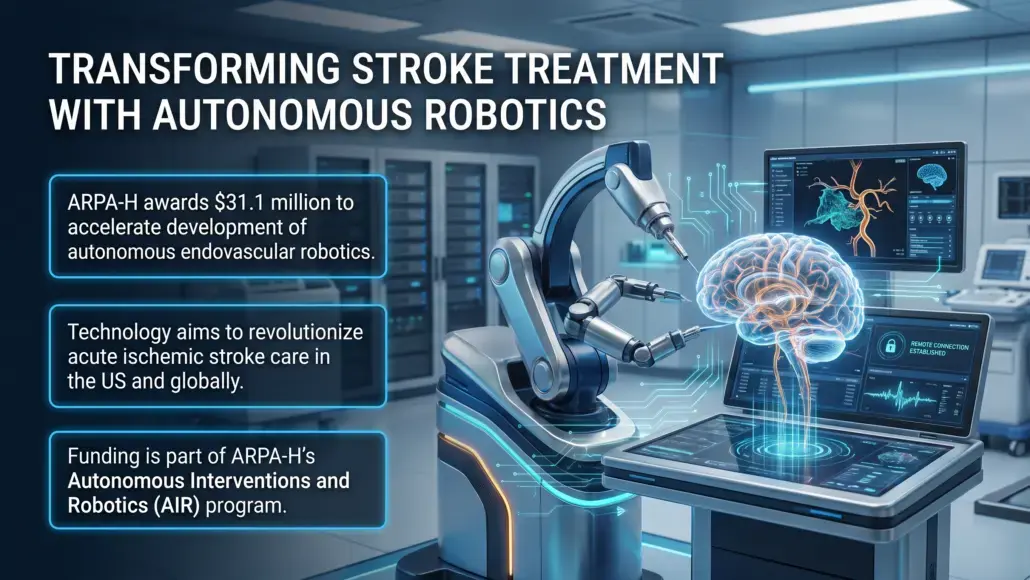

The Advanced Research Projects Agency for Health (ARPA-H) has awarded Siemens Healthineers up to $31.1 million over five years to accelerate the development of autonomous, remote endovascular robotics — a technology aimed at transforming how acute ischaemic stroke is treated across the United States and beyond.
A Landmark Investment in Neurovascular Robotics
The funding is part of ARPA-H’s Autonomous Interventions and Robotics (AIR) program, led by ARPA-H program manager Ileana Hancu. Siemens Healthineers will also contribute $5.4 million as a cost share over the course of the project, bringing the total combined investment in autonomous remote endovascular robotics development to as much as $36.5 million.
Siemens Healthineers believes that a combination of endovascular robotics, image guidance, and dedicated devices will significantly impact how neurovascular procedures will be performed in the future. Under the award, Stryker is acting as a sub-awardee, further advancing the strategic partnership established by the two companies in 2025 to accelerate innovation in robotic neurovascular interventions.
Philipp Fischer, Head of Advanced Therapies at Siemens Healthineers, stated: “The ARPA-H investment is a big step in advancing autonomous remote endovascular robotics for the benefit of patients and communities around the world.”
Technology Designed to Close a Critical Access Gap
With a focus on neurovascular robotics, Siemens Healthineers’ technology is designed to enable robots to perform long-distance treatment of acute ischaemic stroke through mechanical thrombectomy without direct human input. Mechanical thrombectomy is a minimally invasive procedure that removes a blood clot from a blocked blood vessel in the brain to restore blood flow following an acute ischaemic stroke. When performed promptly, it can significantly improve patient outcomes and reduce the risk of long-term disability.
It is important to note that autonomous remote endovascular robotics for acute stroke treatment is currently under development and is not commercially available.
The Scale of the Access Problem
Today, mechanical thrombectomy is almost exclusively available in comprehensive stroke centres, which means large portions of the population remain without access to this potentially life-altering procedure. According to ARPA-H, in the United States, more than half of the population lives over an hour from a thrombectomy-capable clinic. Additionally, only an estimated 12% of 335,000 eligible stroke patients receive mechanical thrombectomy each year — underscoring the significant gap that this ARPA-H funding aims to help address through the development of autonomous solutions.
Stryker Partnership Strengthens the Program
Under the terms of the award, Stryker joins as a sub-awardee, building on the strategic partnership the two companies formed in 2025 focused on accelerating innovation in robotic neurovascular interventions. This collaboration is expected to further support the technical development needed to bring autonomous, remote mechanical thrombectomy closer to broader implementation.
The combined investment of up to $36.5 million reflects the scale of commitment from both public and private stakeholders in advancing this field of endovascular robotics over the next five years.