










The global helium shortage impact is increasingly reshaping healthcare operations, moving from a supply-side concern to a direct clinical and operational risk. While helium has long been treated as a background industrial input, recent geopolitical disruptions and structural supply limitations are exposing its critical role across diagnostic imaging, research, and broader healthcare infrastructure.
The current shortage is largely driven by concentrated global production and geopolitical instability. A significant share of helium supply originates from Qatar, with exports heavily dependent on transit routes such as the Strait of Hormuz. Disruptions in this corridor, alongside damage to production infrastructure, have constrained global availability. Since helium is a by-product of natural gas extraction, its supply cannot be easily scaled in response to demand, further tightening market conditions.
MRI systems at the centre of the disruption
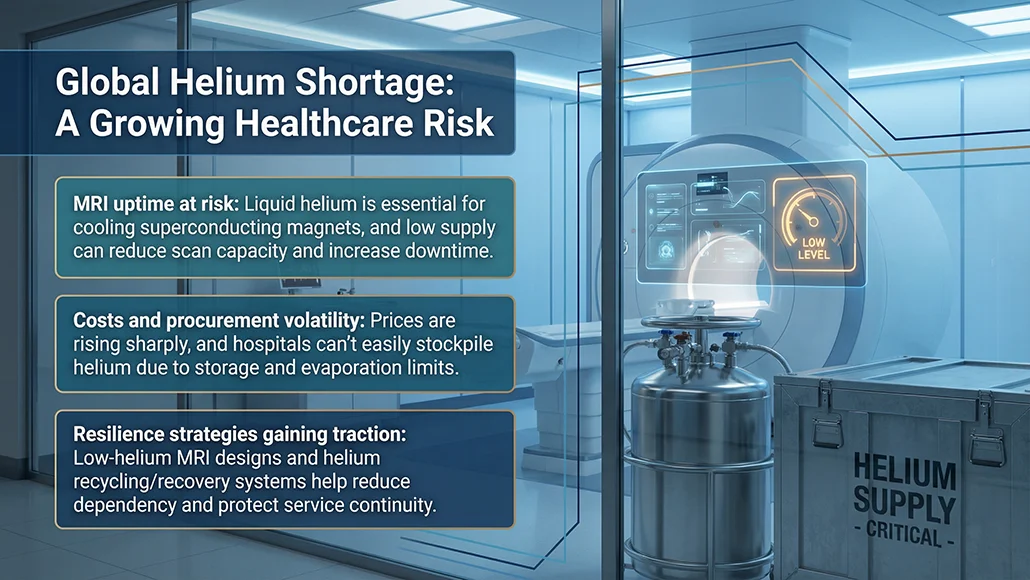
Magnetic Resonance Imaging (MRI) remains the most exposed segment within healthcare. These systems rely on liquid helium to cool superconducting magnets to temperatures close to absolute zero, enabling stable, high-resolution imaging.
- MRI scanners typically require around 1,500 litres of liquid helium
- Healthcare accounts for nearly 30% of global helium consumption
- Helium has no viable substitute in MRI cooling systems
- Periodic refilling is required throughout a scanner’s lifecycle
As supply tightens, radiology departments face increasing uncertainty around maintenance and refilling cycles. Unlike sudden equipment failures, helium shortages create a gradual decline in system reliability. Reduced helium levels can limit scanning capacity, increase downtime risks, and complicate servicing.
This directly affects diagnostic workflows. Delays in MRI availability can extend timelines for cancer detection, neurological assessments, and surgical planning, placing additional strain on already burdened healthcare systems.
Expanding impact across clinical and research applications
Beyond MRI, the helium shortage impact extends into multiple layers of healthcare and life sciences:
- Nuclear Magnetic Resonance (NMR): Essential for drug development, molecular analysis, and pharmaceutical quality control
- Cryogenic research systems: Used in advanced biological and medical research requiring ultra-low temperatures
- Specialised surgical and laboratory processes: Where inert, ultra-cold environments are necessary
These applications rely on helium’s unique ability to maintain extremely low temperatures without chemical reactivity. Its physical properties make substitution impractical, meaning shortages can halt or delay critical research and laboratory operations.
Cost pressures and procurement instability
The shortage has triggered sharp price increases, with helium costs rising by an estimated 50–70% in recent months. For healthcare providers, this translates into immediate financial pressure, particularly for institutions operating multiple MRI units or large research facilities.
Procurement is further complicated by helium’s storage limitations. Due to its low boiling point and tendency to escape containment, long-term stockpiling is not viable. Most healthcare systems depend on continuous supply, leaving them exposed to market volatility and logistical disruptions.
This has forced procurement teams to prioritise allocation, renegotiate supplier contracts, and explore alternative sourcing strategies, often under tight operational constraints.
System-wide ripple effects on healthcare infrastructure
The helium shortage is also revealing deeper interdependencies within healthcare supply chains. The same geopolitical disruptions affecting helium are influencing energy markets, shipping routes, and industrial inputs.
- Semiconductor production—dependent on helium—may face constraints, affecting medical devices and digital health technologies
- Pharmaceutical manufacturing faces rising costs due to energy and logistics disruptions
- Transport bottlenecks are increasing lead times for critical medical supplies and equipment
These interconnected pressures highlight how upstream resource constraints can cascade into healthcare delivery, affecting both clinical services and supporting infrastructure.
HHM Global notes that such disruptions underline the growing need for resilience across healthcare systems, where access to critical materials directly influences service continuity and patient outcomes.
Industry response: reducing dependency and improving resilience
Healthcare providers and equipment manufacturers are actively adapting to mitigate supply risks. Several strategies are gaining traction:
- Low-helium MRI systems: Newer designs significantly reduce helium usage, with over 1,000 units deployed globally
- Helium recycling technologies: Systems that capture and reliquefy helium, enabling reuse within facilities
- Supplier diversification: Reducing reliance on single geographic sources
- Operational prioritisation: Allocating helium to critical applications during shortages
Helium recovery systems, in particular, are emerging as a key solution. By creating closed-loop usage models, hospitals can reduce dependence on external supply while maintaining imaging and research continuity.
HHM Global highlights that such technological adoption reflects a broader shift toward operational self-sufficiency, particularly in environments where uninterrupted diagnostic capability is essential.
Long-term outlook: from commodity to critical asset
The current crisis is repositioning helium as a strategic healthcare resource rather than a routine consumable. Its role in sustaining diagnostic capacity, research capability, and advanced medical technologies makes it integral to modern healthcare infrastructure.
In the long term, addressing the helium shortage impact will require a combination of supply diversification, technological innovation, and more efficient resource management. Expanding production, improving recycling systems, and prioritising critical healthcare usage will be central to stabilising the market.
For healthcare systems, the lesson is structural: resilience now depends not only on clinical expertise and infrastructure, but also on securing access to critical materials that underpin everyday medical operations.