











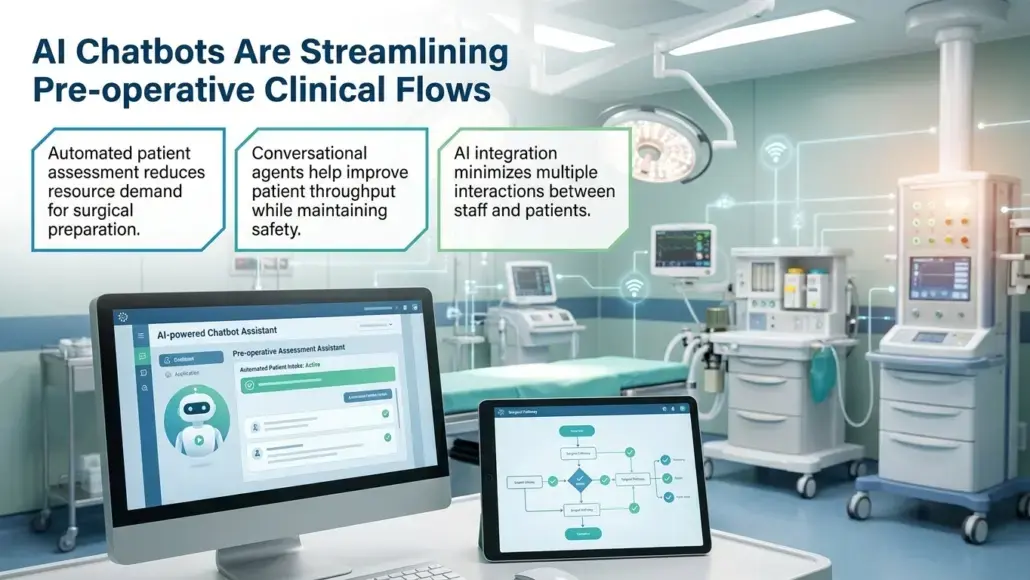

The transition toward automated patient assessment represents a significant pivot in how healthcare institutions manage surgical preparation. Pre-operative assessment remains one of the most resource-intensive phases of surgical care, often requiring multiple interactions between nursing staff, anesthesiologists, and patients. As health systems face increasing pressure to improve throughput while maintaining high safety standards, the integration of conversational agents has emerged as a viable solution to bridge gaps in data collection and patient readiness. These systems interact with patients well before their arrival at the hospital, ensuring that essential health information is captured, verified, and integrated into clinical records without the need for manual transcription or repetitive interviewing. Clinical outcomes depend heavily on the accuracy and completeness of the pre-operative history. Traditional methods, which rely on manual phone calls or in-person clinics, are frequently plagued by missing data, patient unavailability, or late-stage discoveries of contraindications. The deployment of perioperative AI chatbots offers a structured approach to this challenge, providing a persistent and accessible channel for patients to report their medical history, current medications, and lifestyle factors at their own convenience. By utilizing medical databases, these tools guide patients through complex screening protocols, flagging potential risks such as obstructive sleep apnea or cardiovascular instability that might otherwise go unnoticed until the day of surgery. The economic impact of surgical delays and cancellations is substantial in a modern clinical setting. Any cancellation resulting from inadequate patient preparation leads to wasted resources and delayed care. Conversational AI serves as a proactive defense against these inefficiencies by delivering timely reminders tailored to the specific procedure and the individual patient profile. This level of personalized engagement ensures that the clinical pathway remains on schedule, allowing surgical teams to focus on operative execution rather than administrative troubleshooting.
Strategic Automation of Pre-Operative Data Collection
Standardizing the collection of patient-reported outcomes and medical histories is a foundational requirement for modern perioperative medicine. The use of perioperative AI chatbots facilitates a consistent data entry process that eliminates the variability associated with different human interviewers. These systems follow evidence-based guidelines, ensuring that every patient receives the same depth of screening regardless of when or where they engage with the platform. This consistency is particularly valuable in large healthcare networks where multiple clinics must adhere to centralized protocols for surgical clearance and risk assessment. Beyond simple data gathering, these intelligent agents are capable of performing preliminary data validation. For instance, if a patient reports a medication that typically requires cessation before surgery, the system can immediately prompt for the dosage and the specific reason for the prescription. This immediate feedback loop reduces the need for follow-up calls from nursing staff, as the clinical record is populated with high-quality, actionable data from the outset. The automation of these baseline tasks allows clinical staff to reallocate their time toward high-risk patients who require complex medical management, thereby optimizing the overall productivity of the pre-admission testing unit. Integration with existing electronic health records is a critical component of successful automation. When the data collected by a conversational agent flows directly into the patient chart, it creates a single source of truth for the entire perioperative team. Anesthesiologists can review the summarized findings before the patient arrives, identifying potential airway difficulties or cardiac concerns based on the risk report. This level of preparedness transforms the pre-operative visit from a data-gathering exercise into a focused clinical consultation, improving the professional experience for providers and the quality of care for patients.
Enhancing Risk Stratification through Intelligent Patient Triage
Effective risk stratification is the cornerstone of safe surgical practice. Identifying which patients are at higher risk for post-operative complications allows for better resource planning, including the allocation of intensive care beds and the scheduling of specialized monitoring. Intelligent triage systems analyze patient responses in real-time, applying clinical algorithms to assign risk scores based on established medical criteria. This automated triage ensures that patients with complex comorbidities are prioritized for comprehensive reviews by senior clinicians, while healthy patients can be fast-tracked through the assessment process. The ability to identify metabolic, respiratory, or cardiovascular risks early in the surgical journey is paramount. Many patients are unaware of the implications their underlying health conditions have on anesthesia and surgical recovery. By asking targeted questions about exercise tolerance, prior surgical experiences, and family history, the system can detect subtle indicators of underlying pathology. This early detection permits the initiation of pre-habilitation programs or the coordination of specialty clearances weeks before the scheduled procedure, preventing last-minute delays and improving the patient’s overall physiological readiness for surgery. Additionally, the use of predictive analytics in conjunction with patient-reported data enhances the precision of risk assessments. While traditional screening forms provide a snapshot of health, digital interactions capture nuanced changes in patient status over time. If a patient’s symptoms or medication adherence changes during the weeks leading up to surgery, the system can trigger an alert to the clinical team, prompting a re-evaluation of the surgical plan. This dynamic approach to risk management reflects the evolving nature of healthcare delivery, where continuous monitoring and data-driven decision-making are increasingly becoming the standard of care.
Reducing Surgical Cancellations via Consistent Patient Communication
Communication failures are one of the most common reasons for day-of-surgery cancellations. Patients often struggle to remember specific pre-operative instructions, particularly regarding medication management and fasting requirements. The deployment of perioperative AI chatbots provides a reliable, 24-7 resource for patients to clarify these instructions without needing to contact the hospital directly. By offering immediate answers to common questions, these tools reduce patient anxiety and increase compliance with necessary pre-operative protocols, ensuring that the surgical schedule remains intact. Consistency in messaging is vital for patient safety. In a busy clinical environment, verbal instructions can sometimes be misinterpreted or forgotten. A conversational agent provides a written record of all interactions, allowing patients to review their specific preparation steps at any time. Additionally, the system can send automated reminders at critical intervals, such as forty-eight hours before surgery to remind the patient to stop certain medications, and twelve hours before surgery to confirm fasting status. This proactive communication strategy significantly lowers the probability of errors that would otherwise lead to costly cancellations and rescheduled procedures. Reducing the administrative burden on clinical staff also contributes to lower cancellation rates. When nurses are not overwhelmed by routine inquiries, they can dedicate more energy to managing the logistics of the surgical day and addressing urgent clinical issues. The chatbot acts as a primary filter, handling a high volume of standard questions and only escalating complex or high-risk queries to human staff. This balanced approach to patient communication ensures that every patient feels supported throughout their surgical journey while maintaining the operational efficiency required to sustain high-volume surgical programs.
Data Security and Clinical Integration in Conversational AI Systems
Maintaining the confidentiality and integrity of patient data is a non-negotiable requirement for any healthcare technology. Systems utilizing perioperative AI chatbots must adhere to stringent data protection regulations, including the Health Insurance Portability and Accountability Act and other regional privacy standards. Ensuring that patient information is encrypted during transmission and stored securely within hospital-controlled environments is essential for building trust among both providers and patients. As healthcare organizations adopt more sophisticated tools, the focus on cybersecurity must remain a top priority to prevent unauthorized access to sensitive medical records. Clinical integration goes beyond technical connectivity; it involves the alignment of digital tools with existing medical workflows and professional standards. For an automated agent to be effective, its outputs must be presented in a format that is easily interpreted by clinicians during their busy shifts. Automated summaries should highlight key risk factors and deviations from standard health profiles, allowing doctors to make quick, informed decisions. Training clinical teams to use these tools effectively is also crucial, as the success of any technology depends on the willingness of medical professionals to incorporate it into their daily practice. Interoperability between different medical systems remains a challenge that requires ongoing attention. For digital agents to reach their full potential, they must be able to pull data from multiple sources. This comprehensive view of the patient’s health allows for more accurate screening and risk prediction. As the industry moves toward more open data standards, the ability of conversational agents to interact with a wide range of digital health tools will continue to improve, leading to more cohesive and efficient perioperative care pathways.
Long-Term Clinical Gains and Workforce Optimization Trajectories
The long-term benefits of implementing automated assessment tools extend far beyond immediate efficiency gains. By collecting vast amounts of structured pre-operative data, healthcare organizations identify trends and patterns that inform future clinical guidelines and resource allocation strategies. Analyzing the relationship between pre-operative patient status and post-operative outcomes allows for the refinement of risk models, leading to safer and more effective surgical care. This data-driven approach supports the broader goals of value-based healthcare, where the focus is on achieving the best possible outcomes at the lowest necessary cost. Workforce optimization is another significant advantage of conversational intelligence. The global shortage of healthcare professionals requires a shift in how medical work is organized. By automating routine administrative and screening tasks, medical agents allow clinicians to focus on the specialized work they were trained to do. This reduction in cognitive load and administrative drudgery helps mitigate burnout among nursing and anesthesia staff, contributing to a more sustainable and resilient healthcare workforce. As these technologies become more integrated into clinical practice, the role of the healthcare professional will continue to evolve, with a greater emphasis on complex decision-making and patient-centered care. Looking toward the future, the scope of conversational agents in healthcare will likely expand to cover the entire patient journey. Beyond the surgical suite, the continuum of care often extends to physical recovery where robotic gait training supports the next phase of intensive rehabilitation for patients with mobility challenges. The lessons learned from the deployment of automation in the perioperative space will inform the development of similar tools in other clinical domains, creating a more connected and efficient healthcare ecosystem. By embracing these technological advancements, healthcare institutions ensure they are well-positioned to meet the challenges of the future while continuing to provide high-quality care to their patients.