













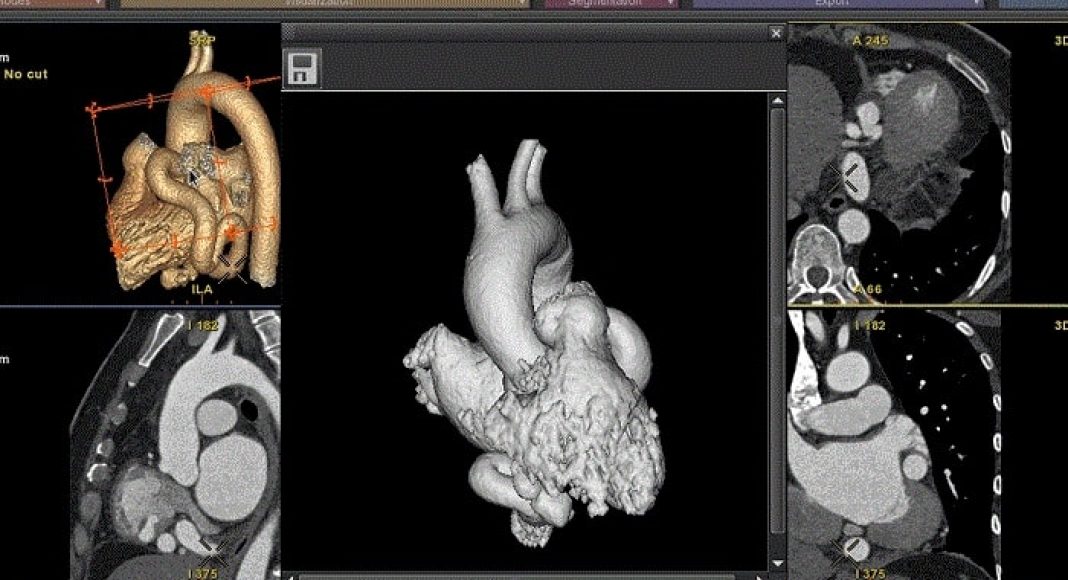
GE Healthcare and VA Puget Sound Health Care System announced a partnership to accelerate the use of 3D imaging in healthcare. As part of their research agreement, GE Healthcare will provide software and work stations, and the VA will provide input on its use of the technology. Prior to this agreement, the VA has used 3D software that is not designed for medical use. Now, the VA will use GE software designed specifically for the medical field – which is expected to reduce the time it takes to create 3D models from hours to minutes.
Building on its 3D printing network, VA Puget Sound and the Veterans Health Administration Innovators Network will integrate GE Healthcare’s advanced visualization AW VolumeShare workstations with 3D printing software across its facilities in Seattle, San Francisco, Minneapolis, Cleveland and Salt Lake City. VA radiologists specializing in cardiology, oncology, orthopaedics and other areas will use this technology and software to develop new 3D imaging approaches and techniques to deliver improved precision healthcare for our nation’s veterans.
“The Veterans Health Administration has been on the forefront of bringing 3D printing to the bedside, and we are thrilled to join forces with GE Healthcare to enhance and accelerate its adoption,” said Beth Ripley, MD, PhD, VA Puget Sound radiologist, VA Innovation Specialist and VHA 3D Printing Advisory Committee chair. “For most radiologists, 3D images are limited to reconstructions on a computer screen. By harnessing the power of 3D printing with a rich data set, we are able to pull images out of the screen and into our hands, allowing us to interact with the data in a deeper way to fuel innovative, personalized care based on the unique needs of each of our patients.”
The use of 3D medical printing in healthcare is still very much in its infancy, and software designed exclusively for the medical community is limited. Software designed to allow manual preparation of image data into 3D printable files can be labor intensive, requiring hours of work. Using GE Healthcare’s advanced visualization tool, specifically designed for the medical community, VA radiologists will be able to produce models of normal and pathological anatomy using automation techniques that will speed up the pre-3D printing preparation work and the diagnostic process. This is expected to reduce the time it takes to create 3D models from hours to minutes.
“We are delighted to partner with the Veterans Administration to accelerate 3D printing in healthcare,” said Terri Bresenham, Chief Innovation Officer for GE Healthcare. “This partnership will result in significant innovation for the growing application of additive manufacturing in medicine while advancing GE Healthcare toward its mission to improve patient outcomes and enable precision healthcare.”
3D printing is primarily used to manufacture orthopedic implants and guide surgical cutting, and peer-reviewed research on potential impact in patient care has expanded exponentially. Recent industry and regulatory advancements such as the establishment of clinical guidelines, 3D printing reimbursement tracking codes, and the integration of technology and software are all expected to support the widespread adoption of point-of-care 3D printing in hospitals.