










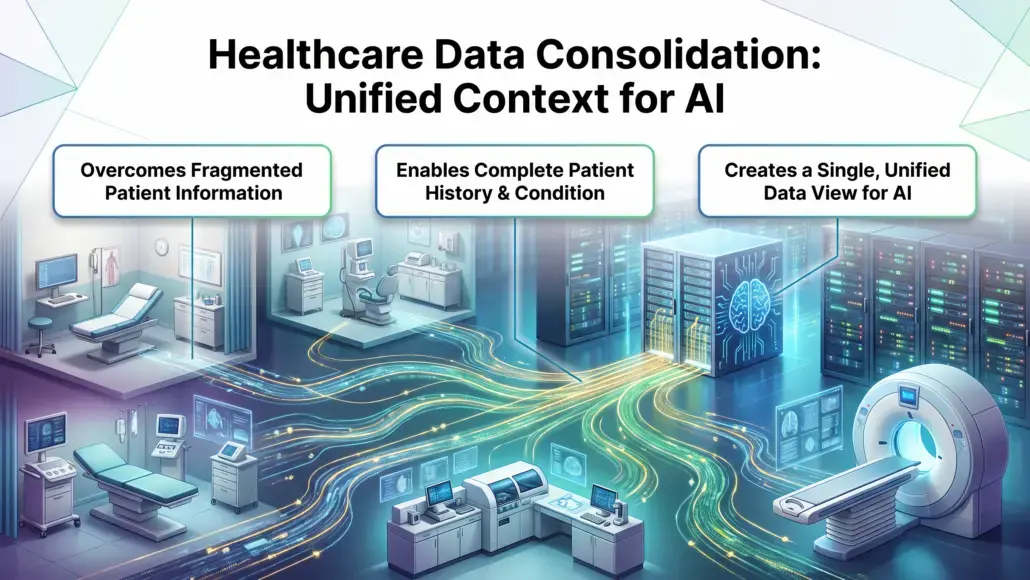

The effectiveness of any intelligent clinical system depends on the quality and depth of the information it processes. In many healthcare settings, patient data is fragmented across various departments, from primary care and specialist clinics to laboratory and imaging centers. This fragmentation prevents a complete understanding of the patient’s history and current condition. By prioritizing healthcare data consolidation improving patient context for AI, organizations can create a unified longitudinal record that provides the rich background needed for advanced analytical tools to function effectively. Consolidation is the process of bringing together diverse data points to create a single, cohesive view of the patient, ensuring that every clinical decision is informed by the full scope of available information.
Improving patient context is essential for reducing diagnostic errors and personalizing treatment plans. When a model has access to a comprehensive dataset, it can identify subtle correlations between different clinical variables that might otherwise be missed. For example, the relationship between a patient’s lifestyle choices, genetic predispositions, and recent lab results can provide critical insights into their risk for certain conditions. A fragmented system, in contrast, only provides a partial view, leading to less accurate conclusions. The move toward data consolidation is a fundamental step in the evolution of intelligent medicine, providing the necessary foundation for high performance diagnostic and prognostic tools.
Synthesizing Longitudinal Records for Comprehensive Patient Views
A longitudinal record tracks a patient’s health history over a long period, providing a continuous narrative of their medical journey. Building these records requires the consolidation of information from every encounter the patient has had with the healthcare system. The focus on creating these comprehensive views involves integrating historical records with real time diagnostic data. This synthesis allows clinicians to see how a patient’s condition has evolved over time, providing the context needed to interpret current findings accurately. A single lab result might be concerning in isolation, but when viewed as part of a long term trend, its significance becomes clearer.
The technical challenge of synthesizing longitudinal records lies in the diversity of data sources and formats. Information might be stored in legacy electronic health record systems, paper files that have been scanned, or modern cloud based applications. A resilient consolidation framework must be capable of ingesting and normalizing this diverse data, ensuring that it is consistent and comparable. This involves the use of standardized data models and terminology mapping tools that translate local codes into a common language. By creating a unified data environment, organizations can ensure that their analytical models are processing high quality, contextualized information.
Maintaining the accuracy of the longitudinal record is a continuous process. As new information is generated, it must be automatically added to the record, updating the patient’s profile in real time. This continuous enrichment ensures that the record remains a reliable source of information for both clinicians and intelligent systems. The focus on data synthesis and enrichment is a hallmark of a mature clinical infrastructure, providing the tools needed to manage health at a highly personalized level.
Resolving Identity and Duplicate Entries in Large Datasets
One of the most significant hurdles in data consolidation is the accurate identification of patients across different systems. In large healthcare organizations, it is common for a single patient to have multiple records under slightly different names or identifiers. This duplication can lead to a fragmented and inconsistent view of the patient’s history. Healthcare data consolidation improving patient context for AI incorporates sophisticated identity management tools that use probabilistic matching algorithms to link records across the enterprise. By resolving these duplicate entries, organizations can ensure that every piece of information is correctly attributed to the right individual.
Identity resolution also involves the management of unique patient identifiers (UPIs) that provide a consistent way to track individuals across the healthcare system. While the use of UPIs is a common goal, their implementation can be complex due to regulatory and technical variations. An effective consolidation framework must be able to manage these variations, providing a reliable link between the patient and their clinical information. Strong identity management is not only a technical requirement but also a critical safety concern, as mismatched records can lead to dangerous clinical errors.
In addition to resolving duplicates, the framework must also address the challenge of data reconciliation. When two systems provide conflicting information about the same patient, the system must have clear rules for determining which data point is most accurate. This might involve prioritizing information from certain sources or using clinical algorithms to resolve the conflict. By establishing clear protocols for identity and data reconciliation, healthcare providers can build a trustworthy and reliable foundation for their intelligent systems.
Enriching Diagnostic Context Through Multi Source Aggregation
Diagnostic accuracy is significantly enhanced when clinicians have access to a wide range of data sources. Healthcare data consolidation improving patient context for AI enables the aggregation of information from diverse sources, including medical imaging, laboratory results, genetic profiles, and even data from wearable devices. This multi source integration provides a holistic view of the patient’s condition, allowing for a more nuanced and precise diagnosis. For example, a model analyzing an EKG can also take into account the patient’s recent activity levels and medication history, leading to a more accurate interpretation of the findings.
Aggregation also facilitates the use of social determinants of health (SDOH) in clinical analysis. Factors such as a patient’s socioeconomic status, environment, and access to healthy food play a major role in their overall health. By consolidating SDOH data with clinical records, healthcare organizations can build more representative and effective models. This level of insight is particularly important for managing chronic conditions and addressing health disparities within the community. The ability to combine clinical and non clinical data is a key advantage of modern data consolidation strategies.
The impact of multi source aggregation extends to the development of predictive models. By including a wide variety of variables in the training set, organizations can build models that are better at identifying early warning signs of disease. For instance, a model that considers both clinical and environmental data might be more effective at predicting asthma exacerbations. The combination of diverse data sources creates a richer and more informative context for AI, leading to better outcomes for patients and a more efficient healthcare system.
Improving Clinical Decision Support via Data Synthesis
The ultimate goal of data consolidation is to improve the quality of clinical decisions at the point of care. Healthcare data consolidation improving patient context for AI provides the synthesized information needed for advanced clinical decision support (CDS) tools to function. These tools analyze the patient’s record in real time and provide recommendations to the clinician, such as suggesting a specific diagnostic test or identifying a potential drug interaction. By providing these recommendations within the context of the patient’s full history, CDS tools can help clinicians make more informed and accurate decisions.
Synthesized data also supports the implementation of personalized treatment pathways. Every patient responds differently to therapy, and their specific profile can influence which treatment is most likely to be effective. With a consolidated record, clinicians can use intelligent tools to simulate different treatment scenarios based on the patient’s specific characteristics. This allows for a more tailored and effective approach to care, improving outcomes and reducing the risk of adverse reactions. The use of advanced analytics to guide therapy is a major advancement in clinical practice, made possible by the underlying data structure.
The integration of CDS tools into the clinical workflow is essential for their success. The recommendations provided by the system must be presented in a way that is intuitive and actionable for the clinician. This requires a deep understanding of clinical workflows and a commitment to user centered design. By making information easily accessible and interpretable, the consolidation framework supports a more efficient and effective clinical environment. The combination of high quality data and intelligent tools creates a powerful partnership that enhances the capabilities of healthcare professionals.
Governance and Transparency in Consolidated Data Environments
Managing a consolidated data environment requires a strong governance framework to ensure the security and privacy of patient information. As data is brought together from various sources, it is vital to establish clear rules for who has access to it and how it is used. Healthcare data consolidation improving patient context for AI simplifies governance by providing a single point of control for all patient information. This allows for more consistent application of security policies and easier auditing of data access. Protecting patient privacy is not only a regulatory requirement but also essential for maintaining the trust of the community.
Transparency is also a key component of effective governance. Patients should have a clear understanding of how their data is being consolidated and used to inform their care. An effective framework provides the tools needed to manage patient consent and provide individuals with access to their own records. This level of transparency builds trust and encourages patients to become active partners in their own health. By prioritizing ethical data management, healthcare organizations can ensure that their consolidation efforts are both sustainable and respected.
Maintaining data integrity is another critical aspect of governance in a consolidated environment. Regular audits and quality checks are necessary to ensure that the information being processed is accurate and reliable. When models are trained on high quality, synthesized data, their outputs are more trustworthy, leading to better clinical decisions. The focus on data integrity ensures that the intelligence generated by the system is both actionable and safe. By building a foundation of trust and reliability, healthcare providers can lead the way in the development of intelligent, patient centered medicine.