













Close
Digital Health & Ai Innovation summit 2026
Medical Taiwan 2026

Cardiac Reader System Market is anticipated to reach at a CAGR of 5% through 2019-2027

Note* - All images used are for editorial and illustrative purposes only and may not originate from the original news provider or associated company.

Subscribe

- Never miss a story with notifications

- Gain full access to our premium content

- Browse free from any location or device.

Media Packs

Expand Your Reach With Our Customized Solutions Empowering Your Campaigns To Maximize Your Reach & Drive Real Results!

– Access the Media PackNow

– Book a Conference Call

Leave Message for Us to Get Back

Related stories

Healthcare Wearables Driving Preventive Care Strategies...

Healthcare wearables are profoundly reshaping the landscape of modern medicine, moving the focus from reactive treatment to proactive prevention. This article explores how these sophisticated devices, through real-time health tracking, advanced wellness monitoring, and early risk detection, empower individuals and medical professionals alike to implement smarter, more effective preventive care strategies, ultimately fostering a healthier, more informed populace.

Digital Health Technologies Enhancing Modern Care...

Digital health technologies are fundamentally reshaping how healthcare is delivered, moving beyond traditional models to offer more efficient, accessible, and patient-centered solutions. From the widespread adoption of telehealth platforms to the seamless integration of Electronic Health Records (EHR) and the proactive insights gained from remote patient monitoring, these innovations are not merely incremental improvements but represent a profound healthcare digital transformation. This article delves into how these advanced digital health technologies are enhancing care delivery, optimizing clinical workflows, and fostering a new era of proactive, personalized patient care, ultimately driving better outcomes for individuals and healthcare systems alike.

AI Powered Diagnostics Improving Clinical Accuracy...

AI powered diagnostics are revolutionizing healthcare by significantly enhancing clinical accuracy. Through advanced medical image analysis, early disease detection, and robust data-driven clinical decisions, these diagnostic AI tools are transforming patient outcomes and empowering clinicians with unprecedented precision. This article delves into how artificial intelligence is becoming an indispensable force in modern diagnostics, ensuring a future of more reliable and effective healthcare.

Estimated to witness a healthy Y-o-Y increase in revenue by more than 5% over 2018, the global cardiac reader system sales will close in on US$ 1,500 Mn in 2019. As depicted in a new research study of Future Market Insights (FMI), benchtop analyzers continue to account for over 80% of overall sales of cardiac reader systems. Although the compact analyzer modularity is seemingly gaining ground, recently, owing to the convenience of usage, it is highly likely that the sales of benchtop variants will remain on a higher side over the coming years.

More than 40% of the overall demand for cardiac reader systems is catered by enzyme immunoassay analyzers, according to FMI’s findings. The next high-selling types of cardiac reader systems, chemiluminescence immunoassay analyzers and magnetic immuno-chromatographic assay analyzers, hold a significant revenue share of over 45% in the global cardiac reader system sales.

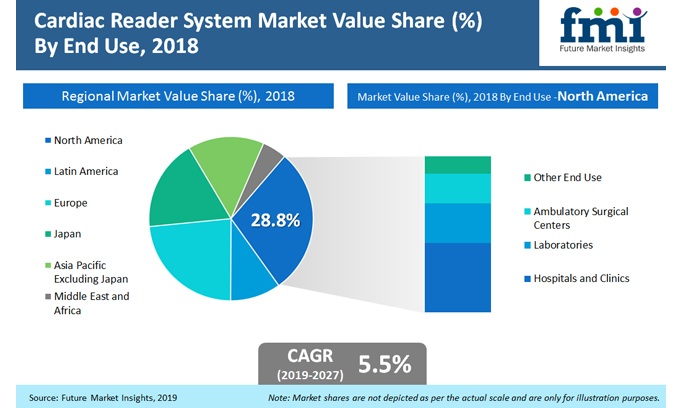
Prominent adoption of cardiac reader systems will prevail at hospitals and clinics. As revealed by FMI’s analysis, diagnostics continue to gather momentum, and thus laboratories are highly likely to develop lucrative potential in terms of adoption of cardiac reader systems. By the end of 2019, more than 1/4th of the overall cardiac reader system sales will be accounted by laboratories.

Troponin Remains Preferred Biomarker

In around 2/5th of the cardiac reader systems sold, globally, troponin is the sought-after type of marker. According to the report, creatine kinase will also demonstrate high growth potential over other marker types in the cardiac reader system market. Troponin is highly sensitive and specific-in-action, which impart it superior diagnostic abilities over other conventional biomarkers. Except for highly sensitive cardiac injury, troponin barely shows false positive tests for the diagnosis of heart attack, angina pectoris, and myocardial infarction.

In line with the mounting demand for high-accuracy, time-efficient, and effective diagnostic outcomes, manufacturers of cardiac reader systems are focused on augmenting their R&D investments. According to the report, increase in R&D efforts will create a plethora of new growth opportunities for the cardiac reader system market. In addition, the notable increase in funds from PPPs (public-private partnerships) for R&D of novel cardiac biomarkers is cited as an important booster for demand growth of cardiac reader system.

Developing Markets Observing Hike in Sales

Demand for cardiac reader system in developed regional markets account for over half of the global demand, according to the study. Although the demand remains strong in the US, and thereby in North American region, the report envisages stronger growth prospects for the cardiac reader system market in Europe.

Moreover, FMI’s study points to visibly growing potential of developing regions, for the expansion of cardiac reader system market. Following Asia Pacific excluding Japan (APEJ), market in Latin America and Middle East and Africa (MEA) is also reflecting signs of healthy growth in forthcoming years.

Collaborations Trending in the Competitive Landscape

Some of the key vendors actively operating in the global cardiac reader system industry, include Radiometer Medical Aps, Creative Diagnostics, Boditech Med Inc., Mitsubishi Chemical Europe GmbH, and Quidel Corporation. According to FMI’s analysis, F. Hoffmann-La Roche Ltd., Beckman Coulter Inc., Siemens AG., and Abbott Laboratories are among the Tier 1 manufacturers of cardiac reader systems and account for a substantial revenue share in the global market.

Key manufacturers of cardiac reader systems are focusing on collaborations with universities and associations to develop their product portfolio. In March 2017, Abbott Laboratories had announced the collaboration with the Hennepin County Medical Center and the University of Minnesota, over the development of markers to be used in the guiding treatment.
Future Market Insights
Company Logo
MEDICAL FAIR ASIA 2026

Latest stories

Related stories

Healthcare Wearables Driving Preventive Care Strategies Today

Healthcare wearables are profoundly reshaping the landscape of modern medicine, moving the focus from reactive treatment to proactive prevention. This article explores how these sophisticated devices, through real-time health tracking, advanced wellness monitoring, and early risk detection, empower individuals and medical professionals alike to implement smarter, more effective preventive care strategies, ultimately fostering a healthier, more informed populace.

Digital Health Technologies Enhancing Modern Care Delivery

Digital health technologies are fundamentally reshaping how healthcare is delivered, moving beyond traditional models to offer more efficient, accessible, and patient-centered solutions. From the widespread adoption of telehealth platforms to the seamless integration of Electronic Health Records (EHR) and the proactive insights gained from remote patient monitoring, these innovations are not merely incremental improvements but represent a profound healthcare digital transformation. This article delves into how these advanced digital health technologies are enhancing care delivery, optimizing clinical workflows, and fostering a new era of proactive, personalized patient care, ultimately driving better outcomes for individuals and healthcare systems alike.

AI Powered Diagnostics Improving Clinical Accuracy in Healthcare

AI powered diagnostics are revolutionizing healthcare by significantly enhancing clinical accuracy. Through advanced medical image analysis, early disease detection, and robust data-driven clinical decisions, these diagnostic AI tools are transforming patient outcomes and empowering clinicians with unprecedented precision. This article delves into how artificial intelligence is becoming an indispensable force in modern diagnostics, ensuring a future of more reliable and effective healthcare.

Advanced Rehabilitation Technologies Supporting Faster Recovery

The landscape of rehabilitation is undergoing a profound transformation, driven by cutting-edge advancements. This article explores how advanced rehabilitation technologies are revolutionizing patient recovery, offering unprecedented precision, personalization, and engagement. From sophisticated robotic systems and immersive virtual reality environments to smart wearables and AI-driven insights, these innovations are significantly enhancing therapeutic outcomes, making recovery journeys more efficient, accessible, and motivating for individuals striving to regain function and independence.

Subscribe

- Never miss a story with notifications

- Gain full access to our premium content

- Browse free from any location or device.

Media Packs

Expand Your Reach With Our Customized Solutions Empowering Your Campaigns To Maximize Your Reach & Drive Real Results!

– Access the Media Pack Now

– Book a Conference Call

Leave Message for Us to Get Back

Translate »