










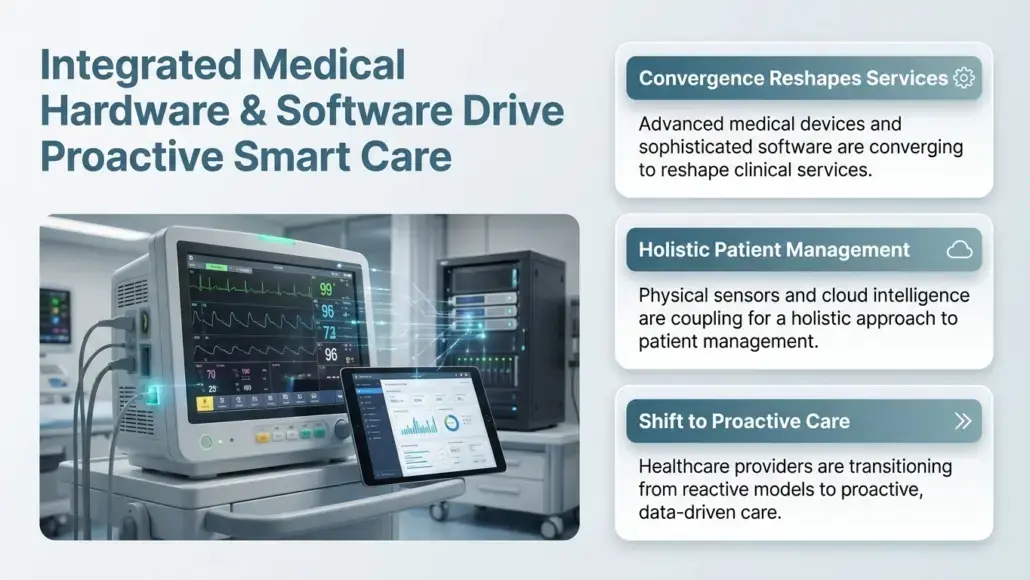

The convergence of advanced medical devices and sophisticated analytical software is reshaping the delivery of clinical services in the modern healthcare environment. This synergy allows for a more holistic approach to patient management, where the physical sensors at the bedside are directly coupled with cloud-based intelligence. By utilizing medical hardware and software supporting integrated smart care, healthcare providers can transition from reactive treatment models to proactive, data-driven interventions. The precision of modern diagnostic tools, when combined with real-time data processing, ensures that clinical teams have access to the most accurate information exactly when it is needed. This technological integration is not merely a matter of convenience; it is a fundamental requirement for the efficient operation of high-acuity departments such as intensive care units and emergency rooms.
As the complexity of patient needs grows, the demand for systems that can provide continuous, high-fidelity monitoring has become paramount. Traditional medical devices often operated in isolation, requiring manual data recording and interpretation by nursing staff. The current generation of smart care technology automates this process, feeding live data streams into centralized clinical dashboards. This reduction in manual labor allows medical professionals to dedicate more time to direct patient interaction, while the system handles the constant vigilance required for monitoring subtle physiological changes. The resulting environment is one where human expertise is augmented by machine precision, leading to significantly improved safety profiles for vulnerable patient populations.
Internet of Medical Things and Device Interconnectivity
The foundation of modern smart care lies in the Internet of Medical Things (IoMT), a network of interconnected devices that communicate vital statistics across a secure infrastructure. These devices include everything from smart infusion pumps and wearable heart rate monitors to advanced imaging systems like MRI and CT scanners. For these tools to be effective, they must be capable of transmitting data in standardized formats that can be ingested by hospital-wide information systems. The integration of high-speed wireless connectivity and low-latency data transmission protocols ensures that there is no delay between a physiological event and its appearance on a clinician’s mobile device or central station.
Security remains a primary concern in the development of IoMT ecosystems. Each connected device represents a potential entry point for unauthorized access, making it essential for hardware manufacturers to implement rigorous encryption and authentication standards. Modern integrated systems utilize secure boot sequences and hardware-based security modules to protect the integrity of the device firmware. Additionally, the software layer must be capable of identifying and isolating compromised devices before they can affect the broader network. By prioritizing security at both the hardware and software levels, healthcare organizations can reap the benefits of connectivity without compromising patient privacy or safety.
The ability to manage a fleet of thousands of connected devices is another critical operational challenge. Hospital IT departments require specialized management software that can track the location, battery status, and calibration history of every device in real-time. This visibility ensures that medical staff always have access to functional, up-to-date equipment when an emergency arises. Automated alerts can notify technicians when a device requires maintenance or when a piece of mobile equipment leaves its designated area. This level of oversight is a key component of integrated smart care, providing the operational reliability needed to support high-stakes clinical decisions.
Edge Computing in Diagnostic Hardware
The implementation of edge computing within medical hardware is a significant advancement that allows for real-time data processing at the point of care. Instead of sending all raw data to a central server for analysis, modern diagnostic devices can perform initial assessments locally. This reduces the load on the hospital network and ensures that critical alerts are generated with minimal latency. For example, a bedside monitor with integrated AI can analyze an electrocardiogram in real-time, identifying life-threatening arrhythmias and alerting the care team in milliseconds. This localized intelligence is particularly valuable in settings where network connectivity may be intermittent or where rapid response is essential for patient survival.
Edge computing also enhances the privacy and security of clinical data. By processing information locally, the amount of sensitive data transmitted over the network is minimized. Only the relevant results and summaries are sent to the electronic health record, reducing the risk of data interception during transit. This decentralized approach to data management aligns with the growing trend toward localized control in healthcare IT architectures. Edge-enabled devices can also continue to function even if the central hospital network goes offline, providing an additional layer of clinical resilience.
The development of specialized microprocessors designed for medical applications has accelerated the adoption of edge computing. These chips are optimized for low power consumption and high computational performance, allowing them to be integrated into portable and wearable devices. As these components become more powerful, the range of diagnostic tasks that can be performed at the bedside will continue to expand. This shift toward localized processing is a core element of integrated smart care, enabling a new generation of intelligent medical tools that are both responsive and reliable.
Real-Time Monitoring and Analytics Infrastructure
A successful smart care implementation requires a stable backend infrastructure capable of handling massive volumes of real-time data. This infrastructure must be able to ingest data from hundreds of different sources simultaneously, applying complex algorithms to identify trends and anomalies. The software layer acting as the orchestrator for this data must maintain high availability and fault tolerance to ensure that clinical monitoring is never interrupted. By utilizing distributed database technologies and microservices architectures, healthcare providers can build systems that scale dynamically based on the current clinical load.
Analytics play a crucial role in turning raw sensor data into actionable clinical insights. By analyzing historical data alongside real-time streams, these systems can identify patients who are at high risk of deterioration before symptoms become obvious to the human observer. For instance, an analytics engine might detect a subtle, downward trend in a patient’s oxygen saturation levels that, when combined with a slight increase in respiratory rate, indicates the onset of pulmonary distress. Early identification of these patterns allows for earlier intervention, often preventing the need for more invasive treatments or intensive care admissions.
The visualization of this data is equally important. Clinicians need interfaces that present complex information in a clear, intuitive manner. Modern clinical dashboards utilize data visualization techniques to highlight the most critical information, using color-coded alerts and graphical trends to provide a rapid overview of a patient’s status. These interfaces are often customizable, allowing different specialists to view the data that is most relevant to their specific role. The goal is to provide a comprehensive view of the patient that supports rapid and accurate decision-making in high-pressure environments.
Remote Patient Management and Infrastructure
The reach of integrated medical hardware and software supporting smart care now extends beyond the walls of the traditional hospital. Remote patient management (RPM) allows healthcare providers to monitor patients in their own homes, using a combination of wearable sensors and mobile applications. This approach is particularly effective for managing chronic conditions like heart failure, diabetes, and hypertension. Patients can record their vitals using connected devices, which then transmit the data to their clinical team for review. This continuous oversight reduces the need for frequent hospital visits and allows for early intervention if the patient’s condition begins to decline.
Infrastructure for remote management must address unique challenges, such as variable internet connectivity and the need for user-friendly interfaces for patients who may not be tech-savvy. The software must be designed to handle data from a wide variety of consumer-grade and medical-grade devices, ensuring that the information is accurate and reliable. Additionally, the clinical workflow for managing remote patients must be carefully integrated into the provider’s existing systems to avoid creating a separate, siloed process. When done correctly, RPM can significantly improve the quality of life for patients while reducing the overall cost of care for the health system.
The data generated by remote monitoring also provides valuable insights into the social determinants of health. By seeing how a patient’s condition changes in their home environment, clinicians can gain a better understanding of the factors that influence their health outside of the clinic. This information can be used to tailor treatment plans to the patient’s specific needs, leading to more effective and personalized care. The expansion of smart care into the home is a major step toward a more proactive and preventative healthcare system.
Synergy Between Software Platforms and Hardware
The full potential of smart care is realized when medical hardware is tightly coupled with medical software platforms supporting connected healthcare operations. This synergy ensures that every piece of data captured by a physical device is immediately available within the broader clinical ecosystem. For example, when a nurse uses a handheld scanner to verify a medication, the software platform should automatically update the patient’s record, check for potential allergies, and adjust the hospital’s pharmacy inventory. This level of automation reduces the risk of human error and ensures that all departments are working with the same, up-to-date information.
Looking forward, the integration of hardware and software will become even more unified, with devices becoming increasingly autonomous. Robotic systems, guided by sophisticated software algorithms, will be able to perform routine tasks like delivering supplies or even assisting in surgery with unprecedented precision. These systems will rely on a constant flow of data from their environment to operate safely and effectively. The ongoing development of integrated smart care will continue to push the boundaries of what is possible in clinical practice, creating an environment where technology and human expertise work in perfect harmony to improve patient outcomes.
The advancement of healthcare through integrated technology is an ongoing process that requires constant innovation in both hardware and software. The focus must remain on creating systems that are not only powerful and efficient but also secure and patient-centered. By investing in the infrastructure and tools needed to support smart care, healthcare organizations can ensure that they are prepared for the challenges of the future. The ultimate goal is a healthcare system that is more responsive, more accurate, and more compassionate, powered by the seamless integration of the digital and physical worlds.